MCP - Introduction
Background
- Generative AI applications are a great step forward as they often let the user interact with the app using natural language prompts.
- However, as more time and resources are invested in such apps, you want to make sure you can easily integrate functionalities and resources in such a way that it’s easy to extend, that your app can cater to more than one model being used, and handle various model intricacies.
- In short, building Gen AI apps is easy to begin with, but as they grow and become more complex, you need to start defining an architecture and will likely need to rely on a standard to ensure your apps are built in a consistent way.
- This is where MCP comes in to organize things and provide a standard.
What Is the Model Context Protocol (MCP)?
- The Model Context Protocol (MCP) is an open, standardized interface that allows Large Language Models (LLMs) to interact seamlessly with external tools, APIs, and data sources.
- It provides a consistent architecture to enhance AI model functionality beyond their training data, enabling smarter, scalable, and more responsive AI systems.
Why Standardization in AI Matters
- As generative AI applications become more complex, it’s essential to adopt standards that ensure scalability, extensibility, maintainability, and avoiding vendor lock-in. MCP addresses these needs by:
- Unifying model-tool integrations
- Reducing brittle, one-off custom solutions
- Allowing multiple models from different vendors to coexist within one ecosystem
- Note: While MCP bills itself as an open standard
- there are no plans to standardize MCP through any existing standards bodies such as IEEE, IETF, W3C, ISO, or any other standards body.
Learning Objectives
- Define Model Context Protocol (MCP) and its use cases
- Understand how MCP standardizes model-to-tool communication
- Identify the core components of MCP architecture
- Explore real-world applications of MCP in enterprise and development contexts
Why the Model Context Protocol (MCP) Is a Game-Changer
MCP Solves Fragmentation in AI Interactions
Before MCP, integrating models with tools required:
- Custom code per tool-model pair
- Non-standard APIs for each vendor
- Frequent breaks due to updates
- Poor scalability with more tools
Benefits of MCP Standardization
| Benefit | Description |
|---|---|
| Interoperability | LLMs work seamlessly with tools across different vendors |
| Consistency | Uniform behavior across platforms and tools |
| Reusability | Tools built once can be used across projects and systems |
| Accelerated Development | Reduce dev time by using standardized, plug-and-play interfaces |
High-Level MCP Architecture Overview
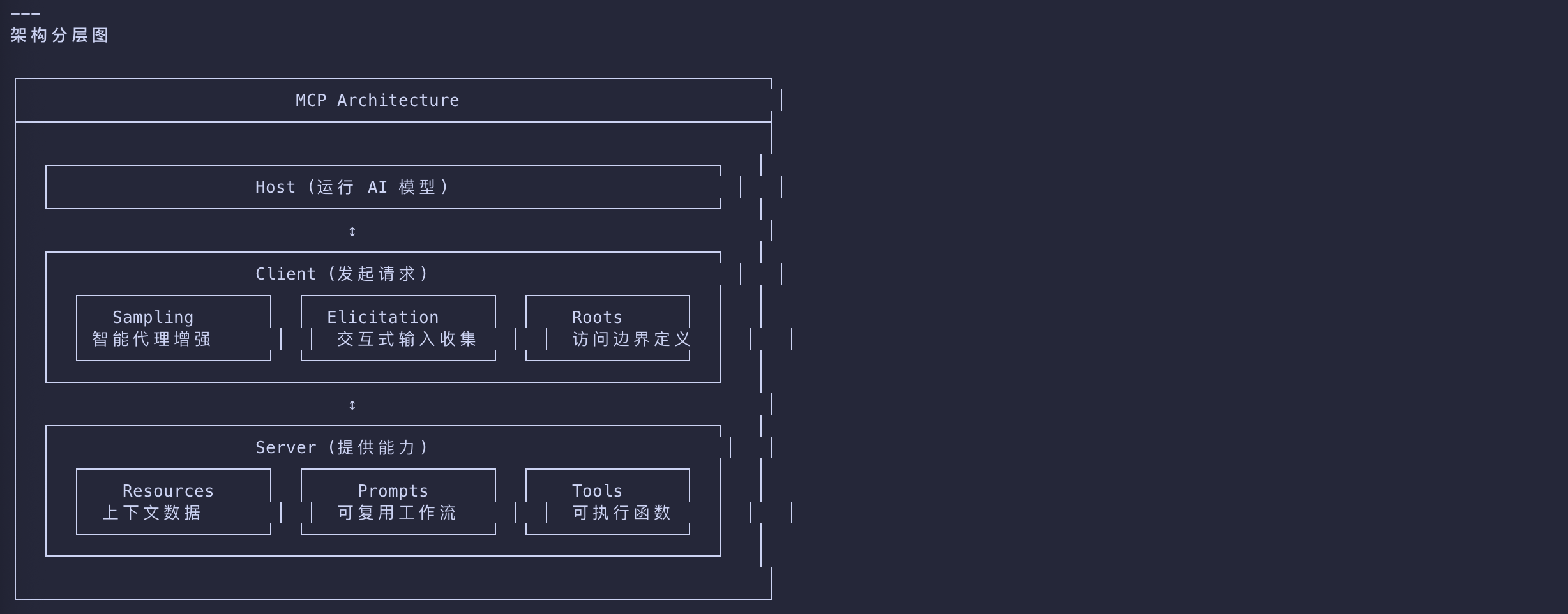
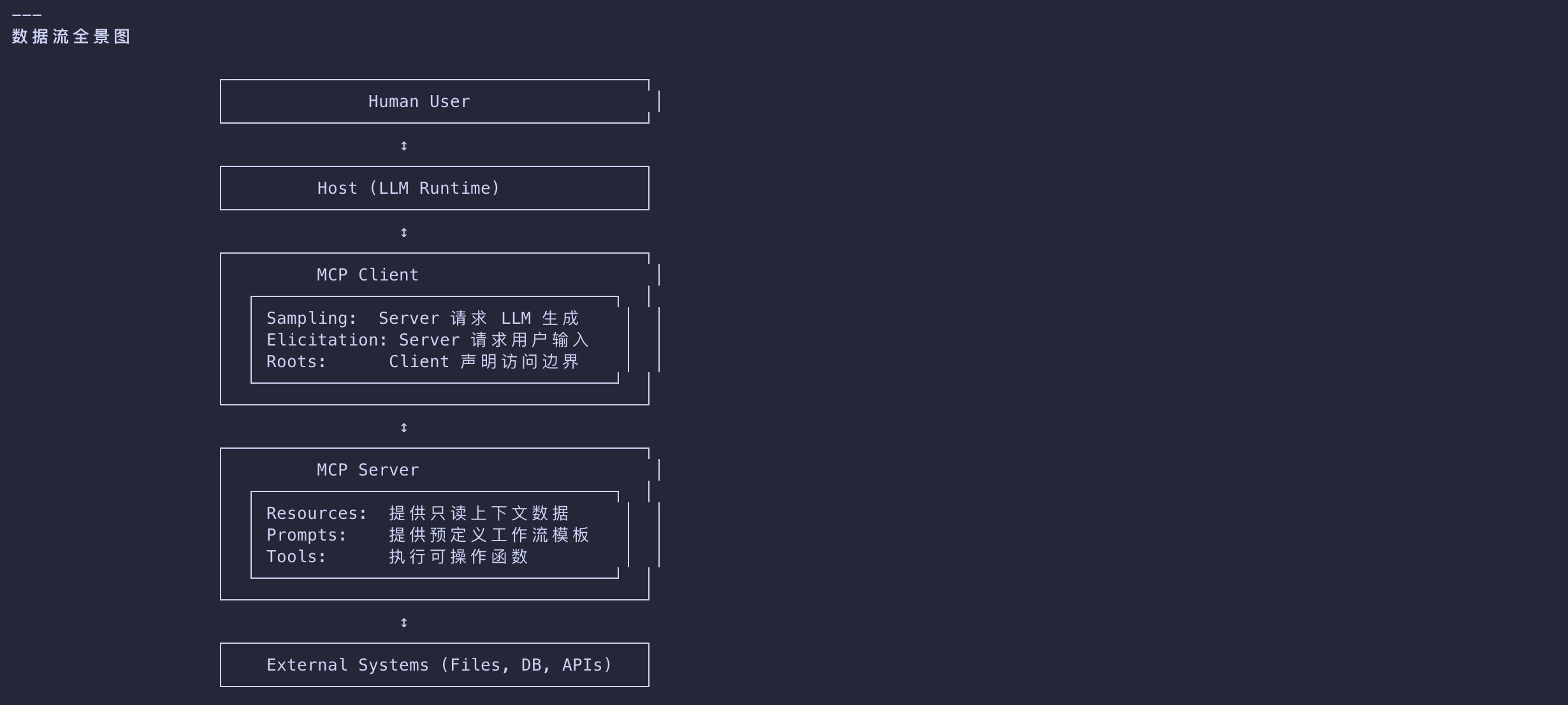
MCP follows a client-server model, where:
| Key | Desc |
|---|---|
| MCP Hosts | run the AI models |
| MCP Clients | initiate requests |
| MCP Servers | serve context, tools, and capabilities |
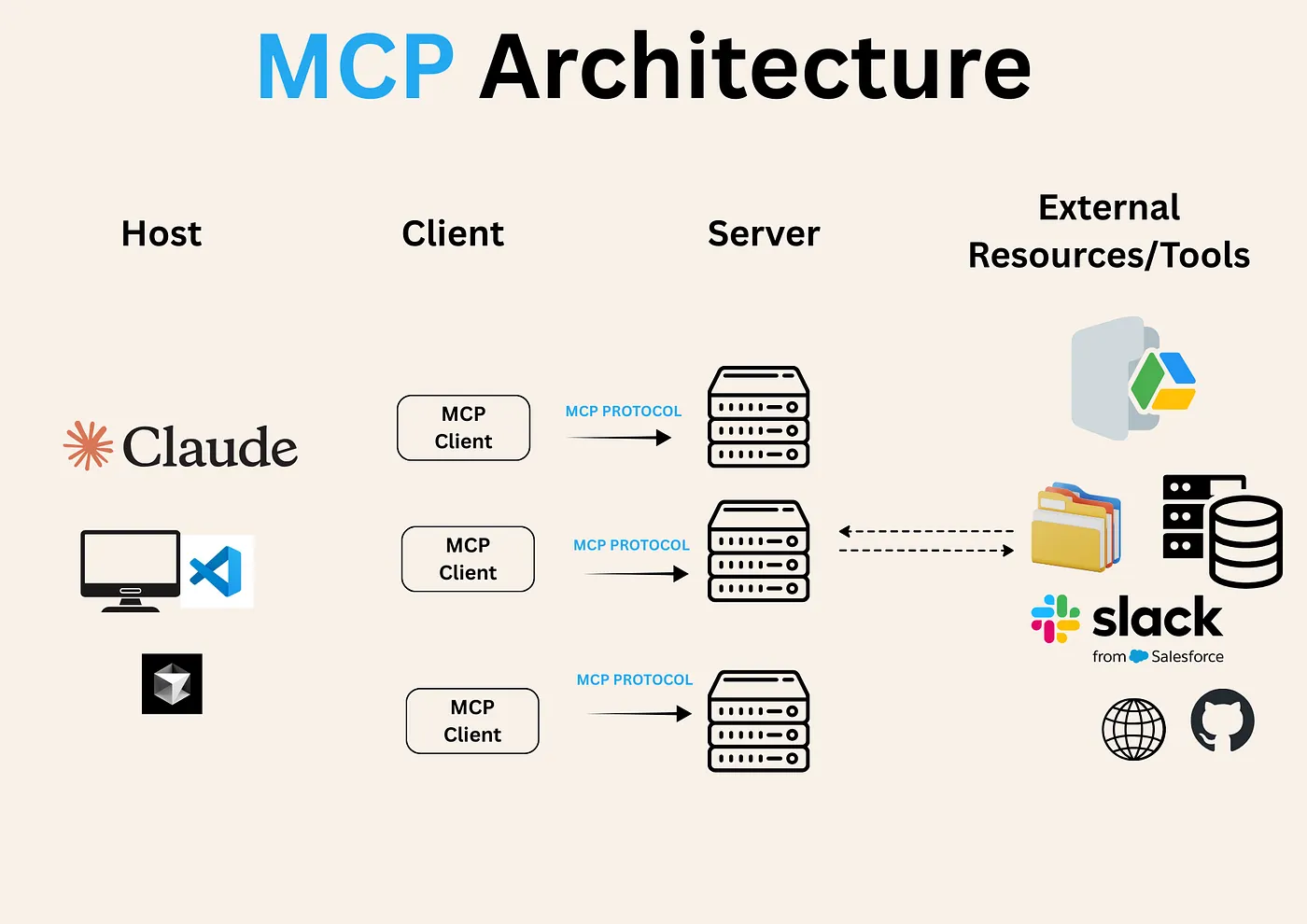
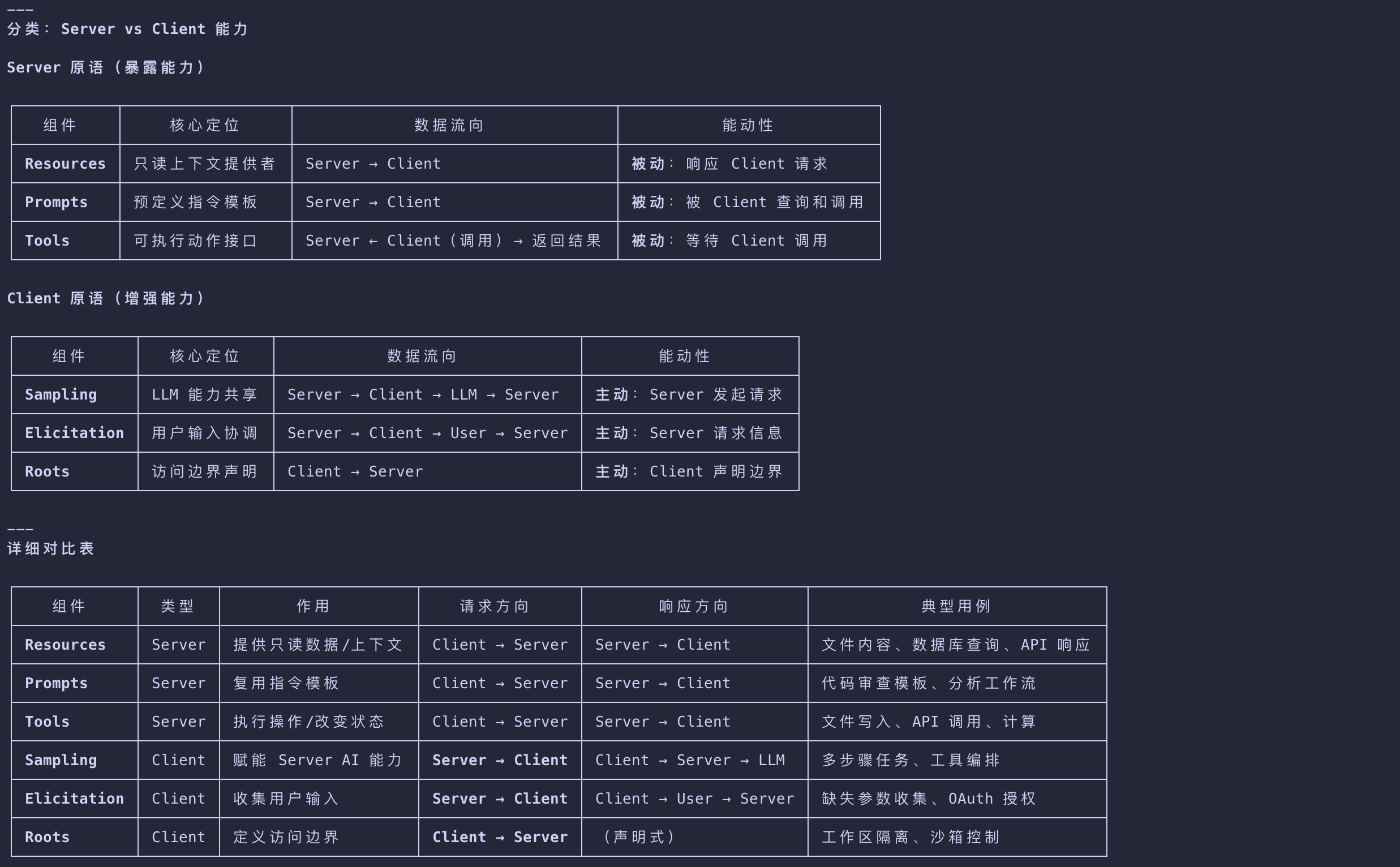
Host
- 职责:承载和执行 LLM 推理引擎,管理模型访问与凭证
- 控制域:模型选择、权限策略、用户授权流、会话协调
- 典型实例:Claude Desktop、Cursor IDE、自定义 AI 应用
Client
- 职责:代表 Host 发起与 Server 的连接,执行协议握手与能力协商
- 暴露能力:Sampling(LLM 生成)、Roots(文件系统边界)
- 通信模式:1:1 映射到单个 Server,通过 stdio 或 SSE 传输
Server
- 职责:暴露外部系统/数据源的结构化接口
- 核心原语:Resources(只读上下文)、Tools(可执行函数)、Prompts(可复用指令模板)
- 设计模式:单一职责原则,每个 Server 封装一个外部系统
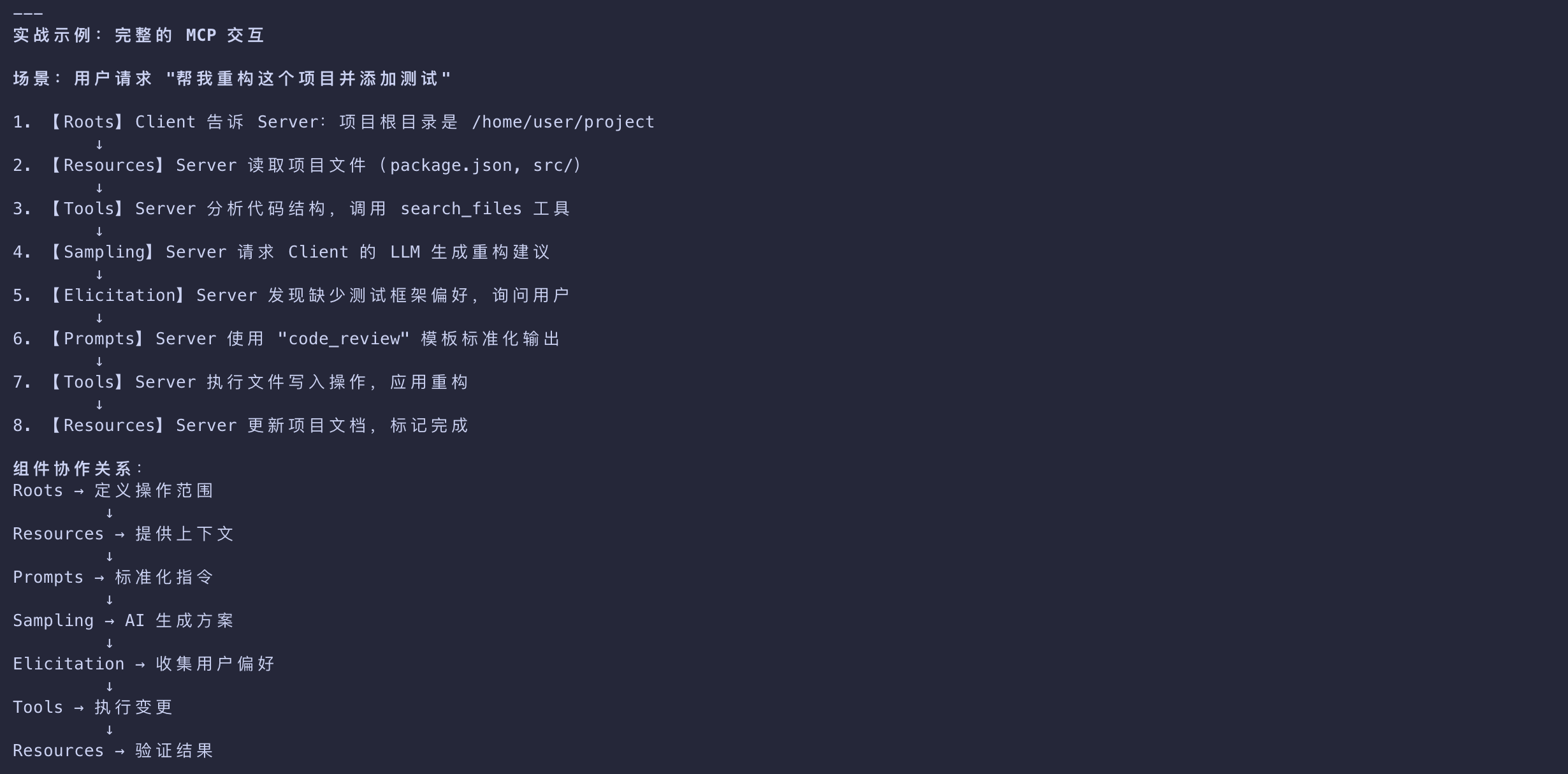
Key Components
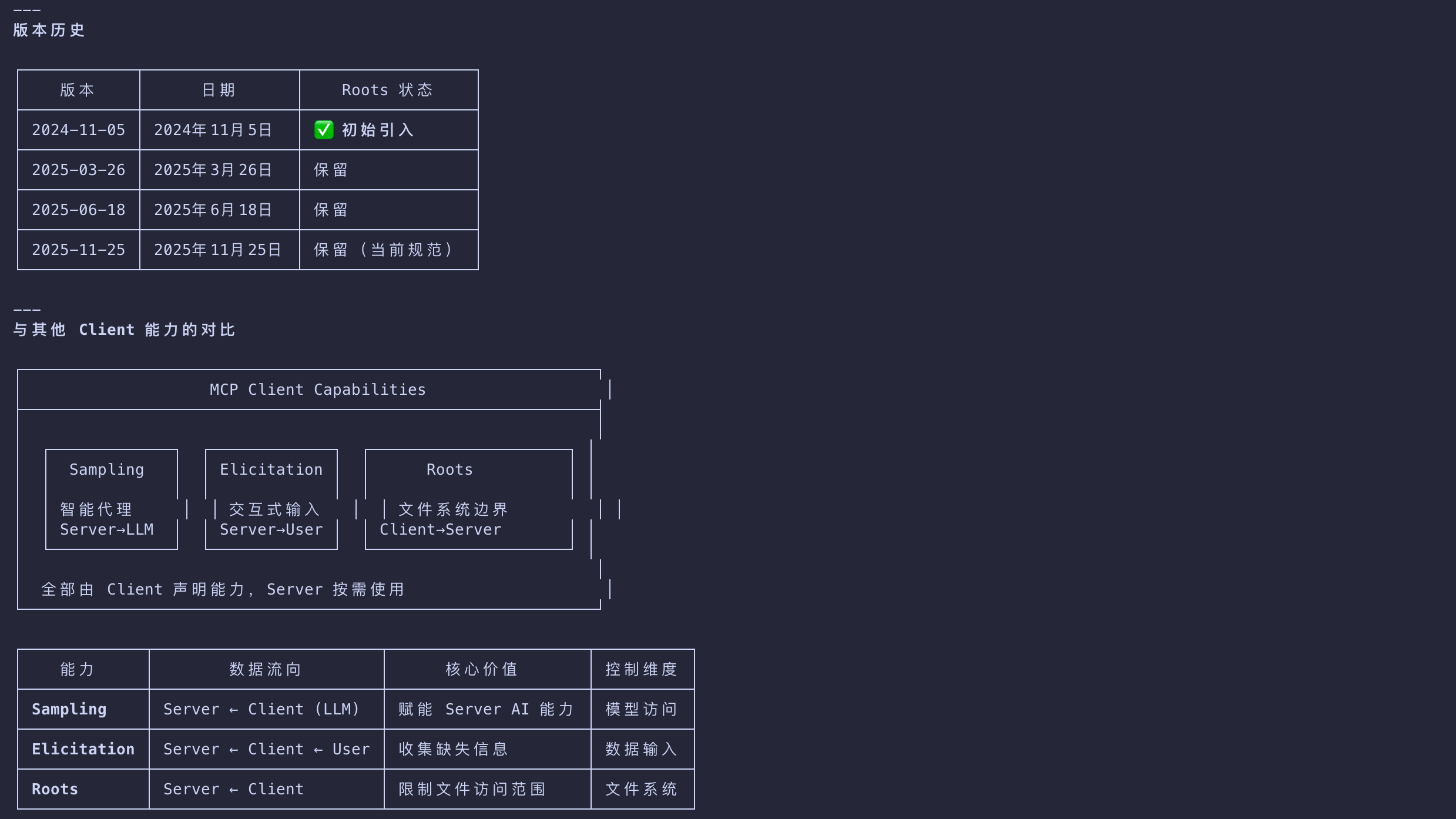
| Components | Desc |
|---|---|
| Resources | Static or dynamic data for models |
| Prompts | Predefined workflows for guided generation |
| Tools | Executable functions like search, calculations |
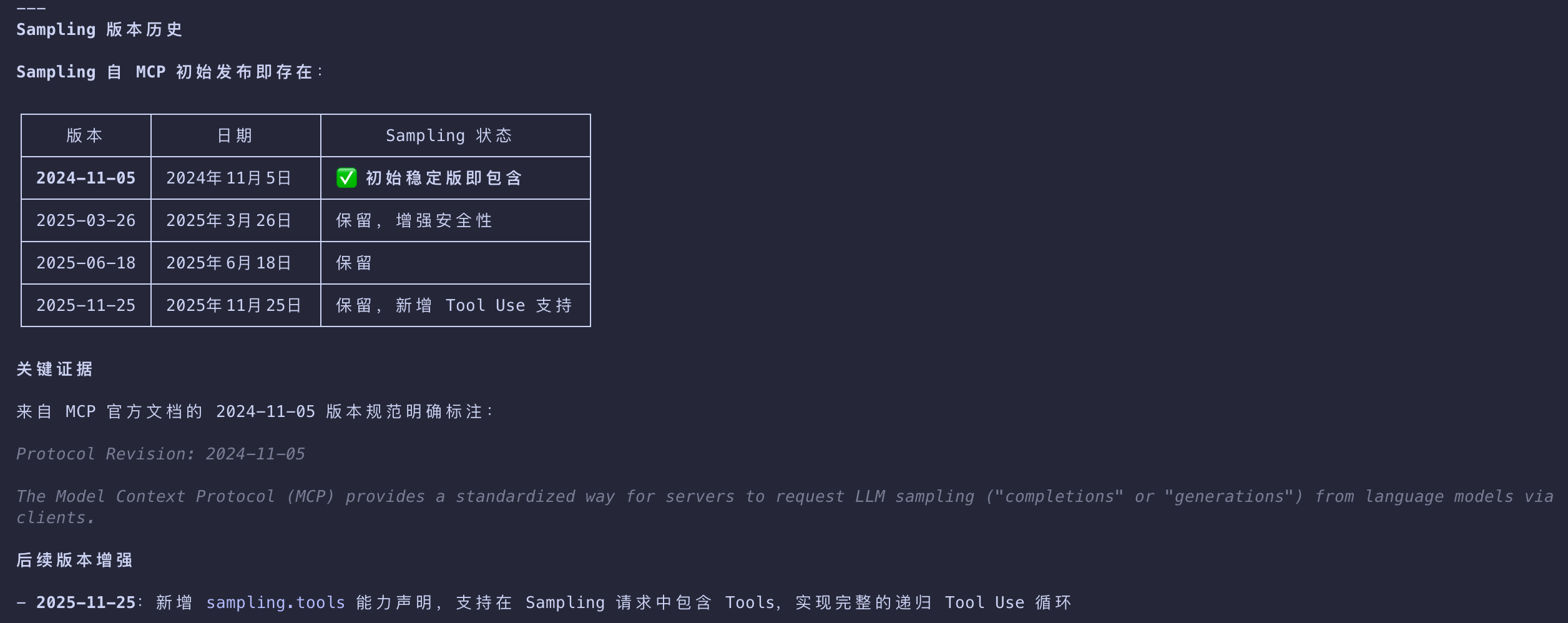
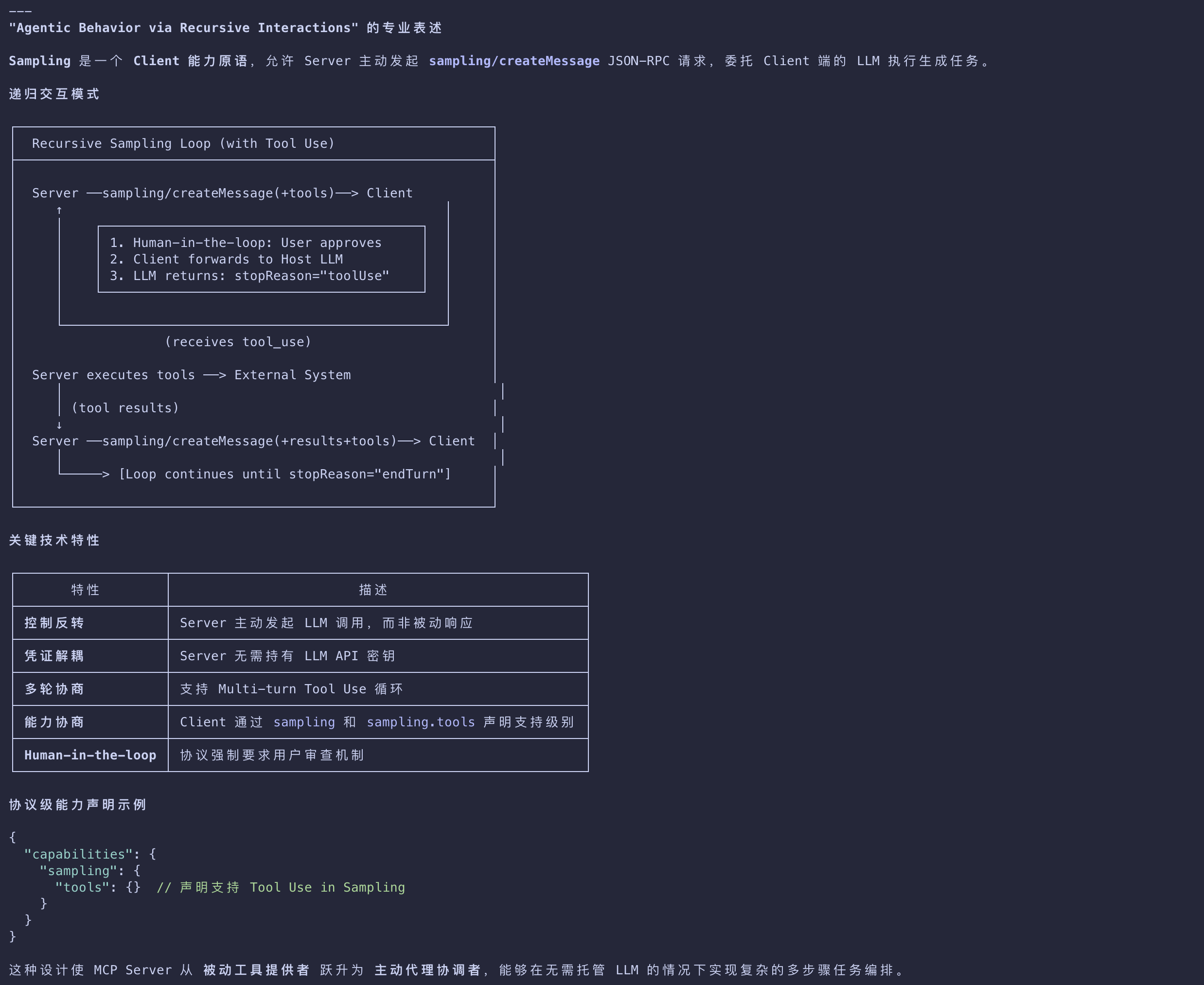
| Sampling | Agentic behavior via recursive interactions |
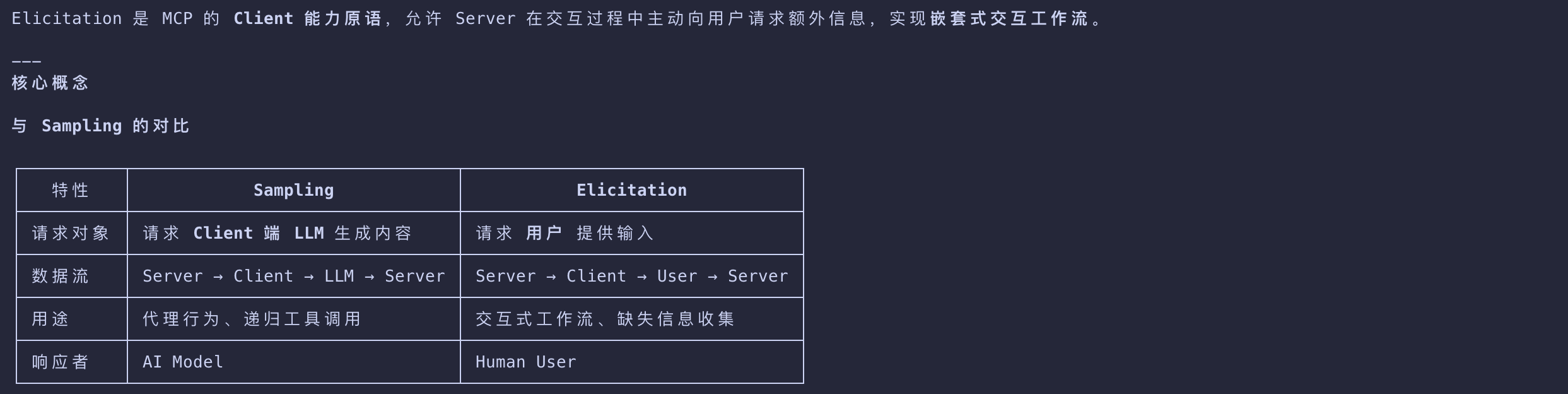
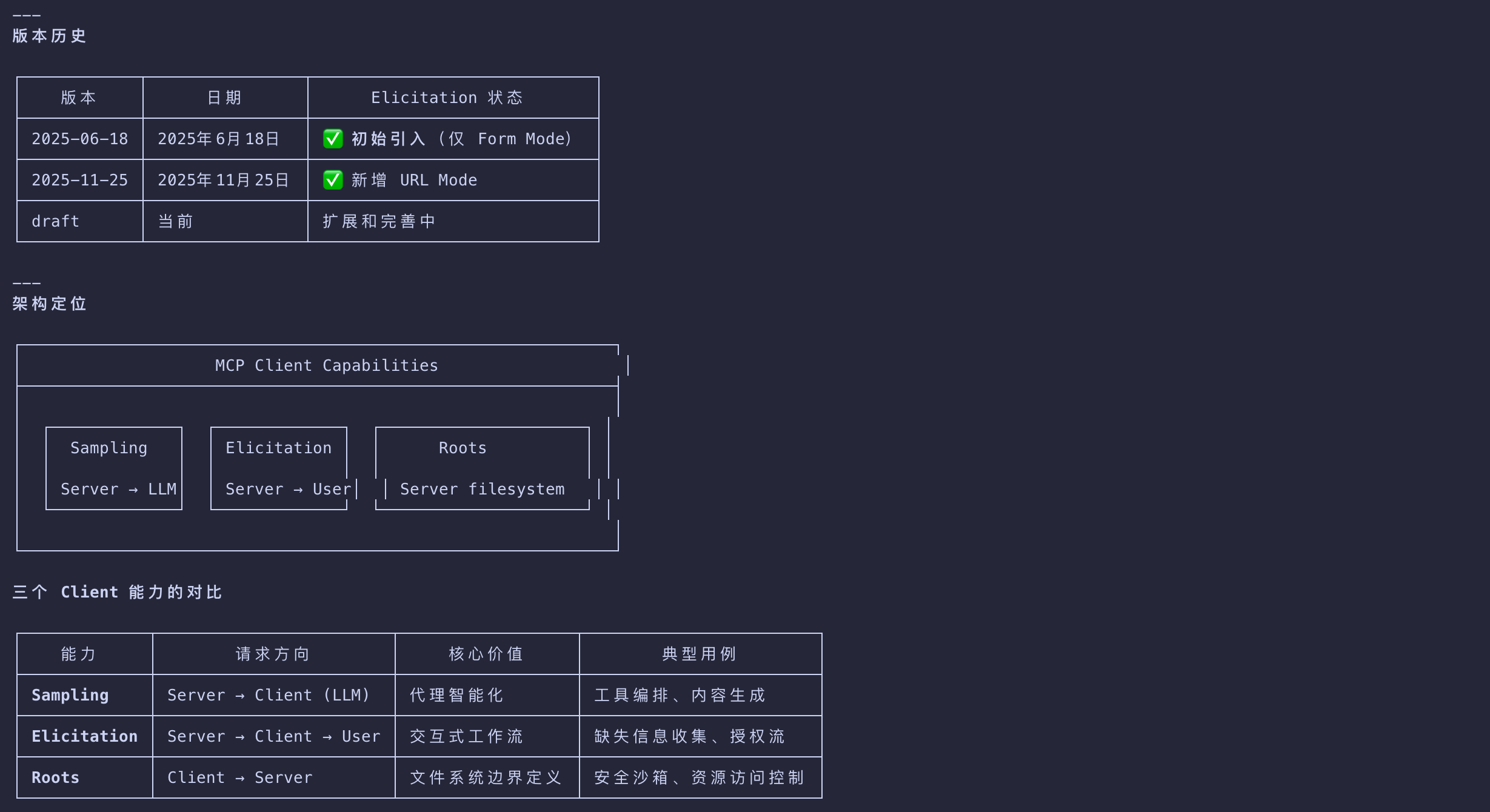
| Elicitation | Server-initiated requests for user input |
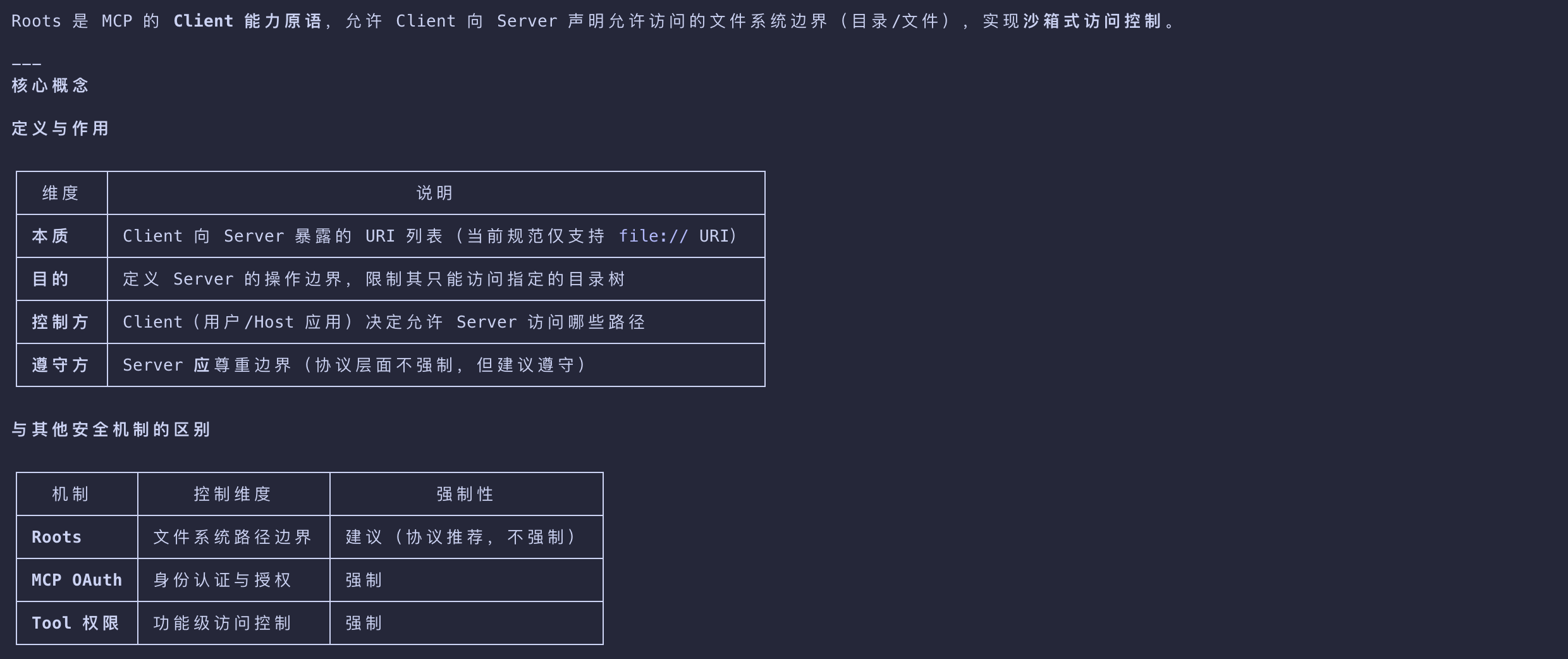
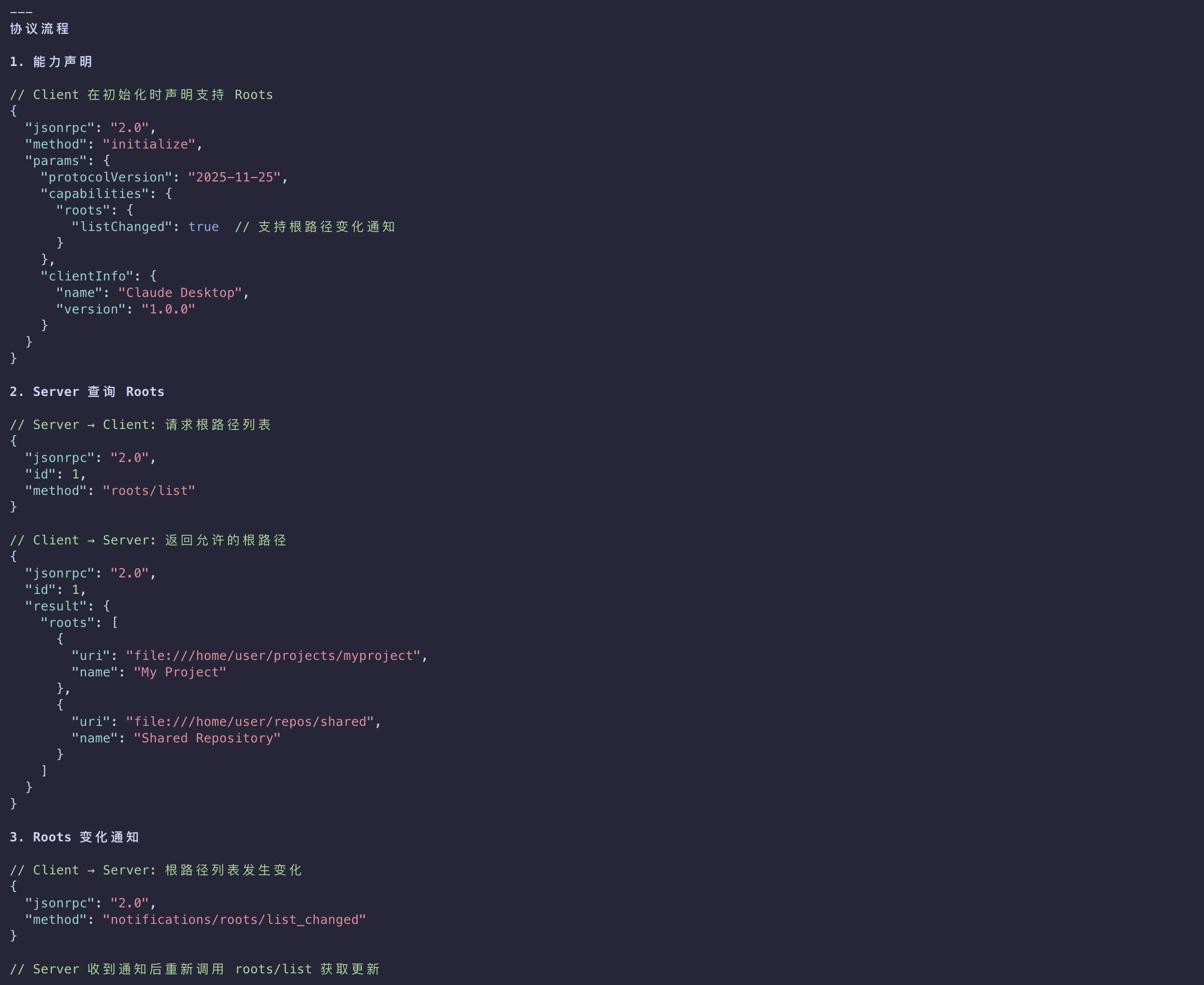
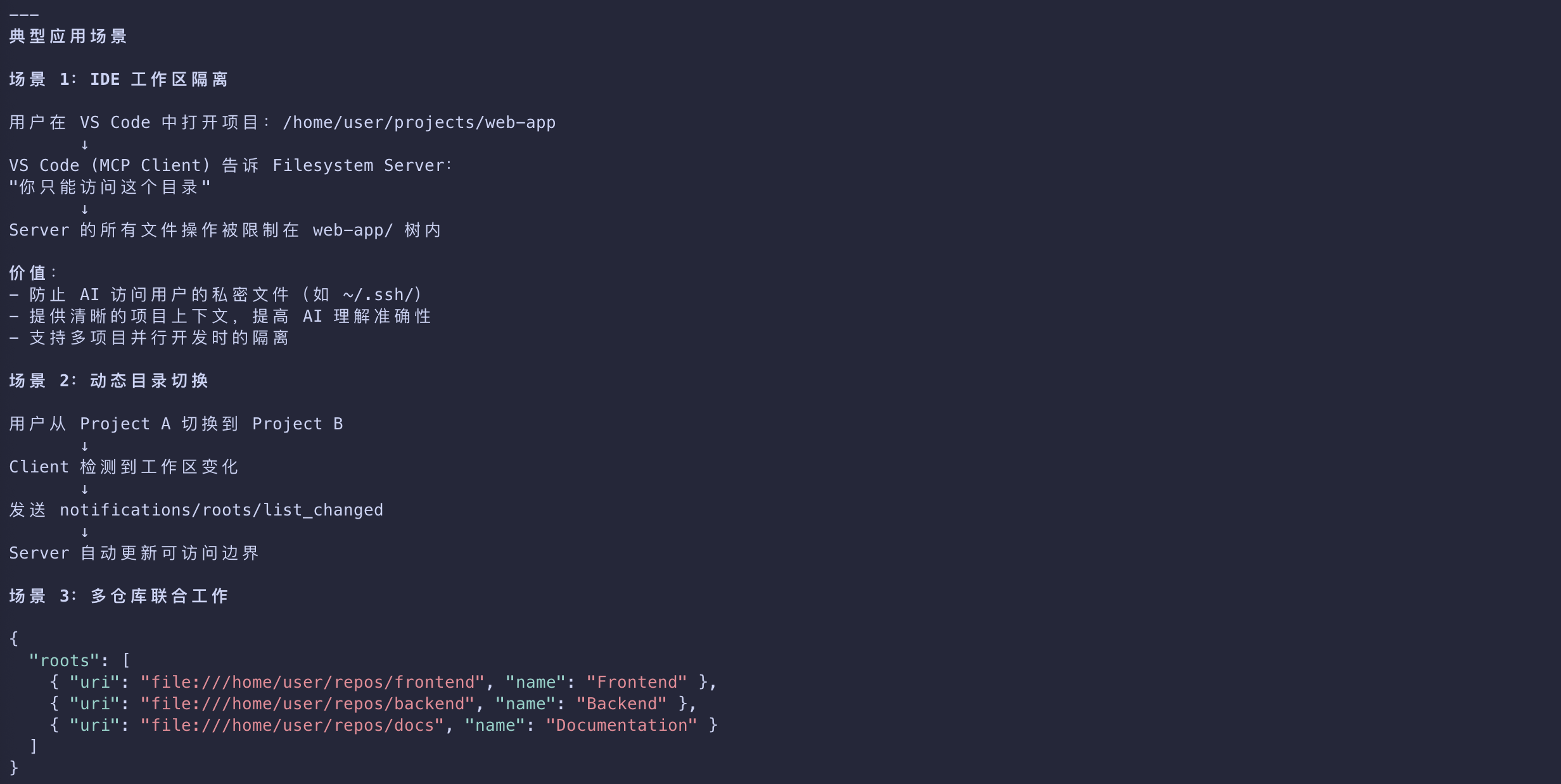
| Roots | Filesystem boundaries for server access control |
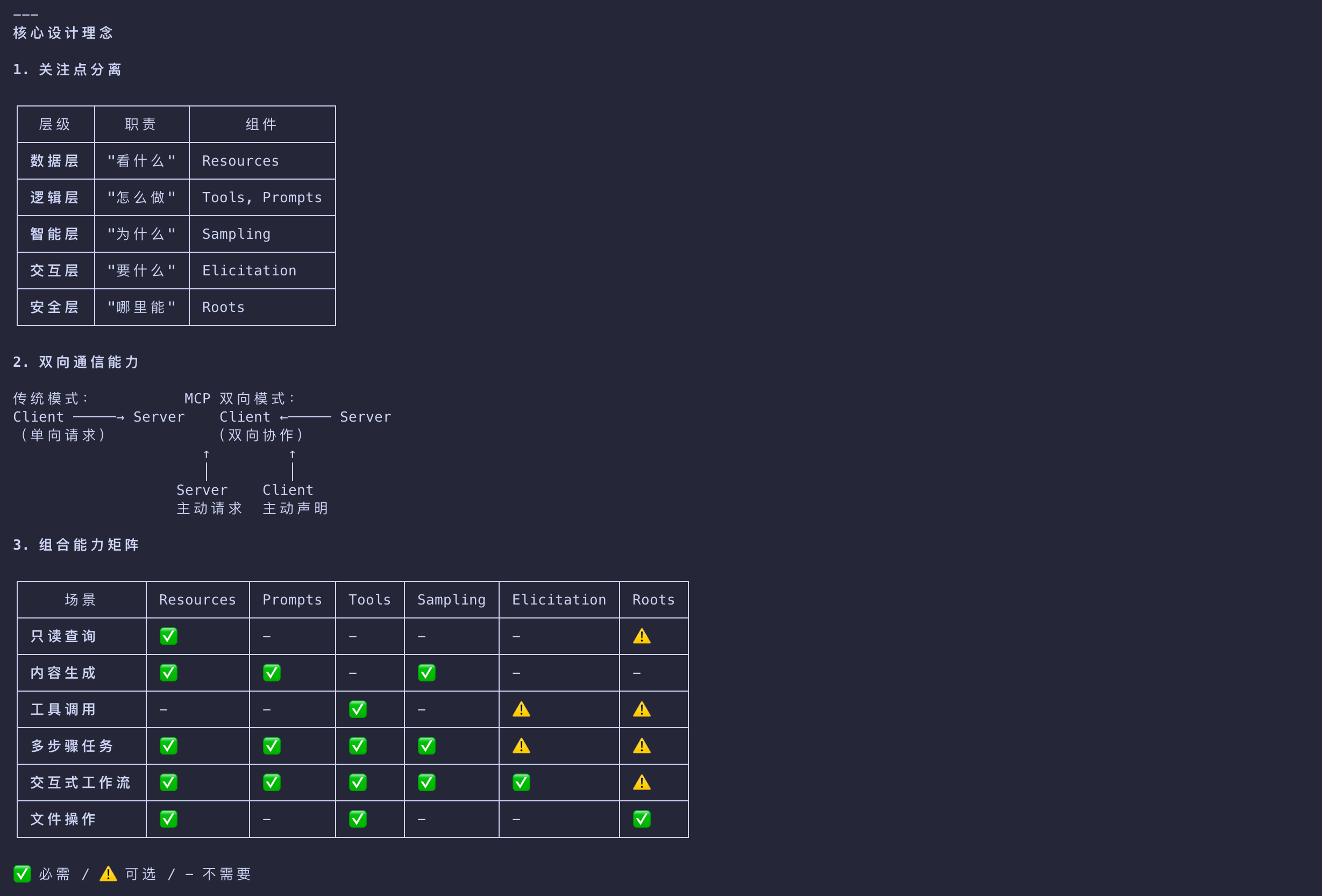
Sampling
Agentic behavior via recursive interactions
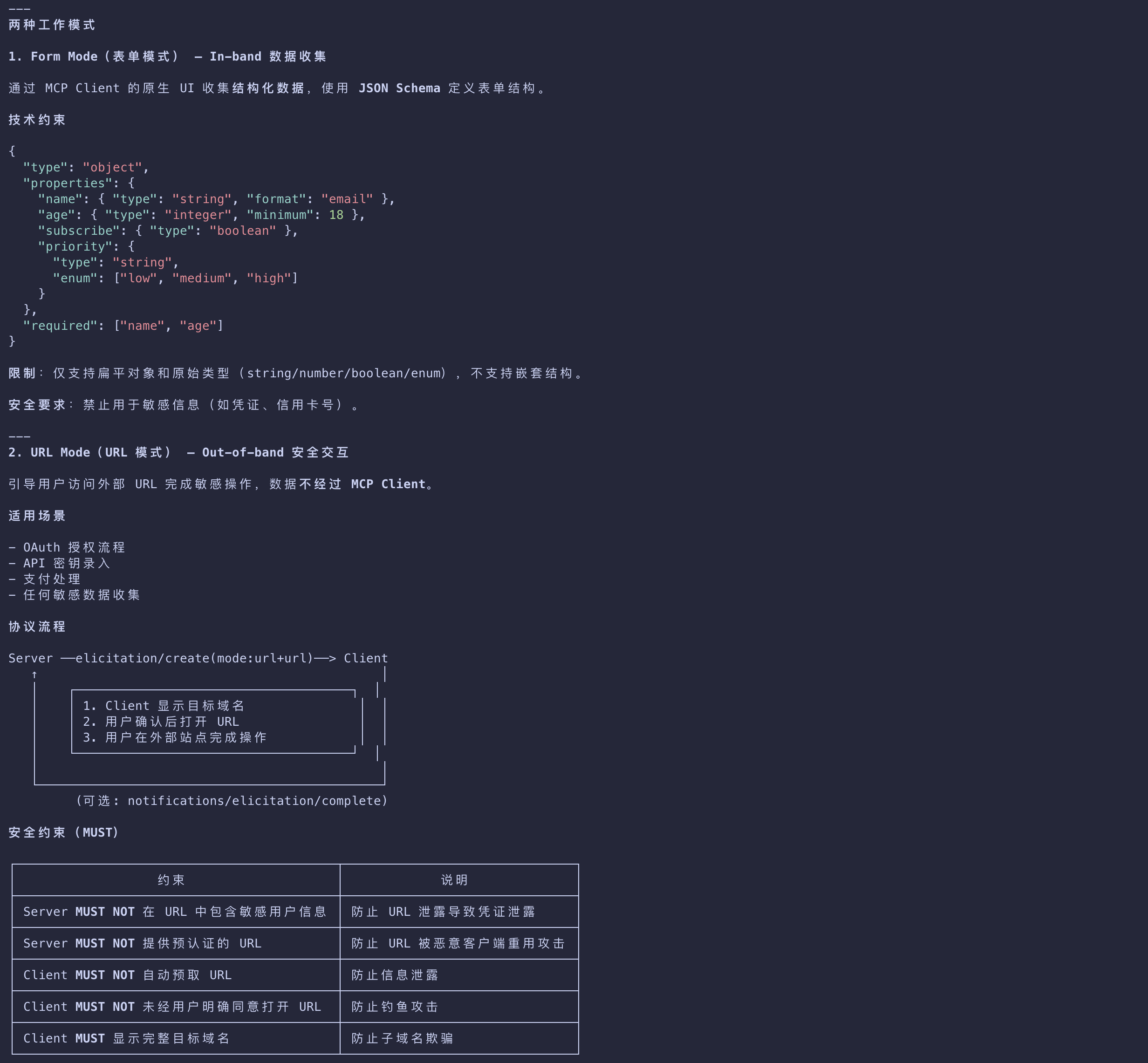
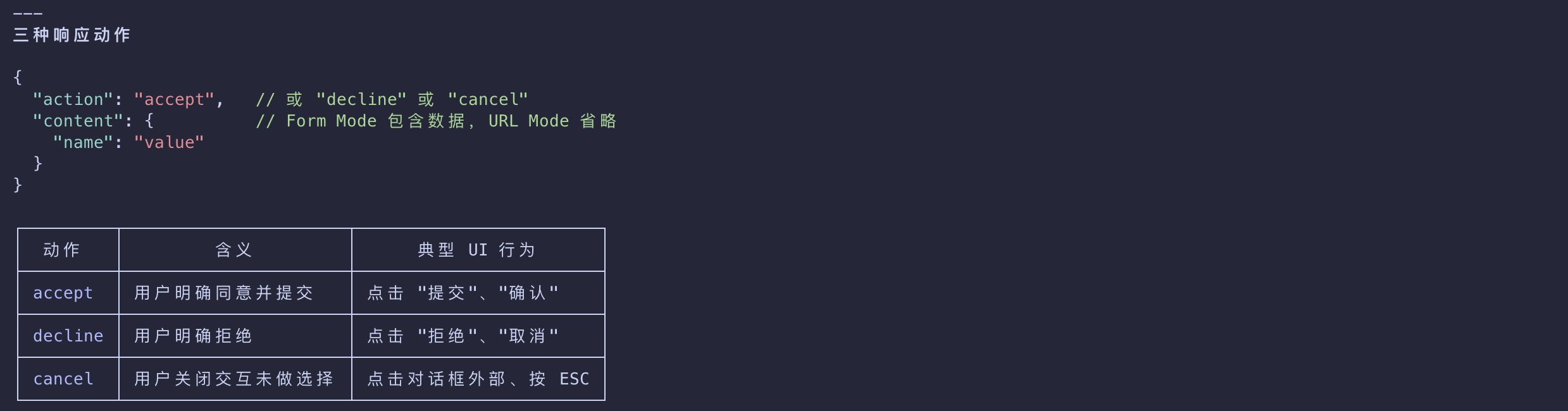
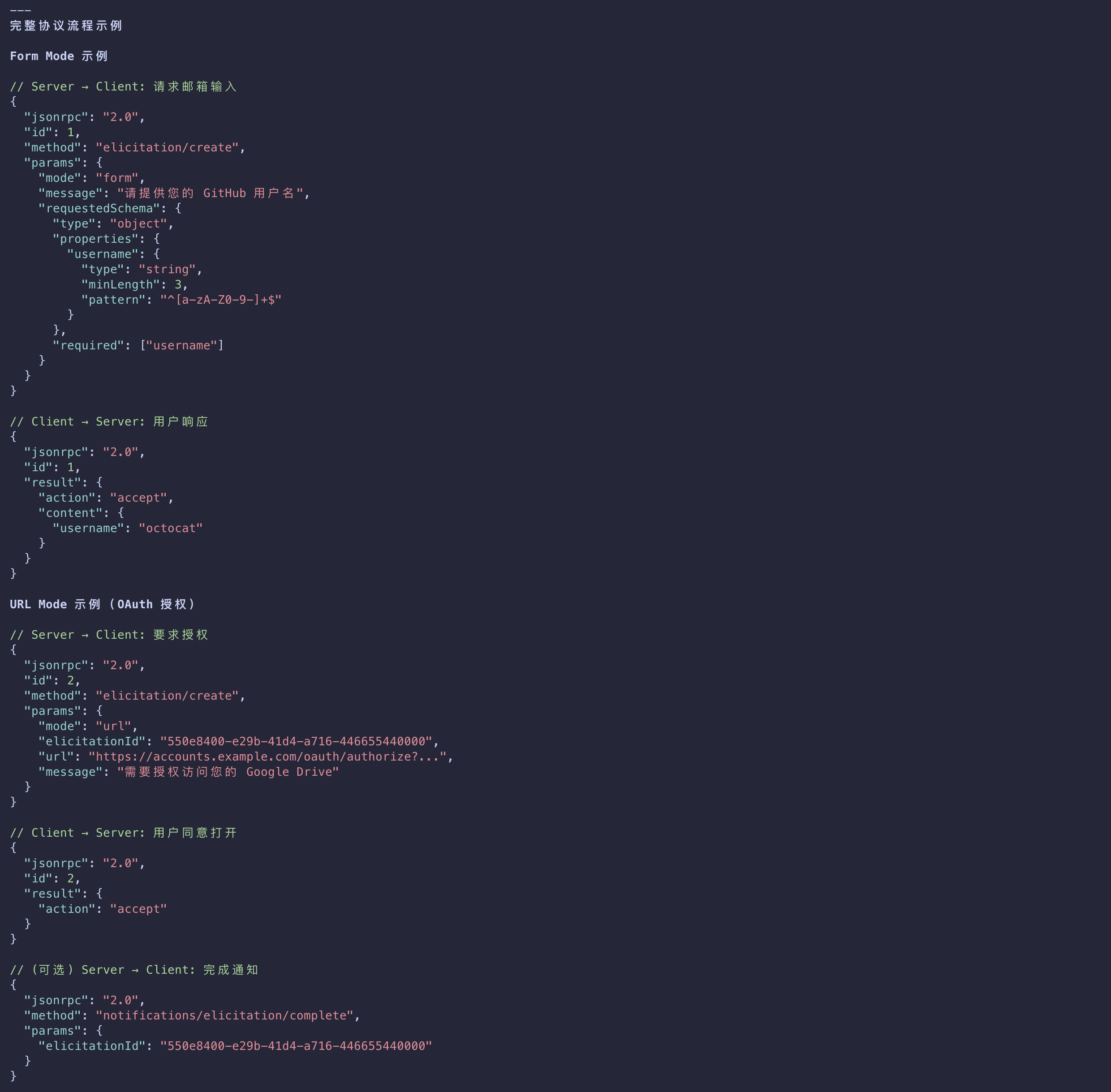
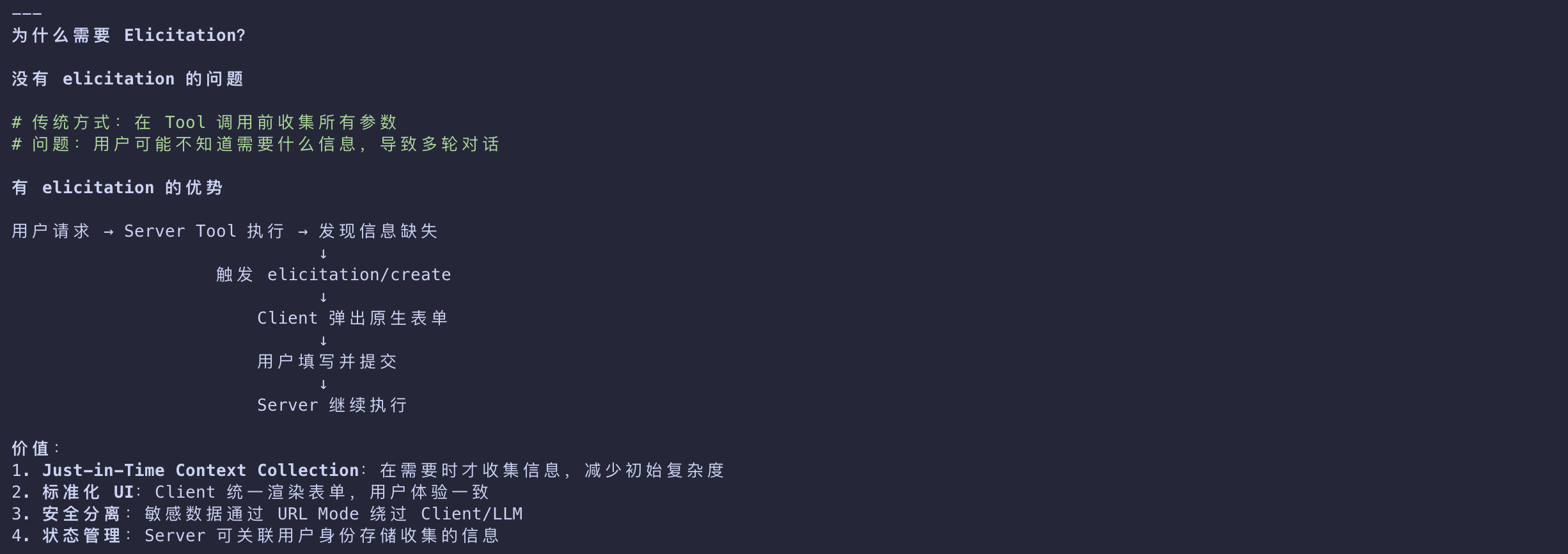
Elicitation
Server-initiated requests for user input - Server 主动请求用户输入
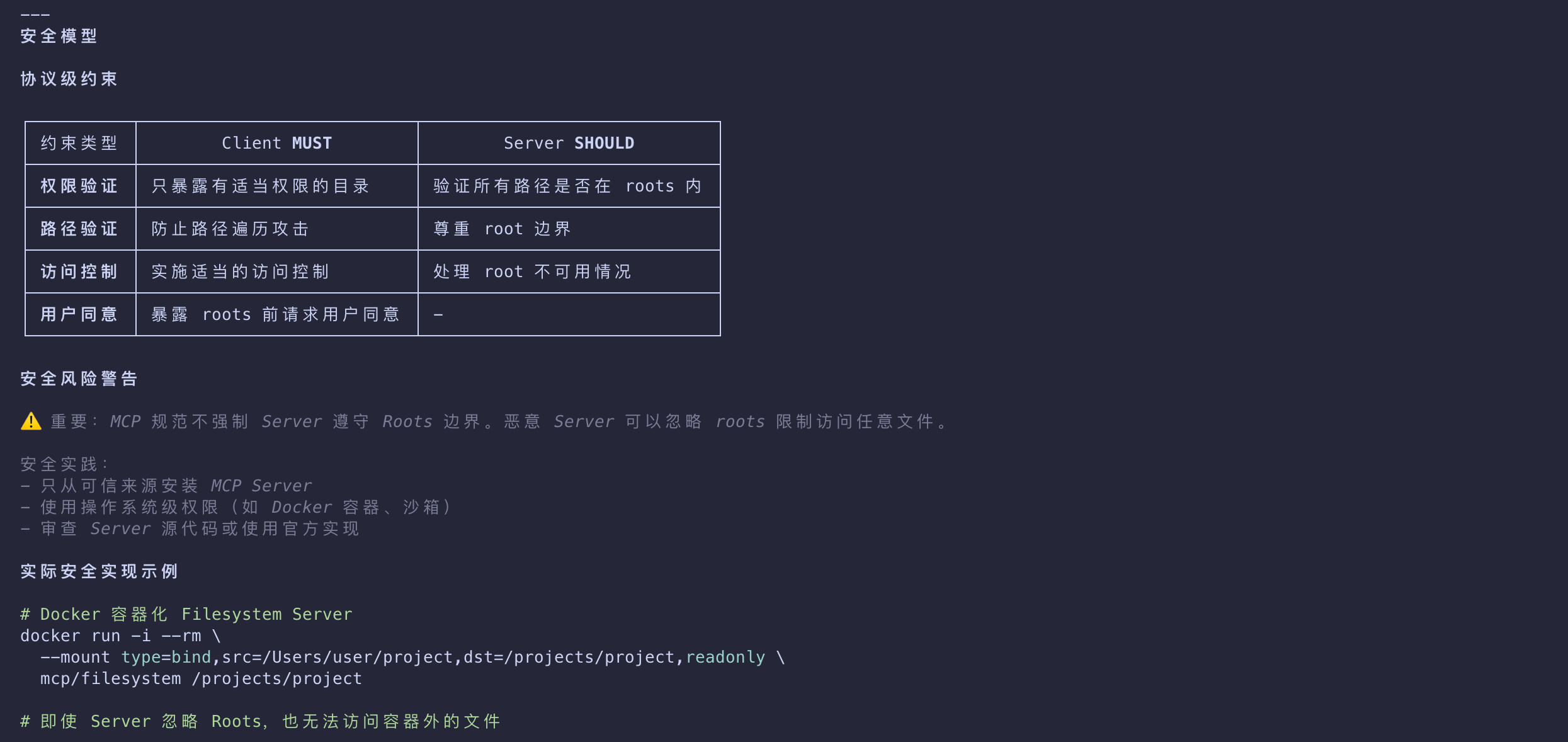
Roots
Filesystem boundaries for server access control
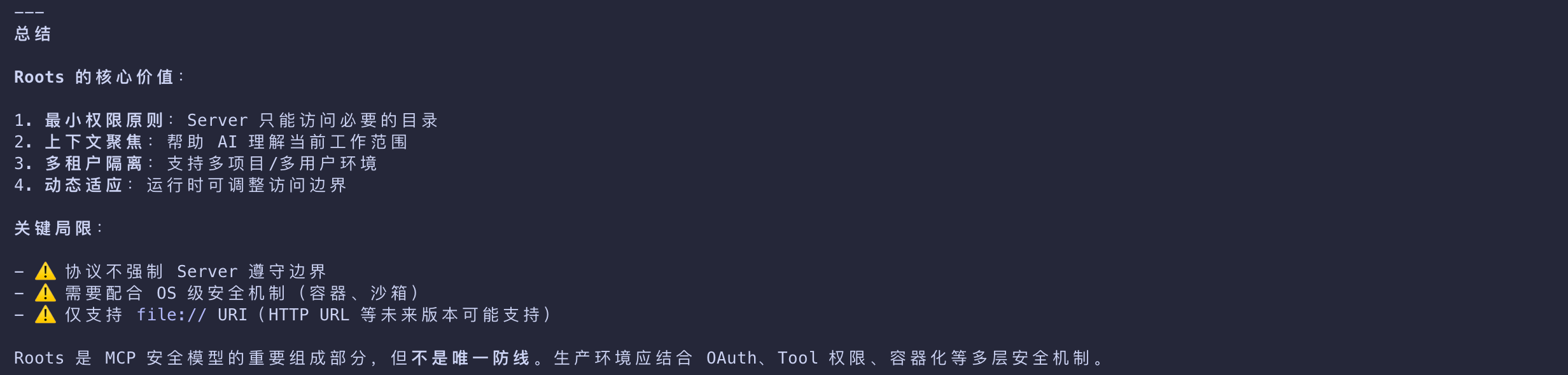
Summary

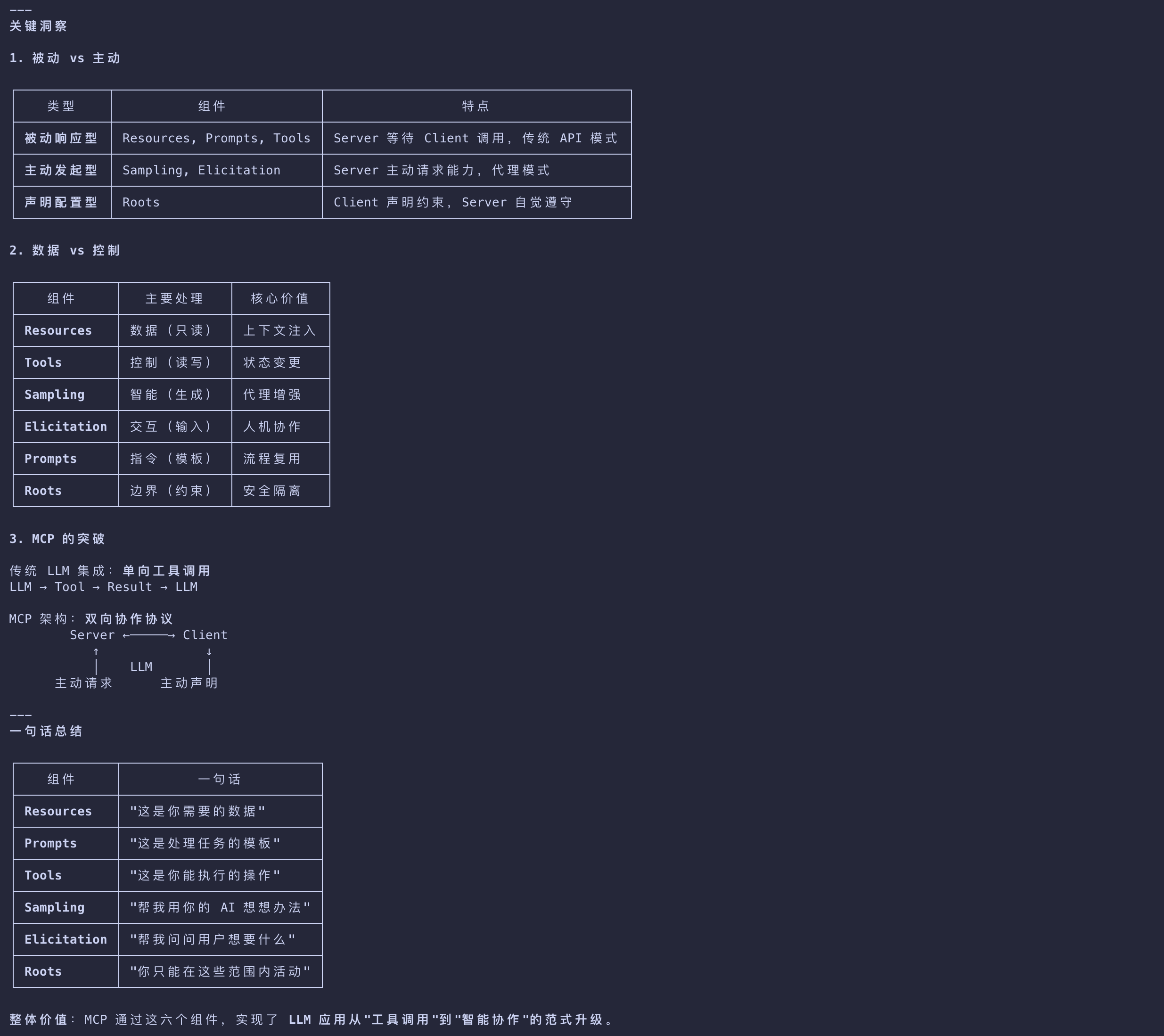
Protocol Architecture
MCP uses a two-layer architecture
| Layer | Desc |
|---|---|
| Data Layer | JSON-RPC 2.0 based communication with lifecycle management and primitives |
| Transport Layer | STDIO (local) and Streamable HTTP with SSE (remote) communication channels |
How MCP Servers Work
How MCP Servers Work

Request Flow
- A request is initiated by an end user or software acting on their behalf.
- The MCP Client sends the request to an MCP Host, which manages the AI Model runtime.
- The AI Model receives the user prompt and may request access to external tools or data via one or more tool calls.
- The MCP Host, not the model directly, communicates with the appropriate MCP Server(s) using the standardized protocol.
MCP Host Functionality
| Functionality | Desc |
|---|---|
| Tool Registry | Maintains a catalog of available tools and their capabilities. |
| Authentication | Verifies permissions for tool access. |
| Request Handler | Processes incoming tool requests from the model. |
| Response Formatter | Structures tool outputs in a format the model can understand. |
MCP Server Execution
- The MCP Host routes tool calls to one or more MCP Servers, each exposing specialized functions (e.g., search, calculations, database queries).
- The MCP Servers perform their respective operations and return results to the MCP Host in a consistent format.
- The MCP Host formats and relays these results to the AI Model.
Response Completion
- The AI Model incorporates the tool outputs into a final response.
- The MCP Host sends this response back to the MCP Client, which delivers it to the end user or calling software.
Real-World Use Cases for MCP
MCP enables a wide range of applications by extending AI capabilities:
| Application | Description |
|---|---|
| Enterprise Data Integration | Connect LLMs to databases, CRMs, or internal tools |
| Agentic AI Systems | Enable autonomous agents with tool access and decision-making workflows |
| Multi-modal Applications | Combine text, image, and audio tools within a single unified AI app |
| Real-time Data Integration | Bring live data into AI interactions for more accurate, current outputs |
MCP = Universal Standard for AI Interactions
- The MCP acts as a universal standard for AI interactions, much like how USB-C standardized physical connections for devices.
- In the world of AI, MCP provides a consistent interface
- allowing models (clients) to integrate seamlessly with external tools and data providers (servers).
- This eliminates the need for diverse, custom protocols for each API or data source.
- Under MCP, an MCP-compatible tool (referred to as an MCP server) follows a unified standard.
- These servers can list the tools or actions they offer and execute those actions when requested by an AI agent.
- AI agent platforms that support MCP are capable of discovering available tools from the servers and invoking them through this standard protocol.
Facilitates access to knowledge
- Beyond offering tools, MCP also facilitates access to knowledge.
- It enables applications to provide context to large language models (LLMs) by linking them to various data sources.
- For instance, an MCP server might represent a company’s document repository, allowing agents to retrieve relevant information on demand.
- Another server could handle specific actions like sending emails or updating records.
- From the agent’s perspective, these are simply tools it can use—some tools return data (knowledge context), while others perform actions.
- MCP efficiently manages both.
- An agent connecting to an MCP server automatically learns the server’s available capabilities and accessible data through a standard format.
- This standardization enables dynamic tool availability.
- For example, adding a new MCP server to an agent’s system makes its functions immediately usable
- without requiring further customization of the agent’s instructions.
- This streamlined integration aligns with the flow depicted in the following diagram
- where servers provide both tools and knowledge, ensuring seamless collaboration across systems.
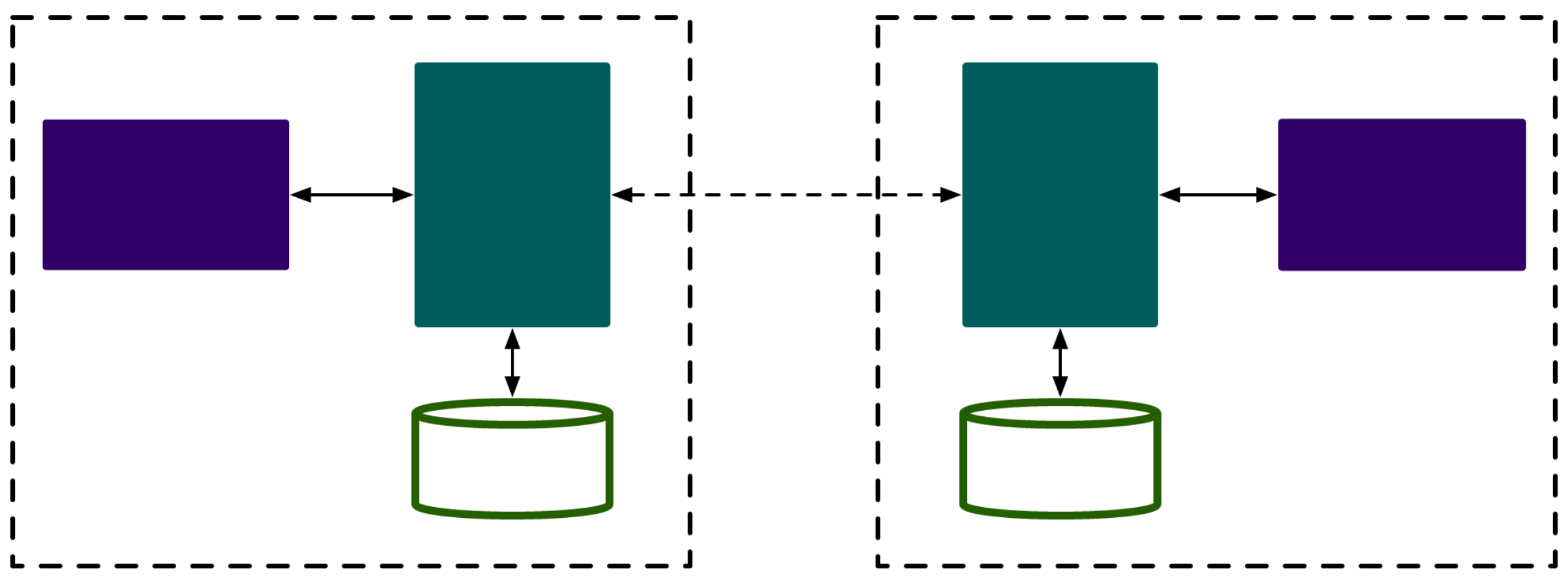
Example: Scalable Agent Solution
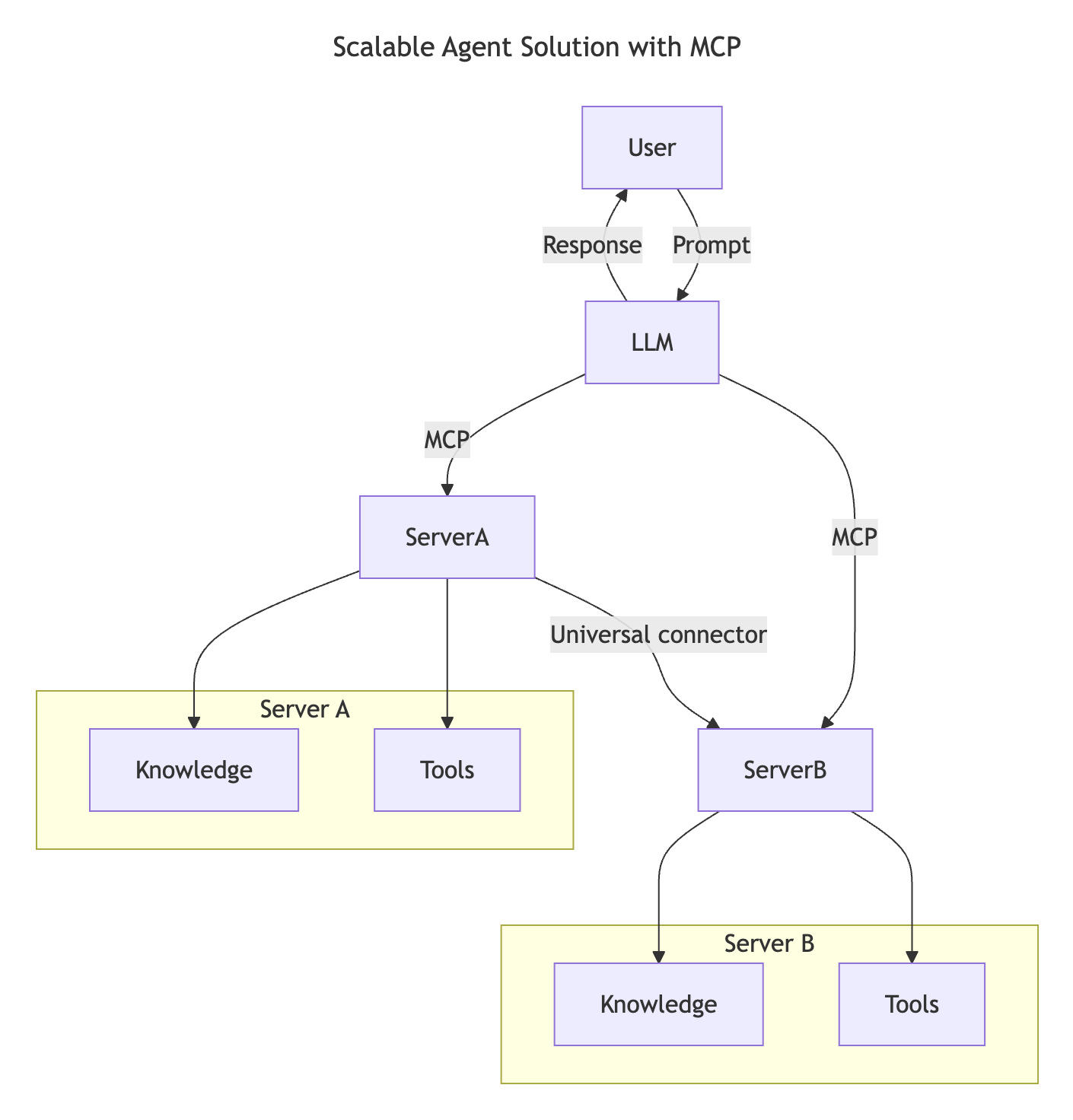
- The Universal Connector enables MCP servers to communicate and share capabilities with each other
- allowing ServerA to delegate tasks to ServerB or access its tools and knowledge.
- This federates tools and data across servers, supporting scalable and modular agent architectures.
- Because MCP standardizes tool exposure, agents can dynamically discover and route requests between servers without hardcoded integrations.
- Tool and knowledge federation: Tools and data can be accessed across servers, enabling more scalable and modular agentic architectures.
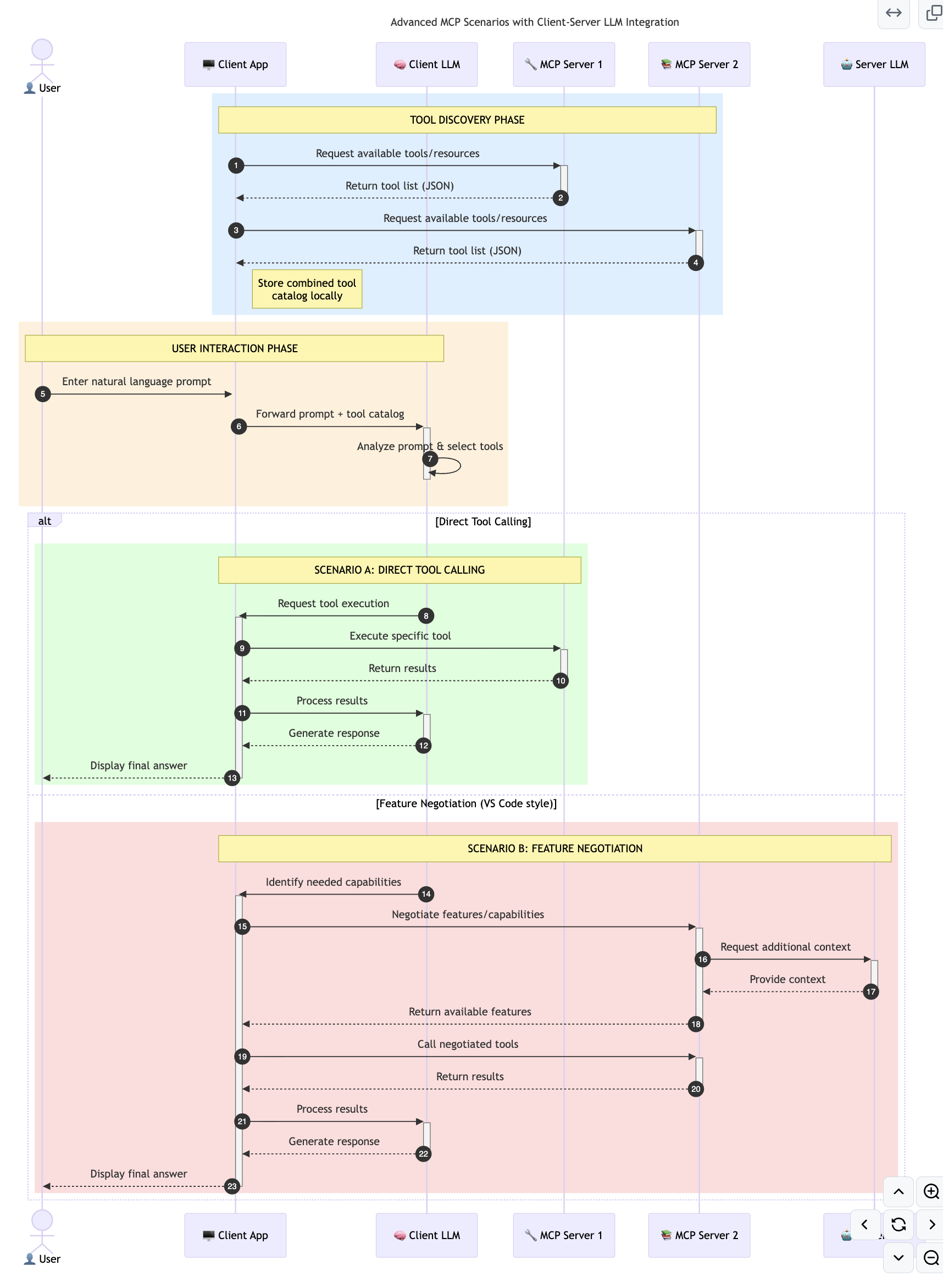
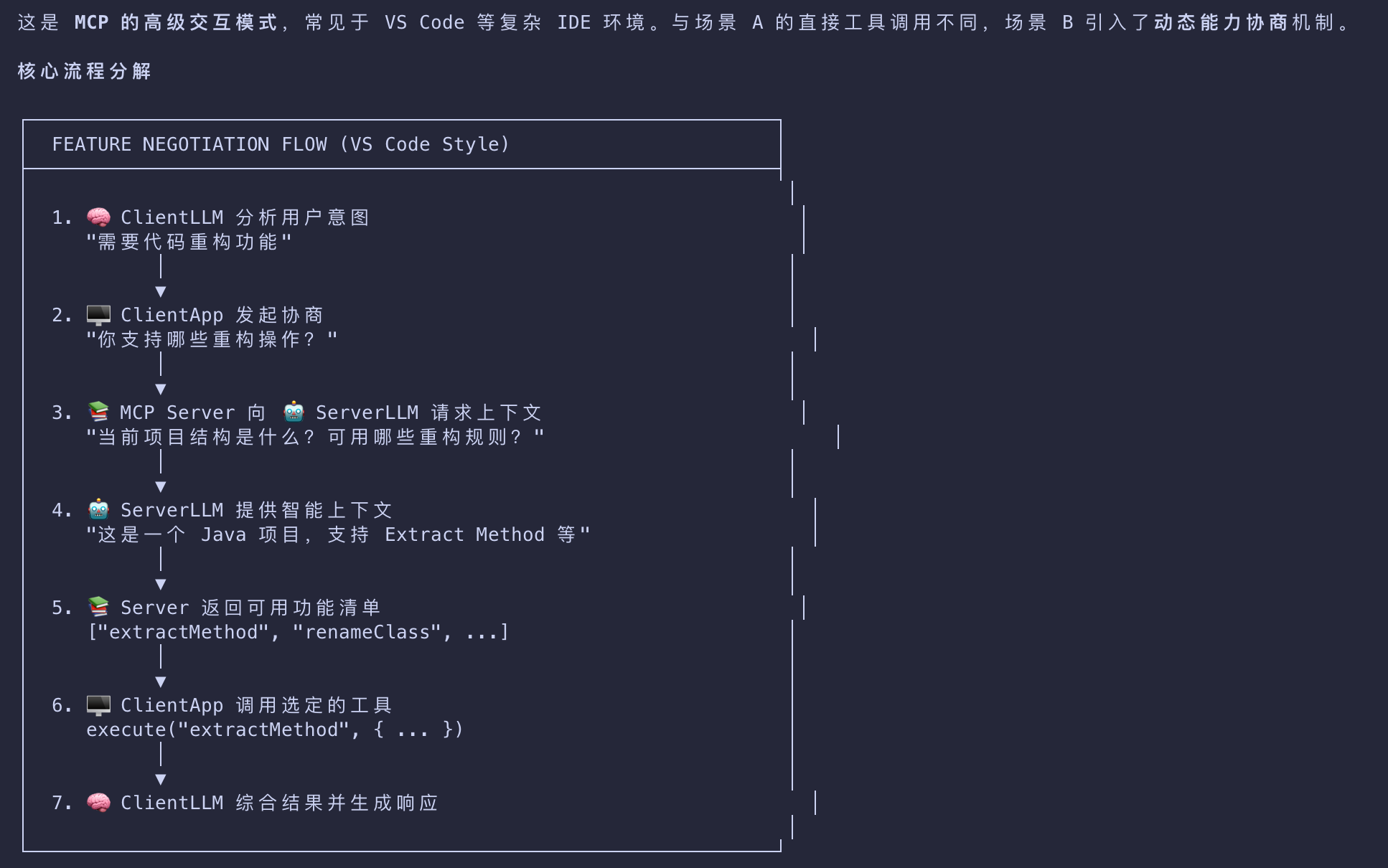
Advanced MCP Scenarios with Client-Side LLM Integration
- Beyond the basic MCP architecture
- there are advanced scenarios where both client and server contain LLMs, enabling more sophisticated interactions.
- In the following diagram, Client App could be an IDE with a number of MCP tools available for user by the LLM:
Practical Benefits of MCP
Here are the practical benefits of using MCP
| Benefit | Desc |
|---|---|
| Freshness | Models can access up-to-date information beyond their training data |
| Capability Extension | Models can leverage specialized tools for tasks they weren’t trained for |
| Reduced Hallucinations | External data sources provide factual grounding |
| Privacy | Sensitive data can stay within secure environments instead of being embedded in prompts |
Key Takeaways
The following are key takeaways for using MCP:
- MCP standardizes how AI models interact with tools and data
- Promotes extensibility, consistency, and interoperability
- MCP helps reduce development time, improve reliability, and extend model capabilities
- The client-server architecture enables flexible, extensible AI applications
Exercise
Think about an AI application you’re interested in building.
- Which external tools or data could enhance its capabilities?
- How might MCP make integration simpler and more reliable?
All articles on this blog are licensed under CC BY-NC-SA 4.0 unless otherwise stated.
Related Articles
2026-03-10
MCP Docs - Authorization
Overview Learn how to implement secure authorization for MCP servers using OAuth 2.1 to protect sensitive resources and operations. Authorization in the Model Context Protocol (MCP) secures access to sensitive resources and operations exposed by MCP servers. If your MCP server handles user data or administrative actions, authorization ensures only permitted users can access its endpoints. MCP uses standardized authorization flows to build trust between MCP clients and MCP servers. Its design doesn’t focu...
2026-03-03
MCP Docs - Overview
Introduction MCP (Model Context Protocol) is an open-source standard for connecting AI applications to external systems. Using MCP, AI applications like Claude or ChatGPT can connect to data sources (e.g. local files, databases) tools (e.g. search engines, calculators) workflows (e.g. specialized prompts)—enabling them to access key information and perform tasks. Think of MCP like a USB-C port for AI applications. Just as USB-C provides a standardized way to connect electronic devices MCP provides a s...
2026-03-03
MCP Docs - Architecture
Overview This overview of the Model Context Protocol (MCP) discusses its scope and core concepts, and provides an example demonstrating each core concept. Because MCP SDKs abstract away many concerns, most developers will likely find the data layer protocol section to be the most useful. It discusses how MCP servers can provide context to an AI application. Scope MCP focuses on context exchange MCP Specification A specification of MCP that outlines the implementation requirements for clients and s...
2024-08-07
RAG - Data Processing
数据存储 LLM 变成生产力,有两个制约因素 - 交互过程中的长文本 + 内容的实时更新 在传统的应用开发中,数据存储在数据库中,保留了应用的全部记忆 在 AI 时代,向量数据库充当了这一角色 在 RAG 系统中,数据被转换为高维向量形式,使得语言模型能够进行高效的语义相似度计算和检索 在向量数据库中,查找变成了计算每条记录的向量近似度,然后按照分值倒序返回结果 RAG 就如何存储向量的方法论,根据不同的实现策略,衍生出了不同的 RAG 技术 利用图结构表示和检索知识的 GraphRAG 结合知识图谱增强生成能力的 KG-RAG - Knowledge Graph Augmented Generation AI 应用的数据建模强调的是数据的语义表示和关联,以支持更灵活的查询和推理 高质量的数据处理,不仅影响检索的准确性,还直接决定了 LLM 生成内容的质量和可靠性 Embedding 将所有内容转成文本 + 额外数据(用来关联数据) 选择一个 Embedding 模型,把文本转成向量,并存储到向量数据库中 厂商 LLM Embedding 国产 百度 文心一言 Embeddi...
2024-06-26
LLM - Prompt
Prompt 是否充分使用好 AI 大模型,提示是关键 OpenAI question / answer prompt / completion - 给 LLM 一个提示,让 LLM 进行补全 LLM 训练原理 GPT 系列模型基于 Transformer 架构的解码器机制,使用自回归无监督方式进行预训练 训练过程 - 大量的文本输入,不断进行记忆 相比于监督学习,训练效率更低,但训练过程简单,可以喂大量的文本语料,上限比较高 completion 根据训练过的记忆,一个字一个字地计算概率,取概率最大的那个字进行输出 因此有人吐槽 LLM 输出很慢 - 逐字计算并输出 Prompt Engineering 需求描述越详细越准确,LLM 输出的内容就越符合要求 Prompt Engineering 是一门专门研究与 LLM 交互的新型学科 通过不断地开发和优化,帮助用户更好地了解 LLM 的能力和局限性 探讨如何设计出最佳提示,用于指导 LLM 帮助我们高效完成某项任务 不仅仅是设计和研发提示,还包含了与 LLM 交互的各种技能和技术 在实现与 LLM 交互、...
2024-07-01
LLM - API
背景 LLM 是没有 Web API 的,需要进行一次封装 将 LLM 的核心接口封装成 Web API 来为用户提供服务 - 必经之路 接口封装FastAPI接口封装 Uvicorn + FastAPI Uvicorn 类似于 Tomcat,但比 Tomcat 轻量很多,作为 Web 服务器 允许异步处理 HTTP 请求,非常适合处理并发请求 基于 uvloop 和 httptools,具备非常高的性能 FastAPI 类似于 SpringBoot,同样比 SpringBoot 轻量很多,作为 API 框架 结合 Uvicorn 和 FastAPI 可以构建一个高性能的、易于扩展的异步 Web 应用程序 Uvicorn 作为服务器运行 FastAPI 应用,可以提供优异的并发处理能力 安装依赖12$ pip install fastapi$ pip install uvicorn 代码分层1234567891011121314import uvicornfrom fastapi import FastAPI# 创建API应用app = FastAPI()@app.get(&quo...