Overview

  1. Learn how to implement secure authorization for MCP servers using OAuth 2.1 to protect sensitive resources and operations.
  2. Authorization in the Model Context Protocol (MCP) secures access to sensitive resources and operations exposed by MCP servers.
  3. If your MCP server handles user data or administrative actions, authorization ensures only permitted users can access its endpoints.
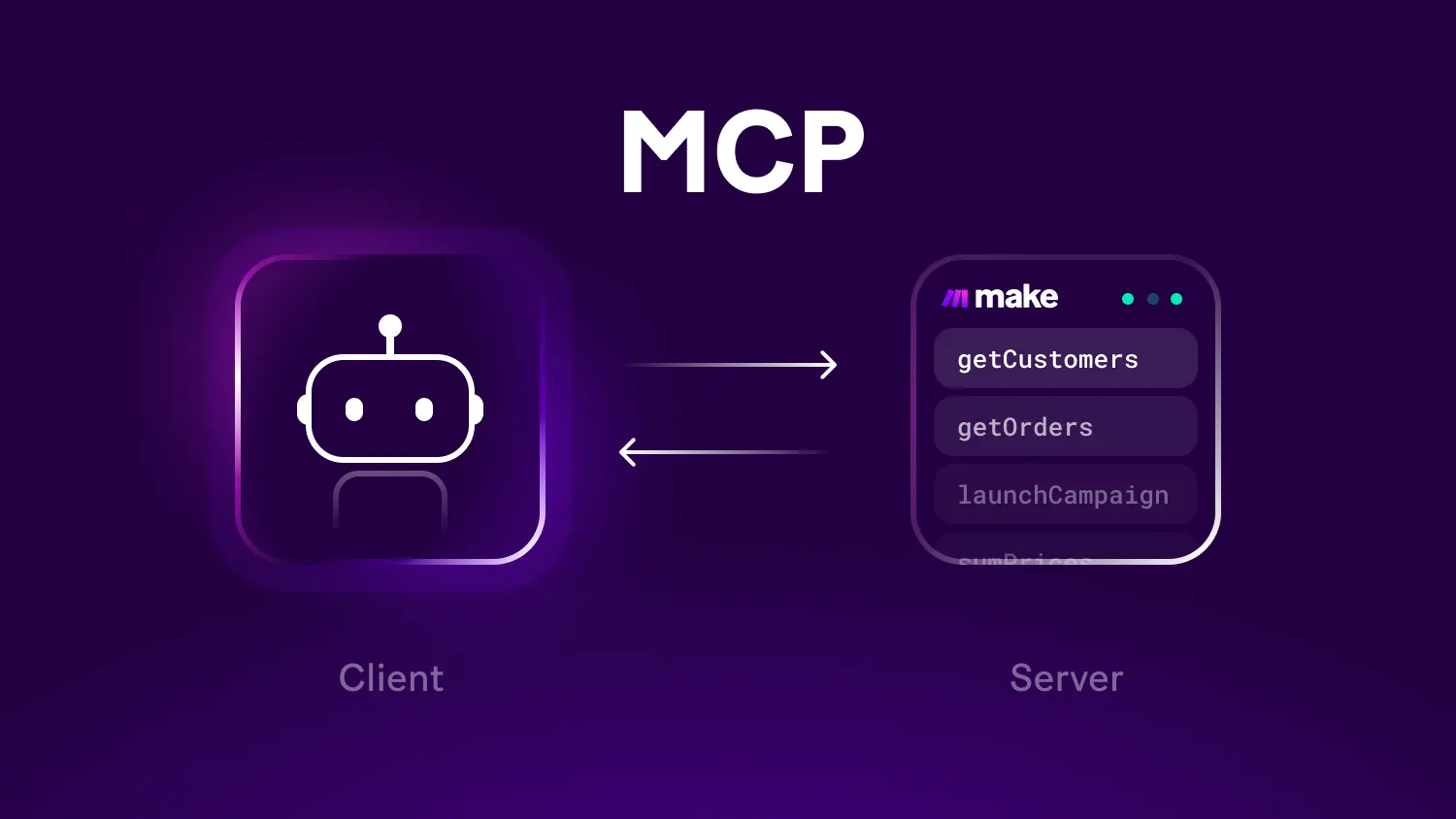
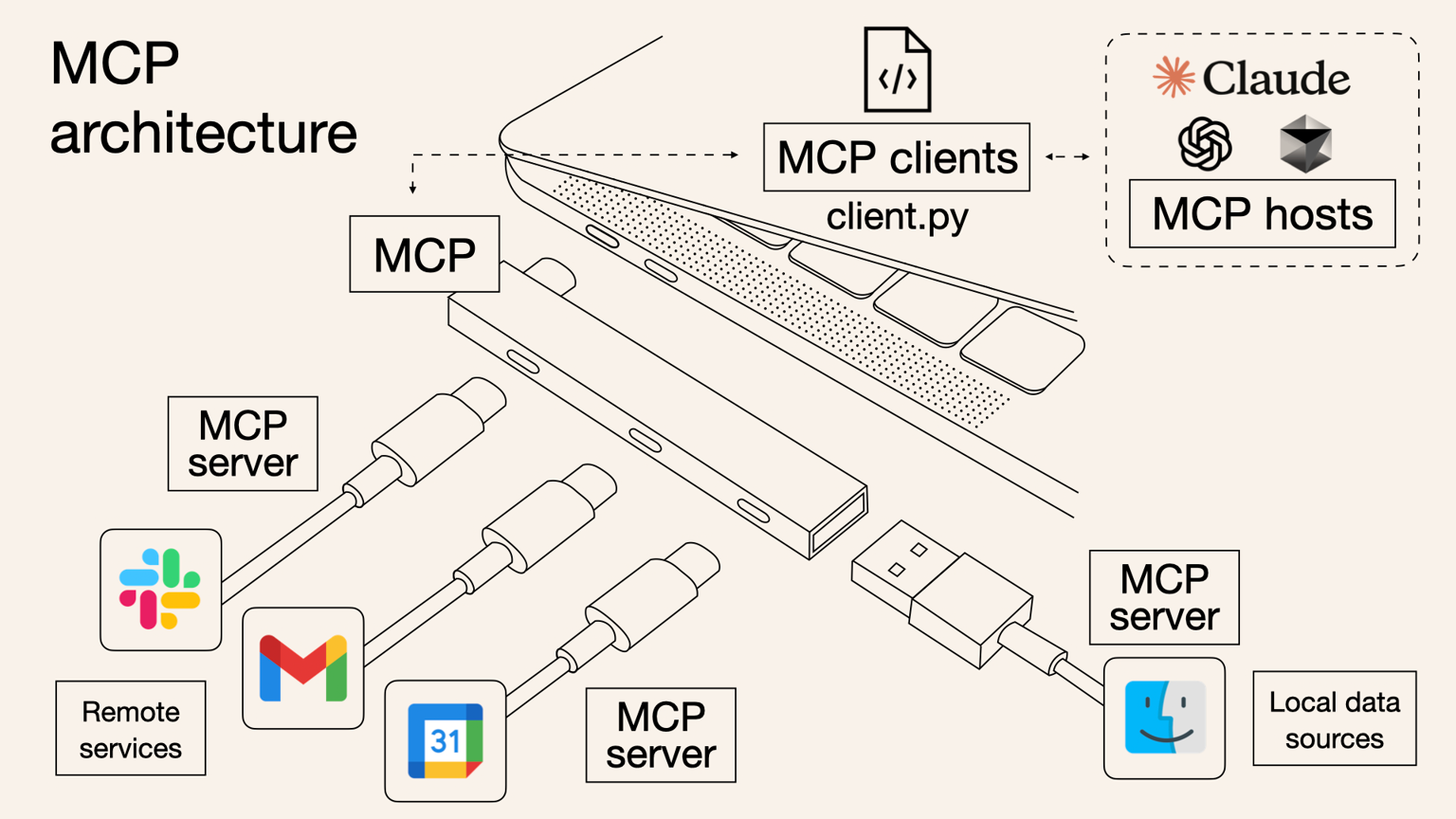
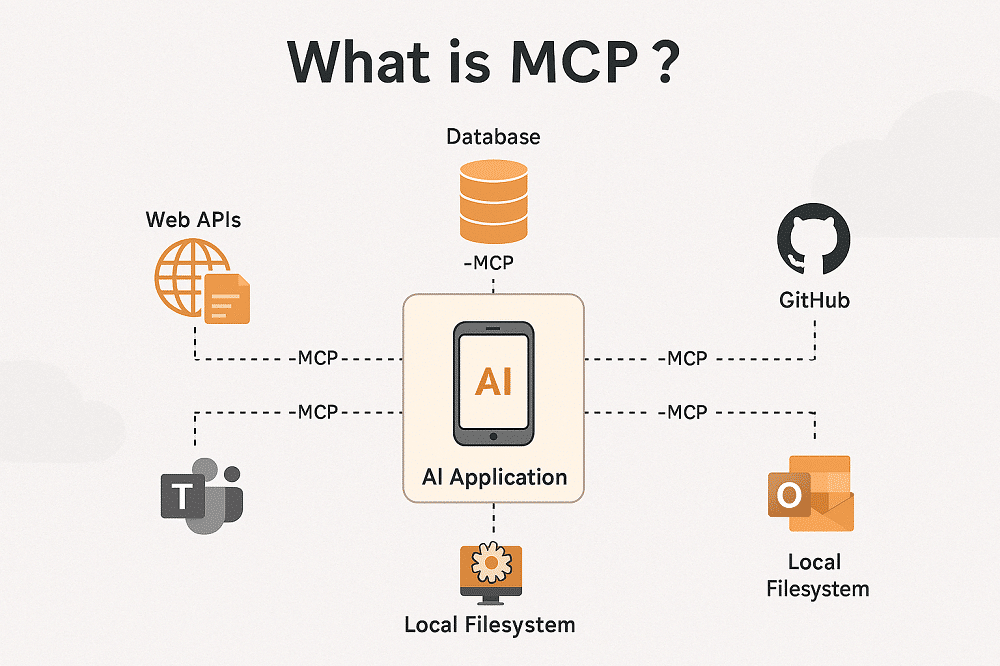
  4. MCP uses standardized authorization flows to build trust between MCP clients and MCP servers.

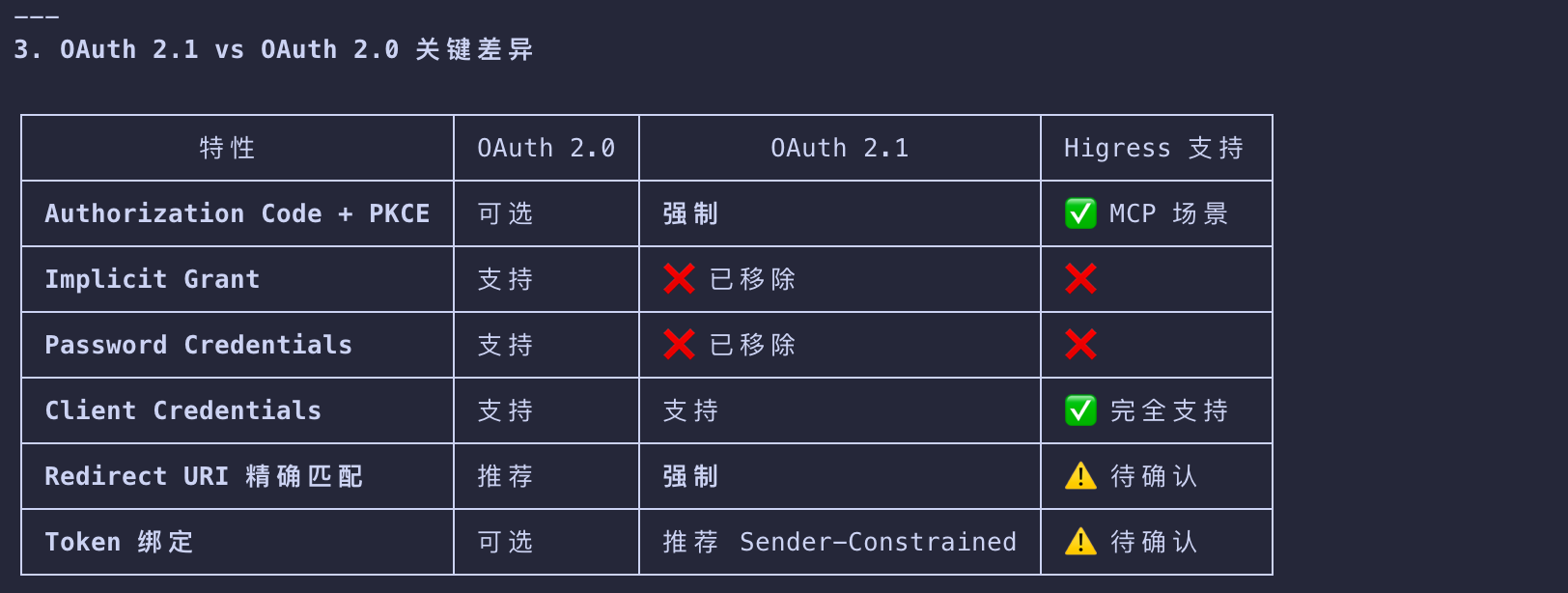
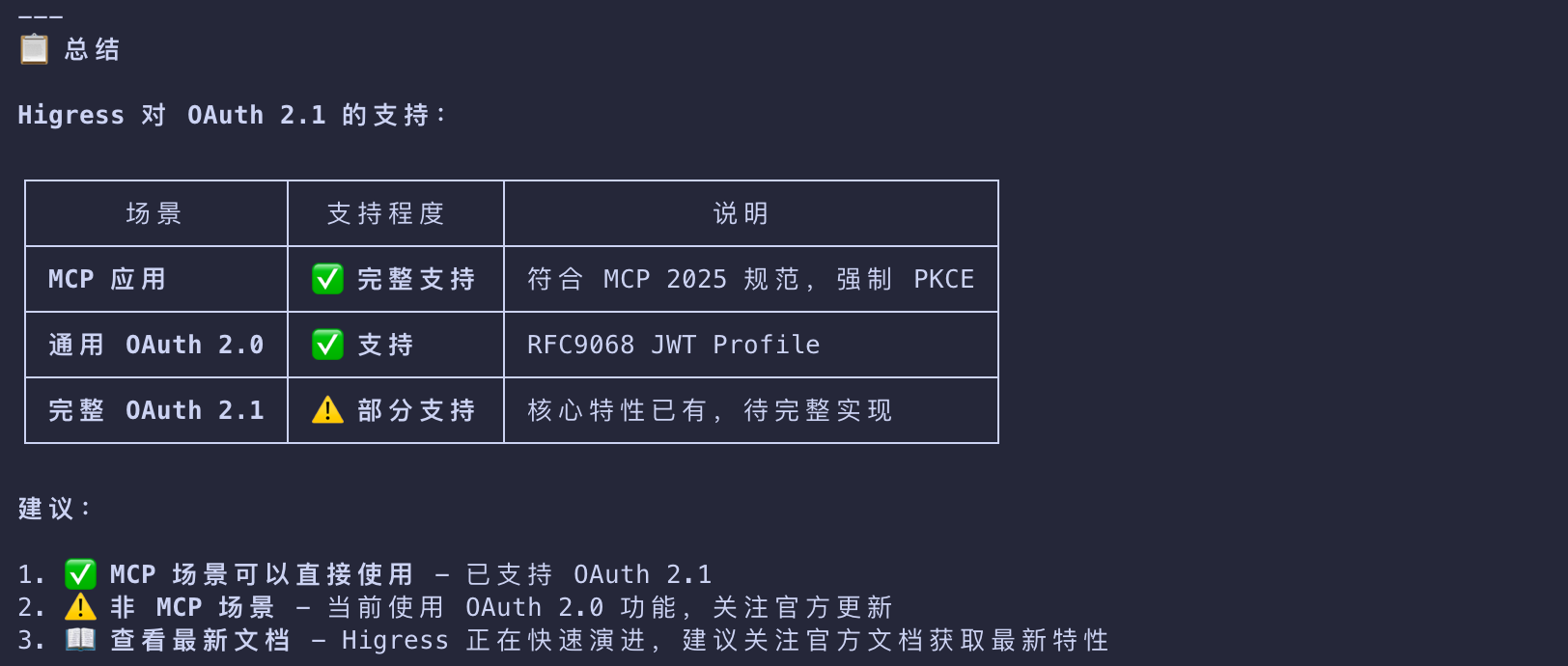
OAuth 2.1

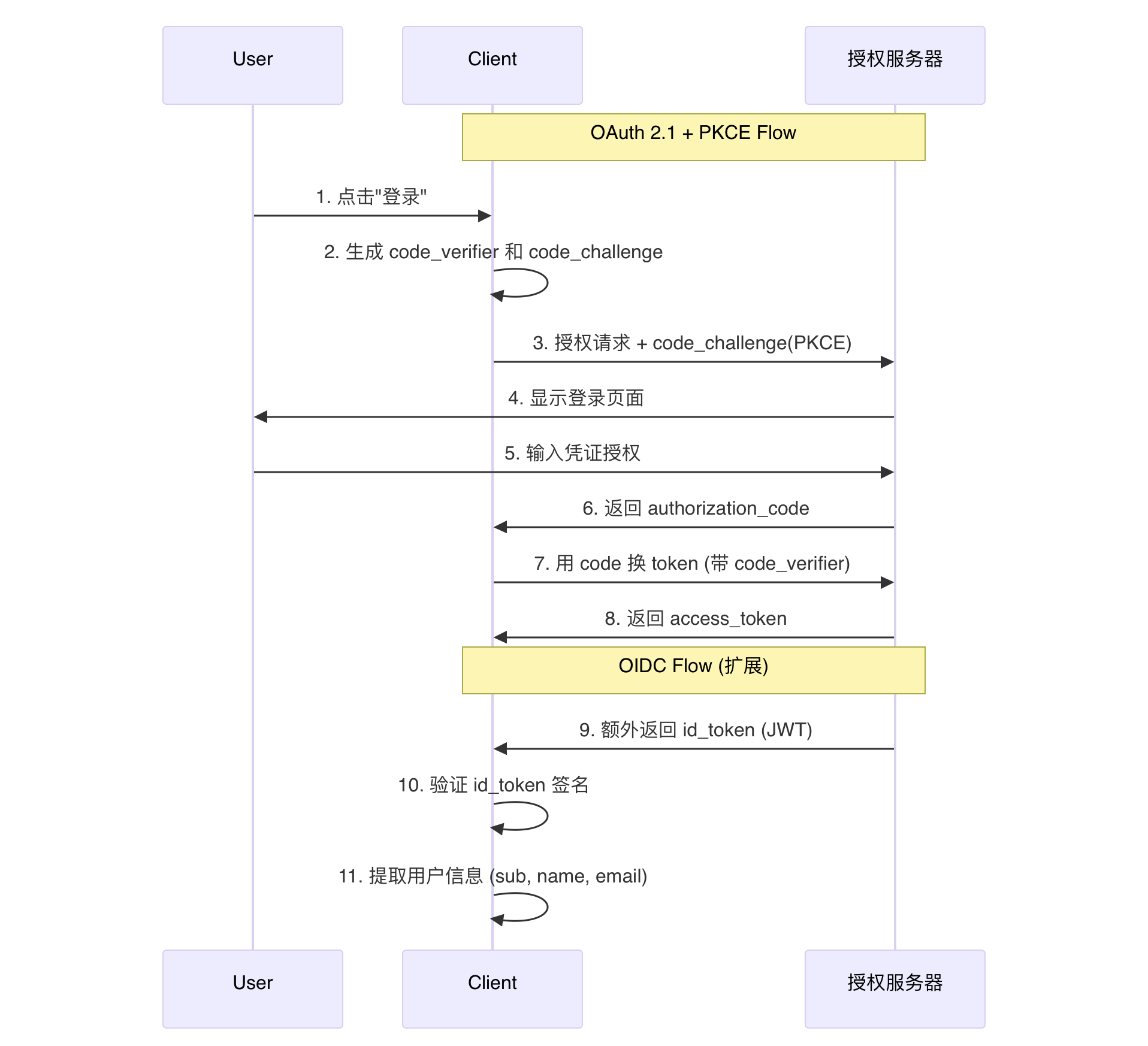
Authorization Code Flow with PKCE
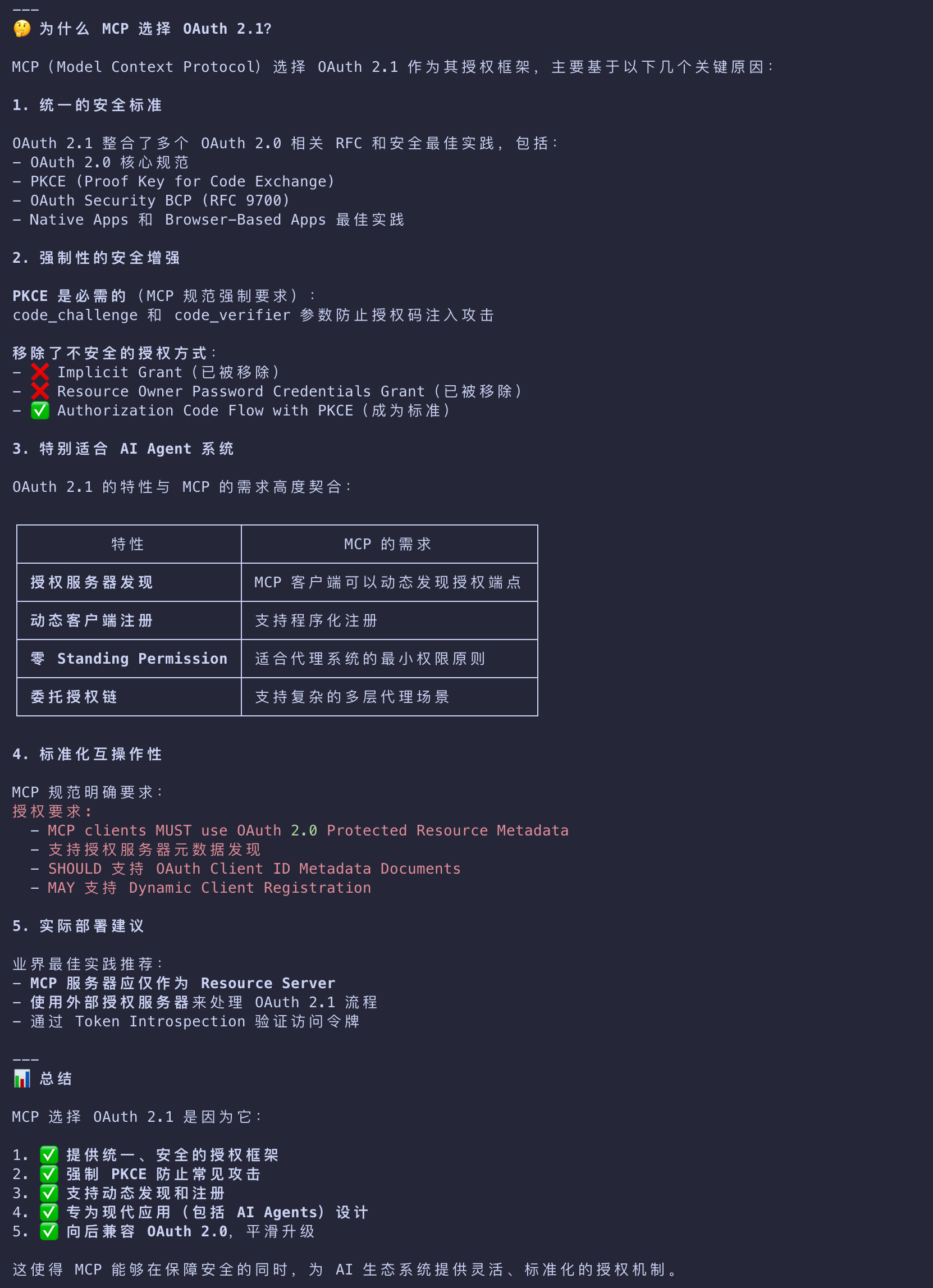
image-20260310174453265

Higress

image-20260310174011329

image-20260310174110240

When Should You Use Authorization?

While authorization for MCP servers is optional, it is strongly recommended when:

  1. Your server accesses user-specific data (emails, documents, databases)
  2. You need to audit who performed which actions
  3. Your server grants access to its APIs that require user consent
  4. You’re building for enterprise environments with strict access controls
  5. You want to implement rate limiting or usage tracking per user

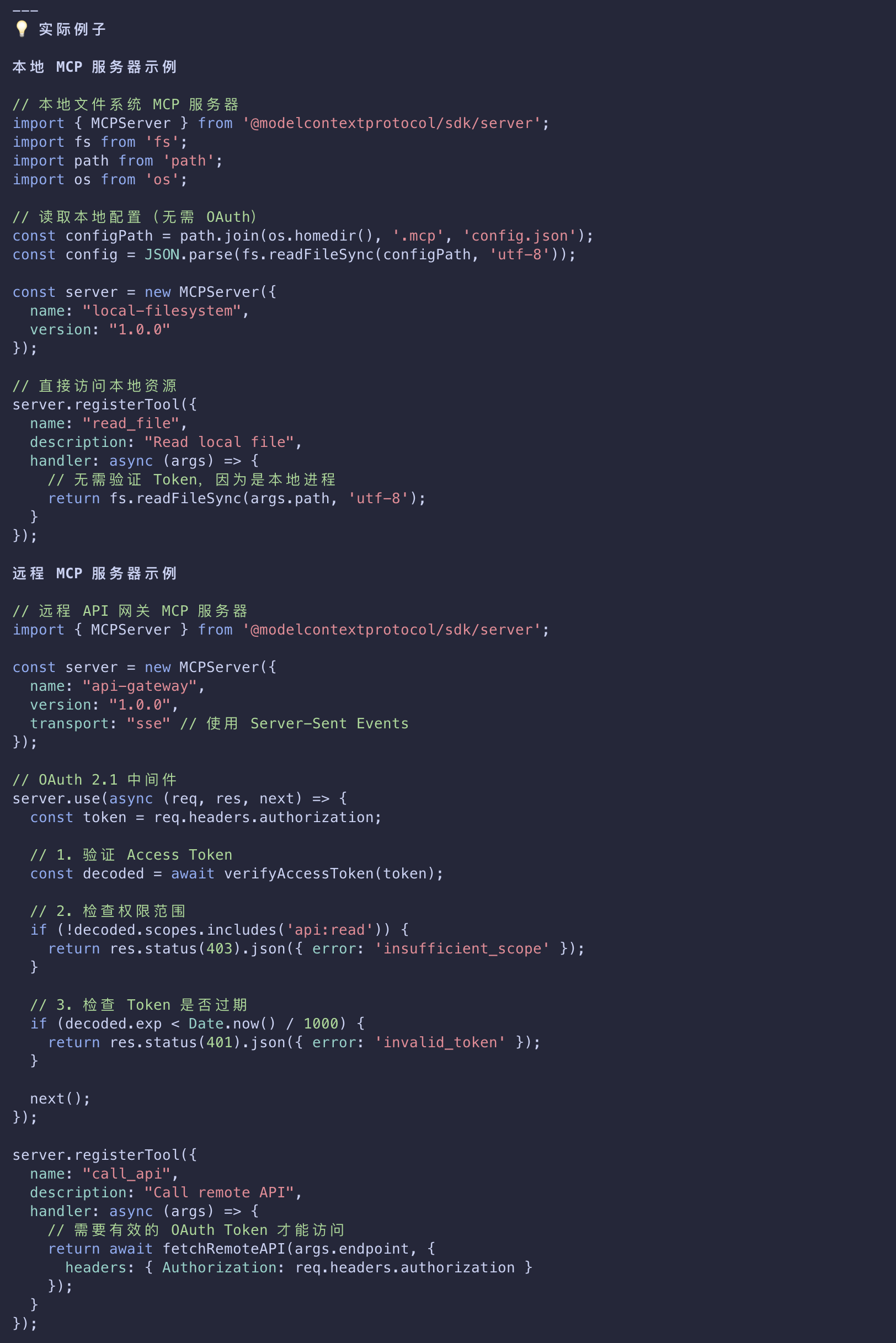
Authorization for Local MCP Servers

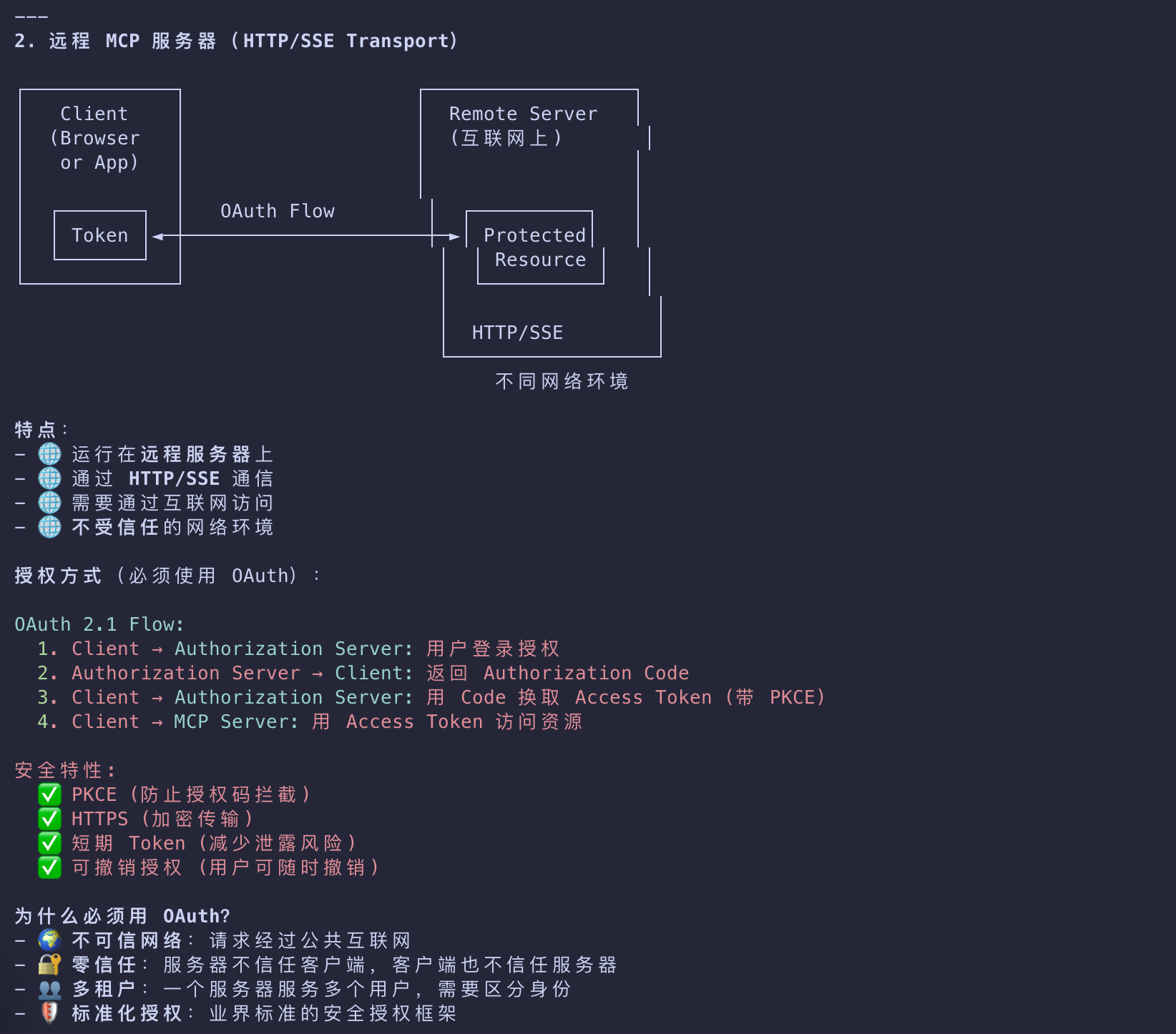
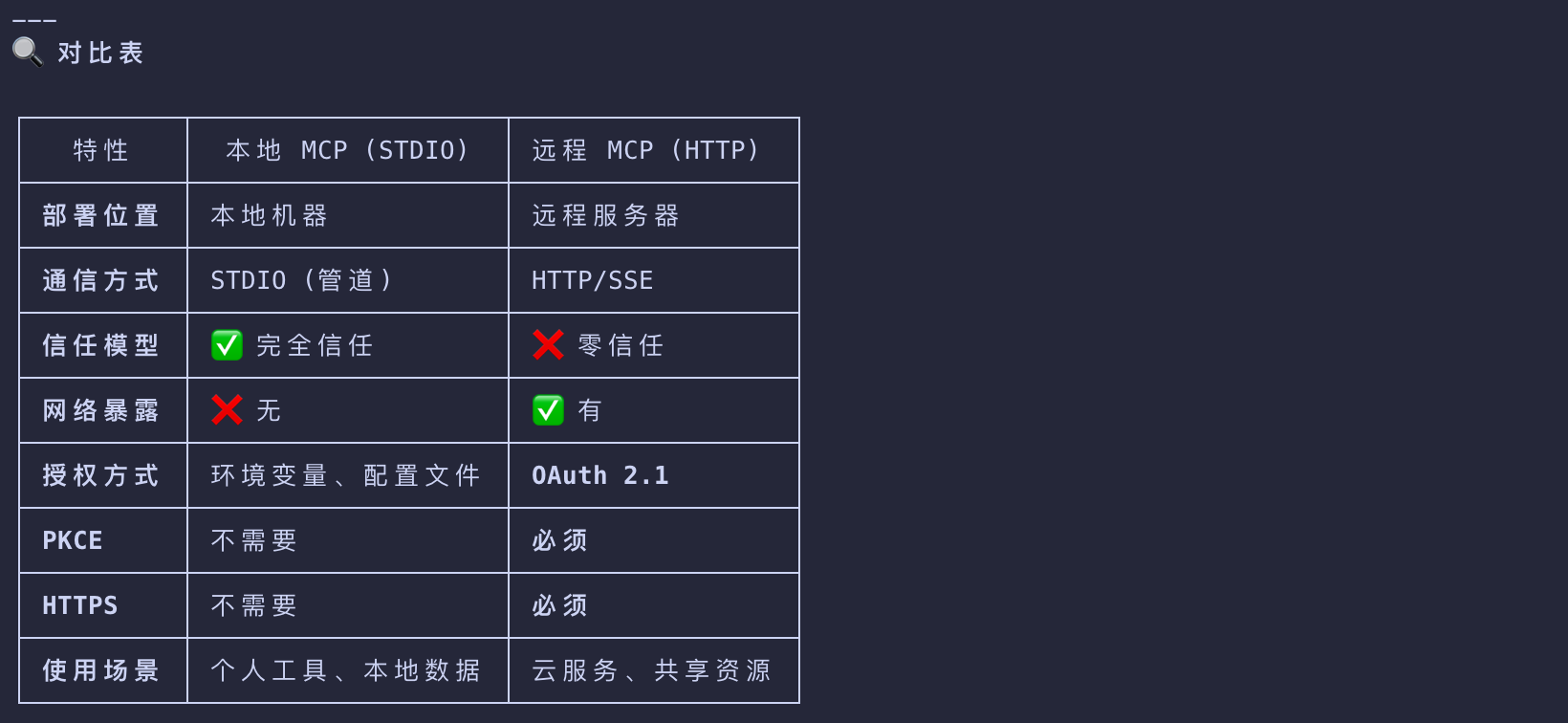
  1. For MCP servers using the STDIO transport
    • you can use environment-based credentials or credentials provided by third-party libraries embedded directly in the MCP server instead.
  2. Because a STDIO-built MCP server runs locally
    • it has access to a range of flexible options when it comes to acquiring user credentials
    • that may or may not rely on in-browser authentication and authorization flows.
  3. OAuth flows, in turn, are designed for HTTP-based transports where the MCP server is remotely-hosted
    • and the client uses OAuth to establish that a user is authorized to access said remote server.
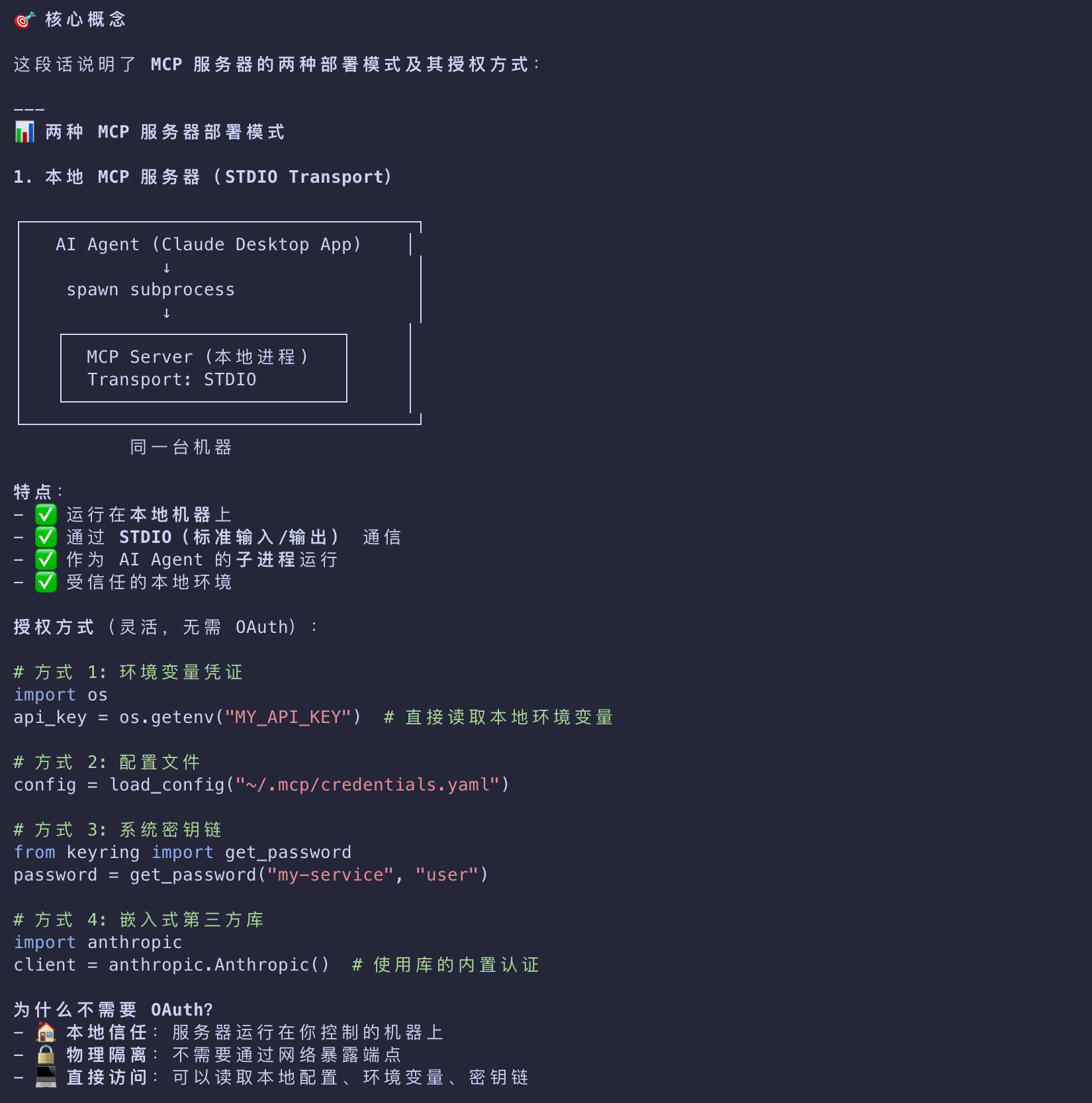
image-20260310175918194

OAuth 2.1 + PKCE

image-20260310180337844

image-20260310180414759

image-20260310180600712

image-20260310180847029

Key Value
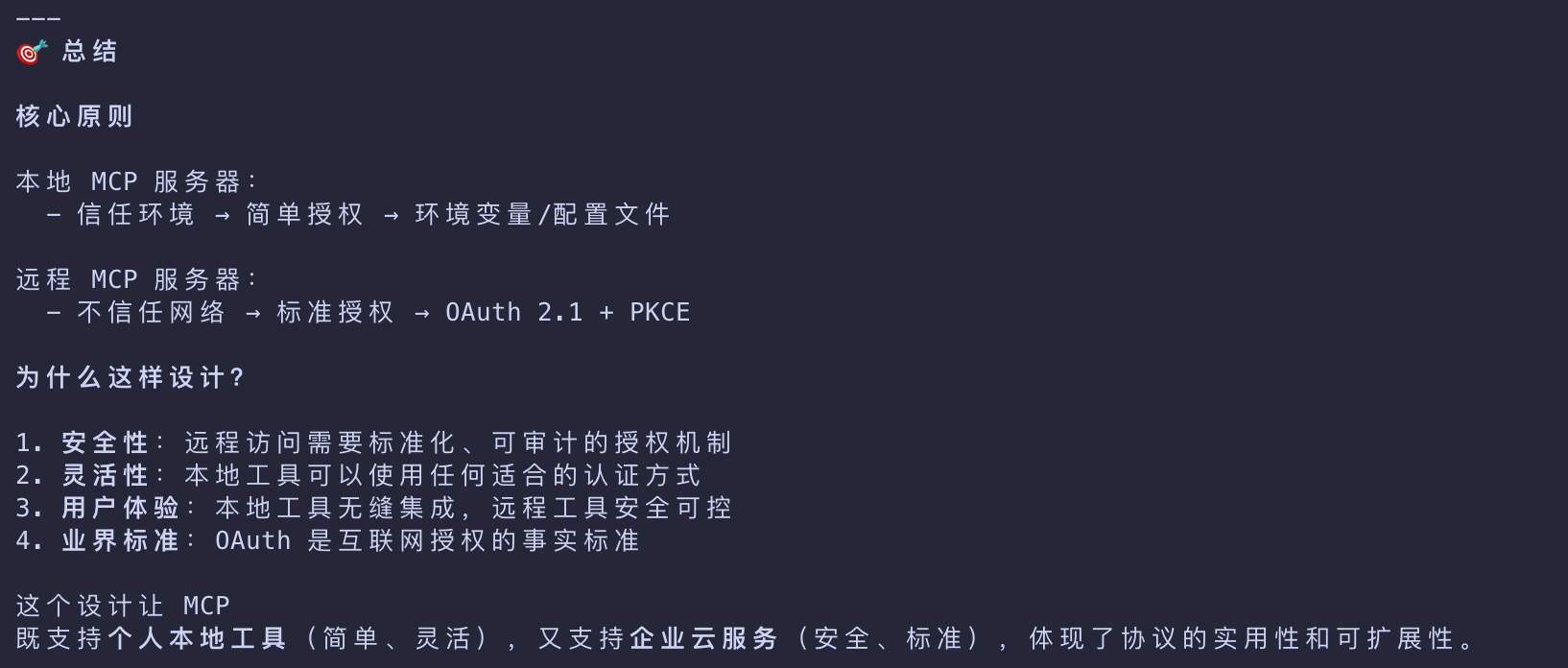
安全性 远程访问需要标准化可审计的授权机制
灵活性 本地工具可以使用任何适合的认证方式
用户体验 本地工具无缝集成,远程工具安全可控
业界标准 OAuth互联网授权事实标准

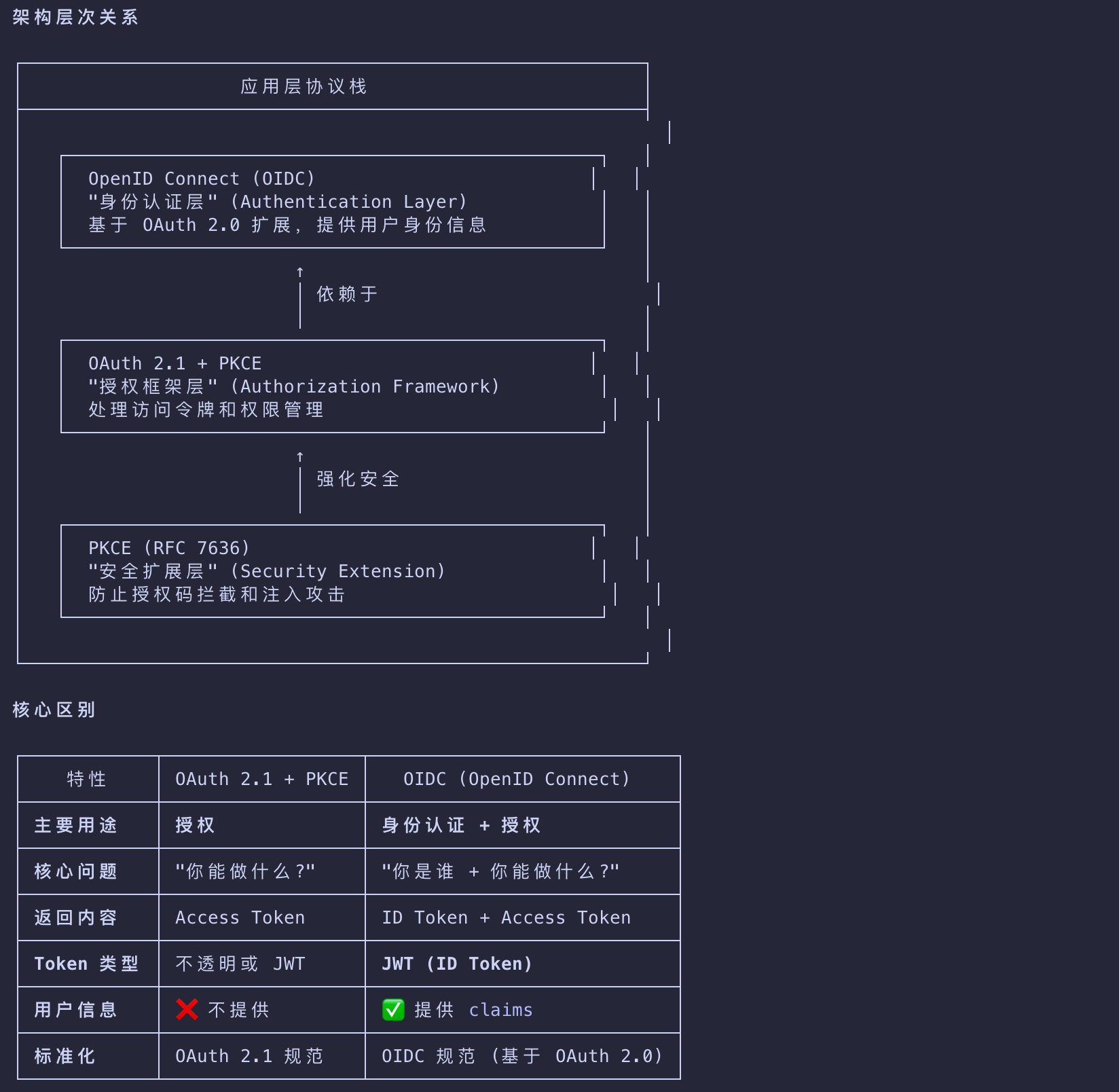
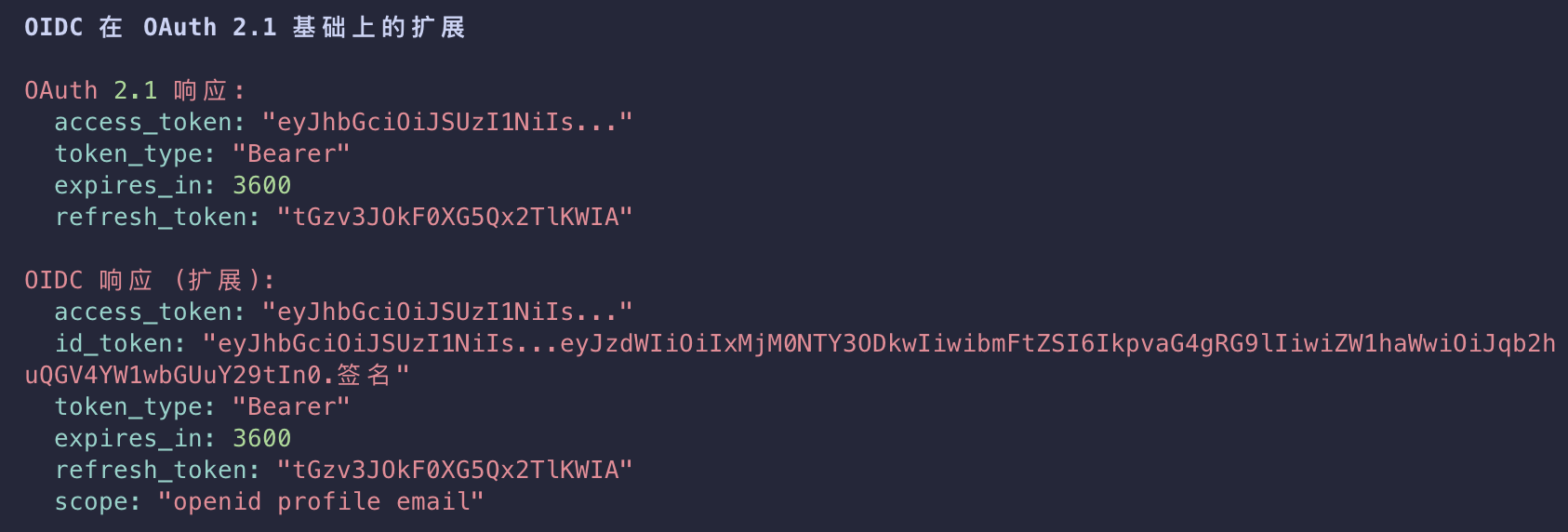
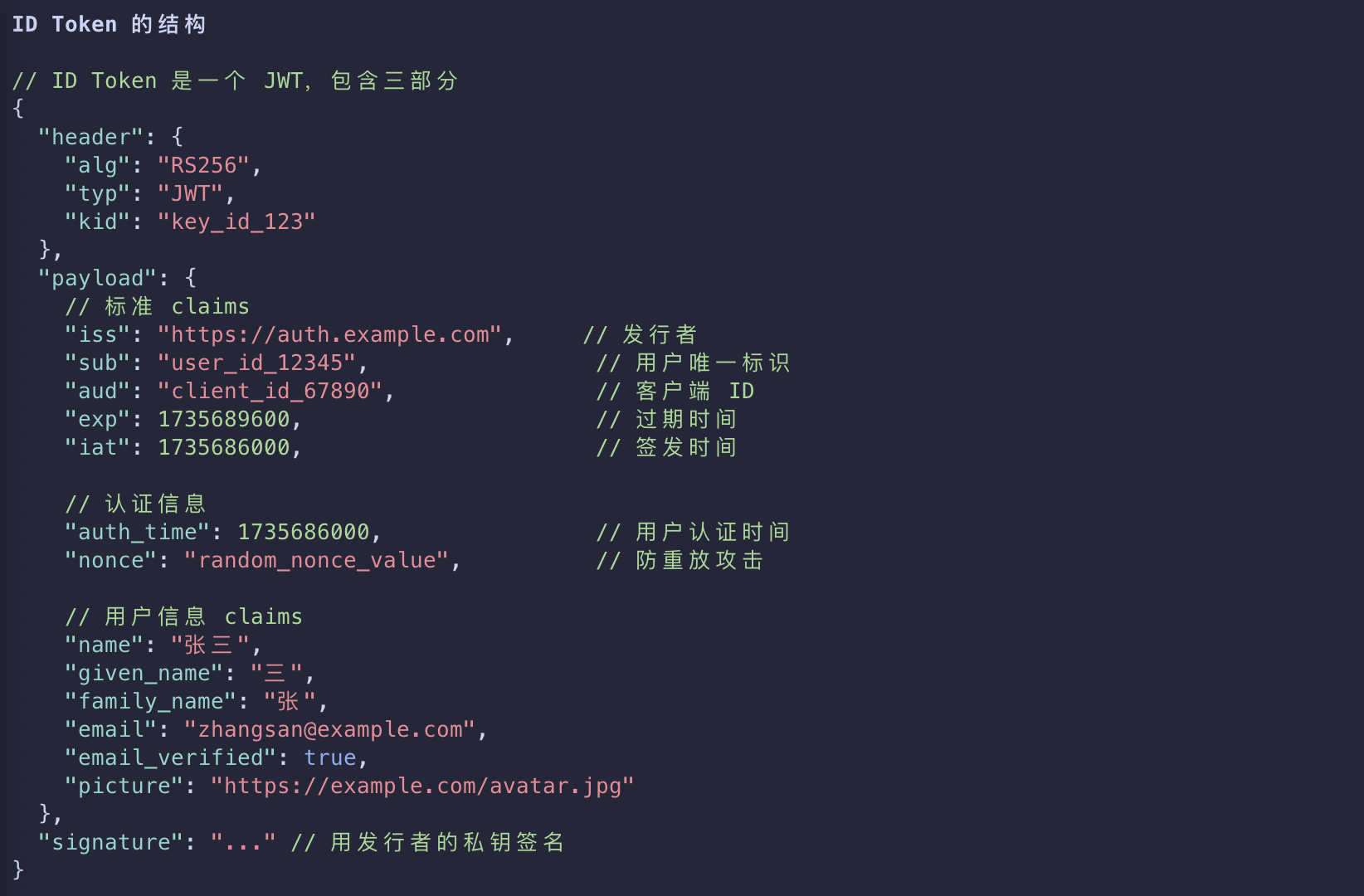
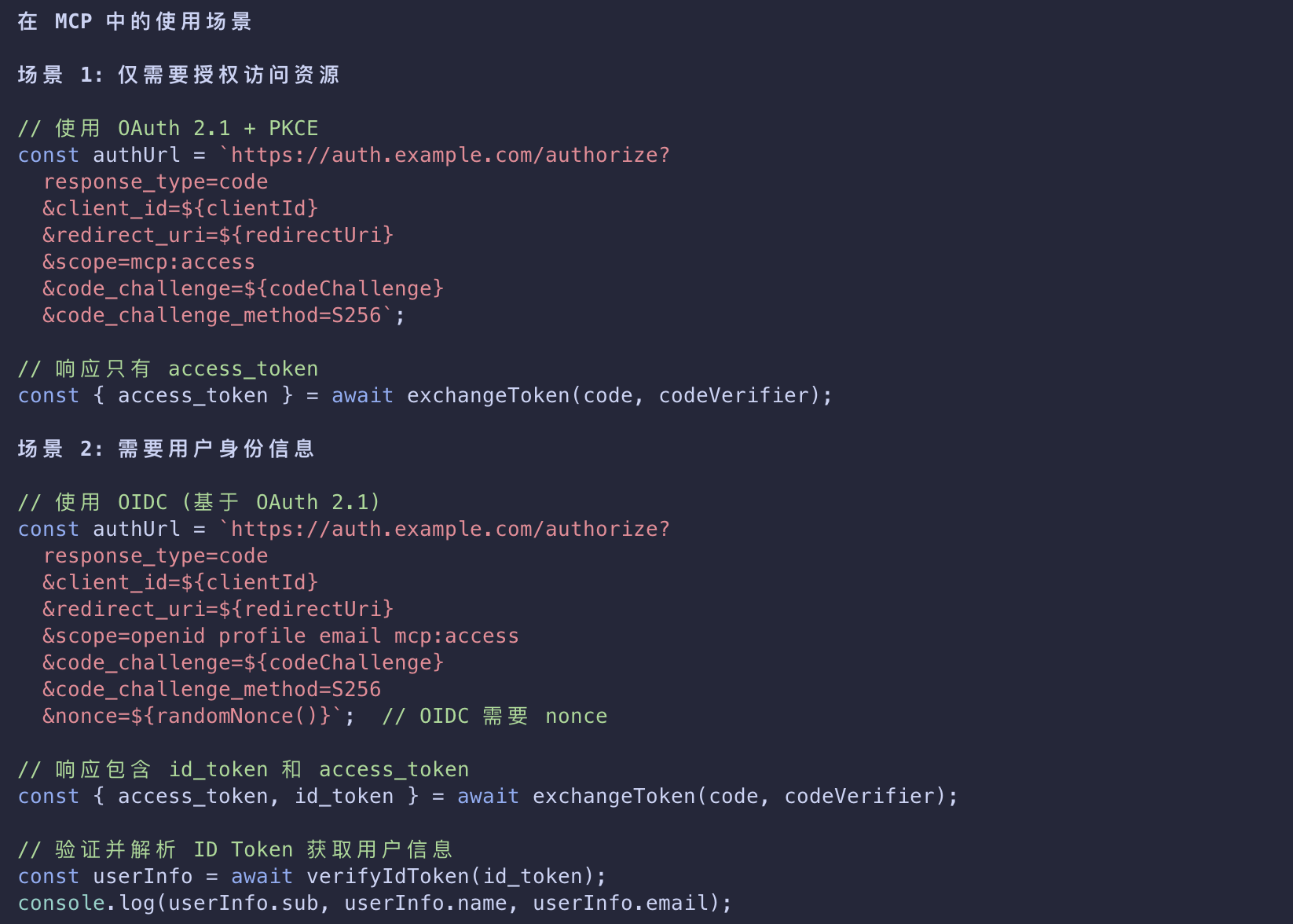
OAuth 2.1 + PKCE vs OIDC

image-20260310181636955

image-20260310181844207

image-20260310182050014

image-20260310182151182

image-20260310182317909

Dex

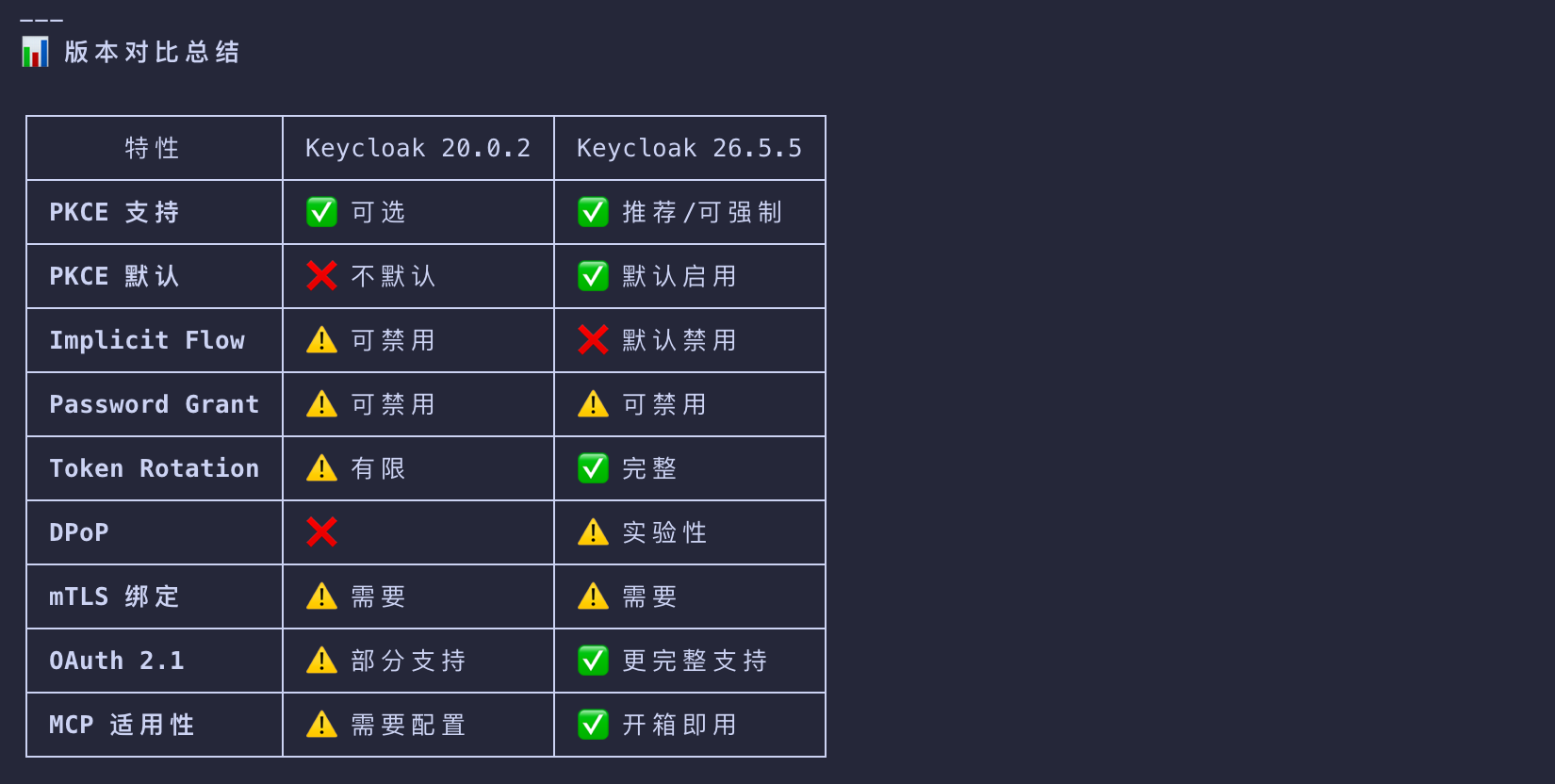
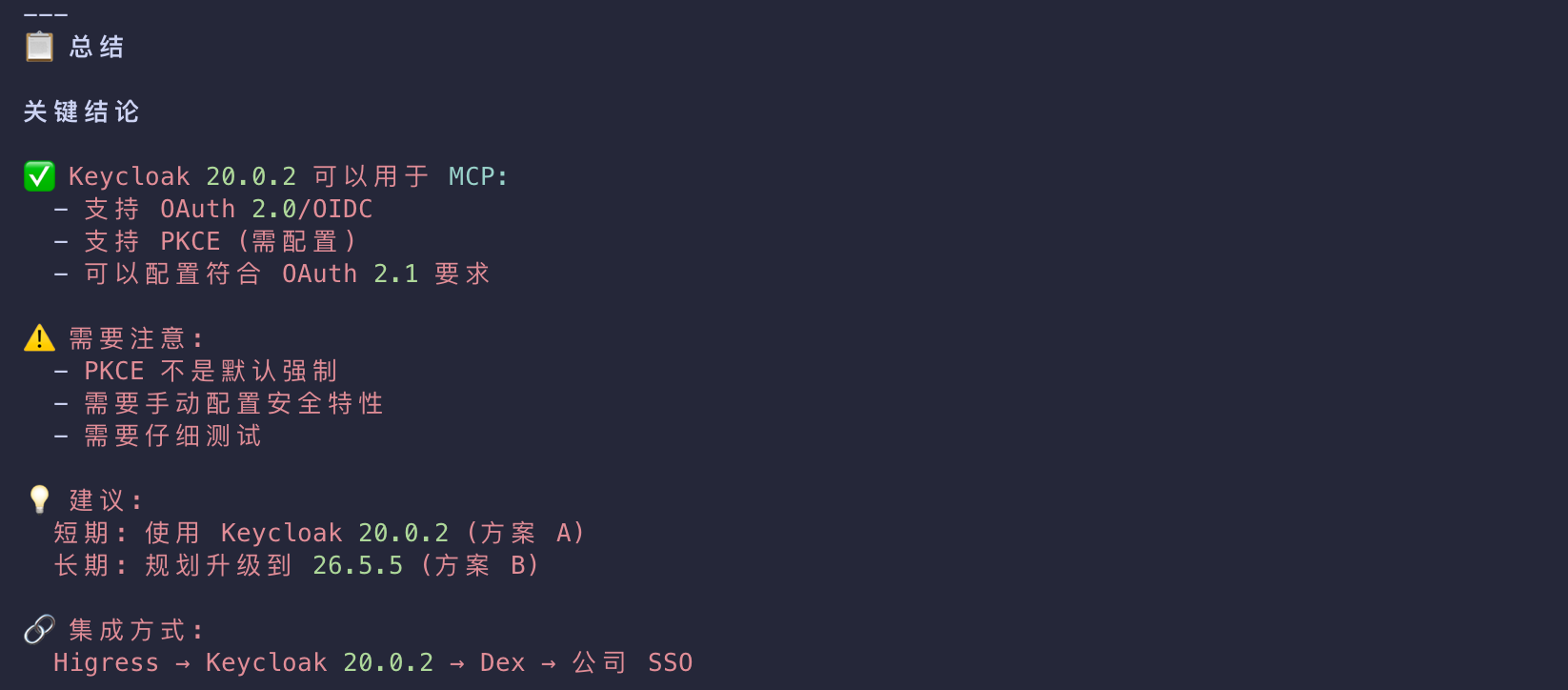
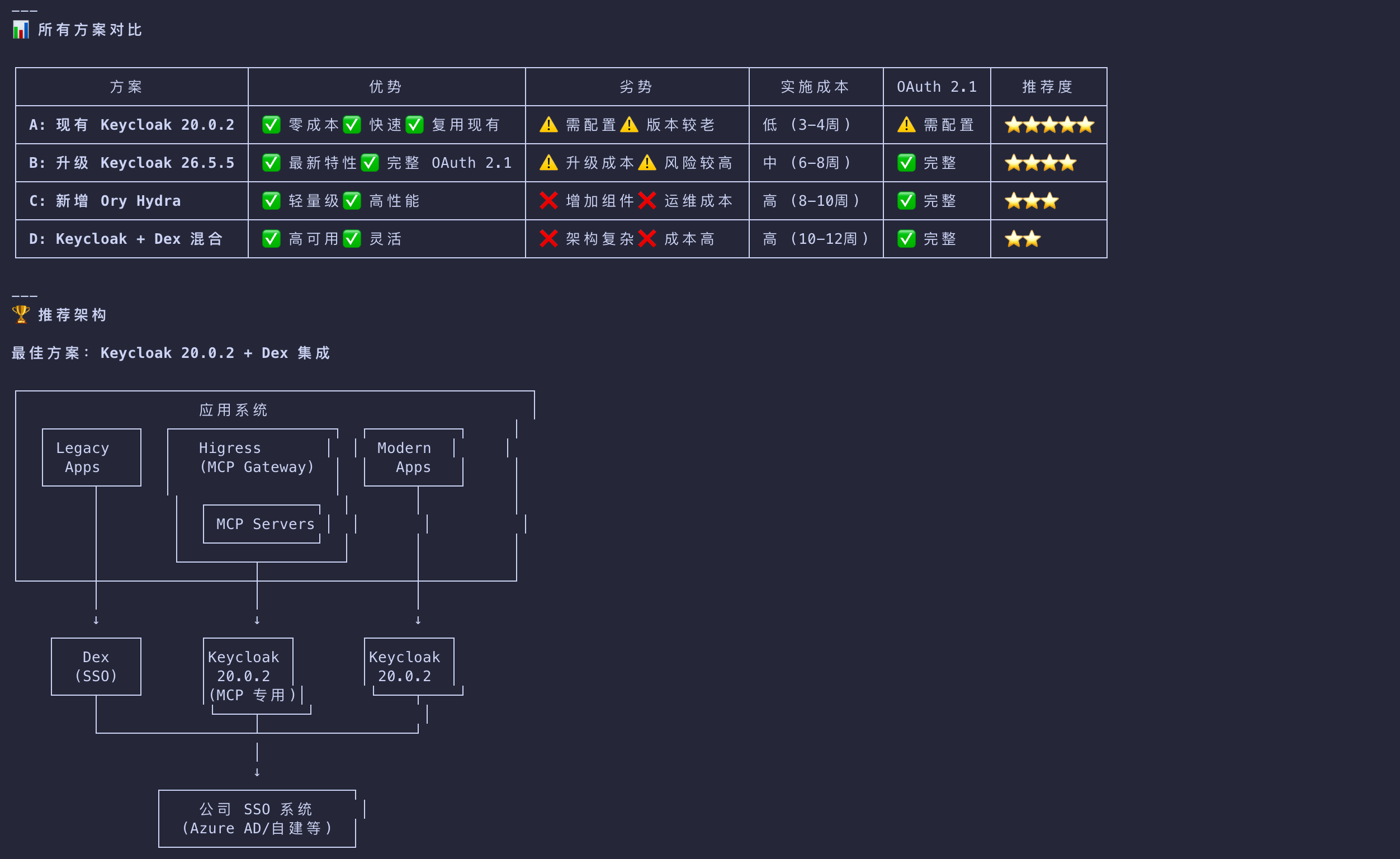
Higress → Keycloak → Dex → 公司 SSO
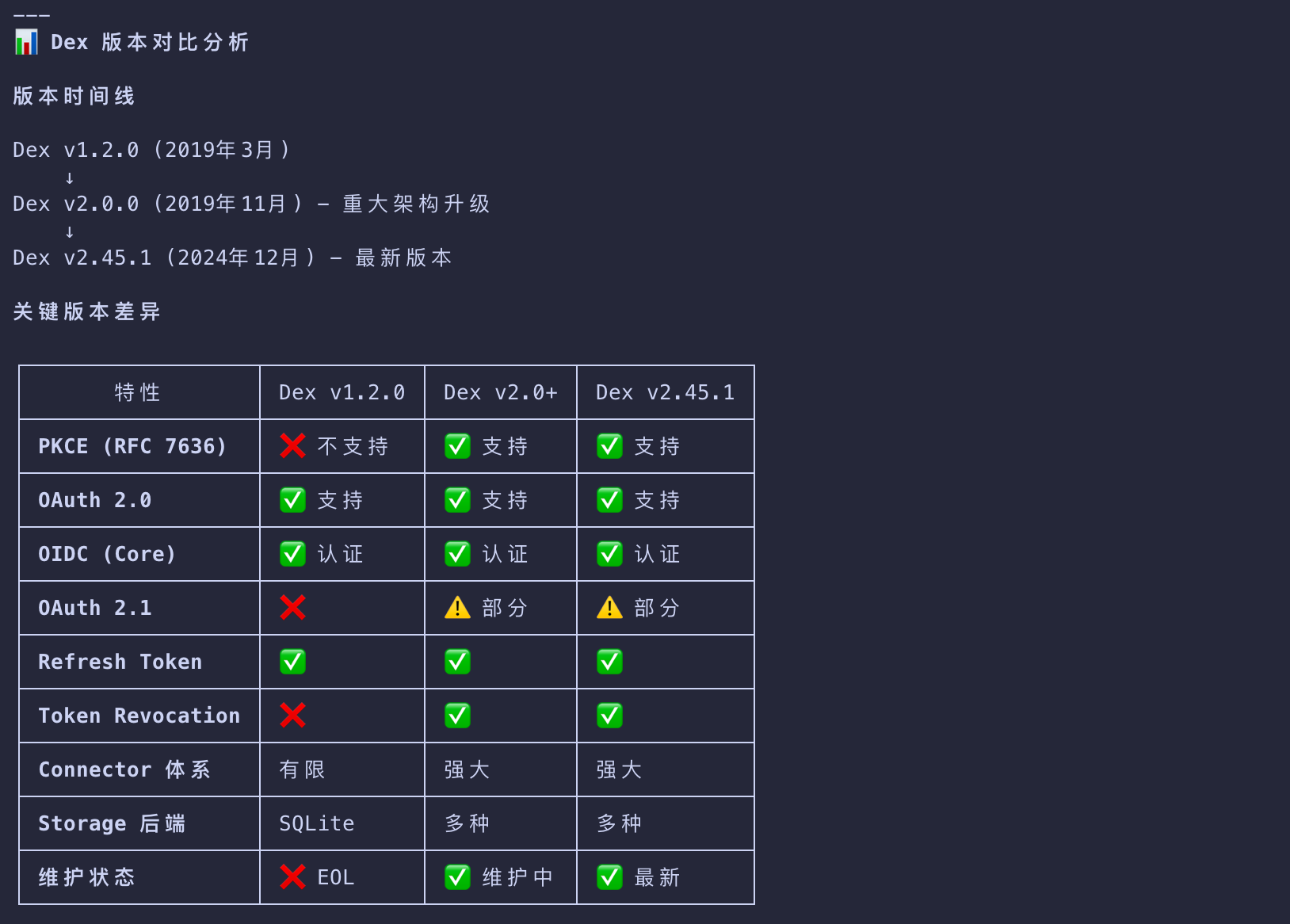
image-20260310183805434

Keycloak

image-20260310184950153

image-20260310185027509

image-20260310185117129

image-20260310185658935

The Authorization Flow: Step by Step

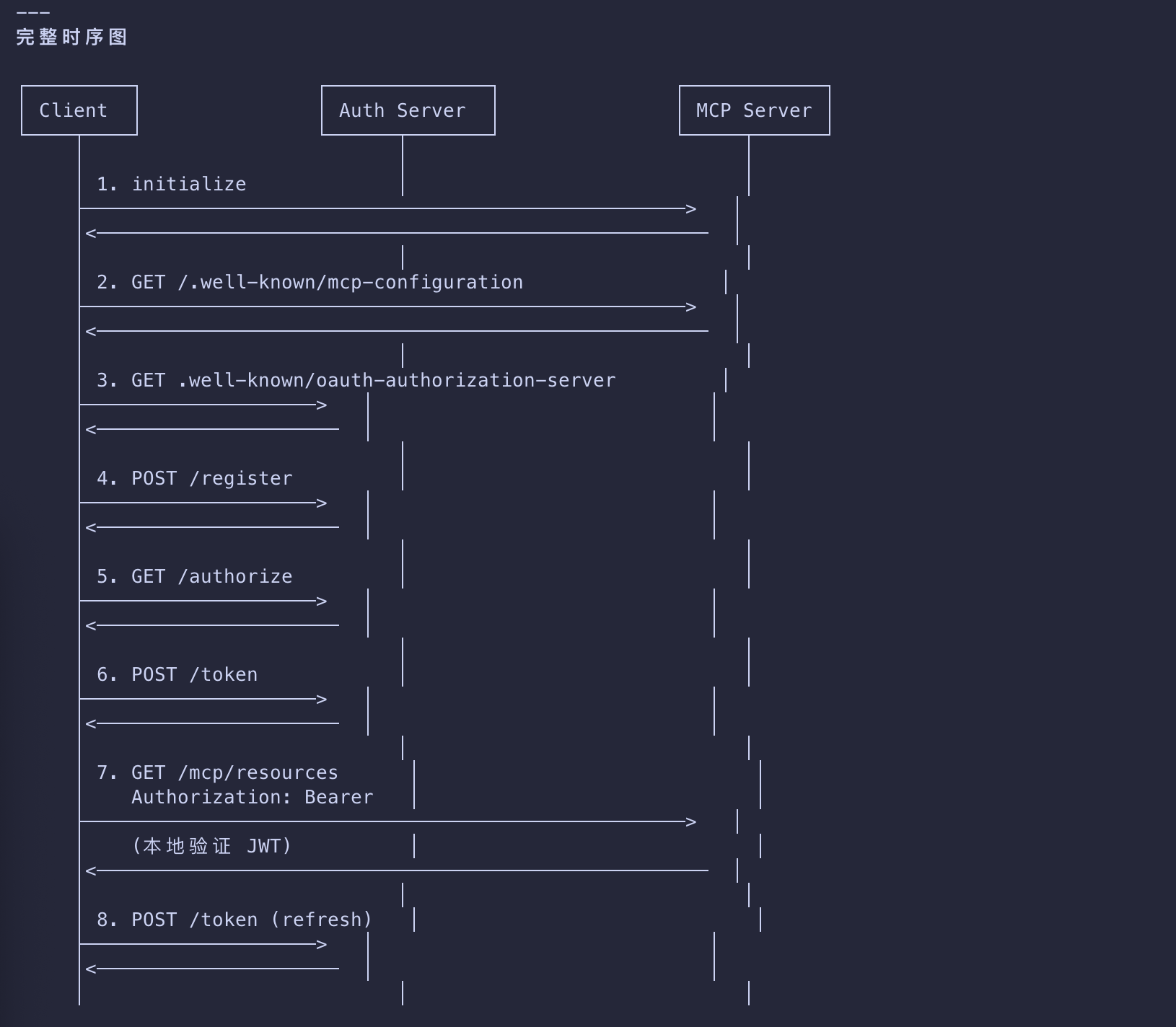
Let’s walk through what happens when a client wants to connect to your protected MCP server:
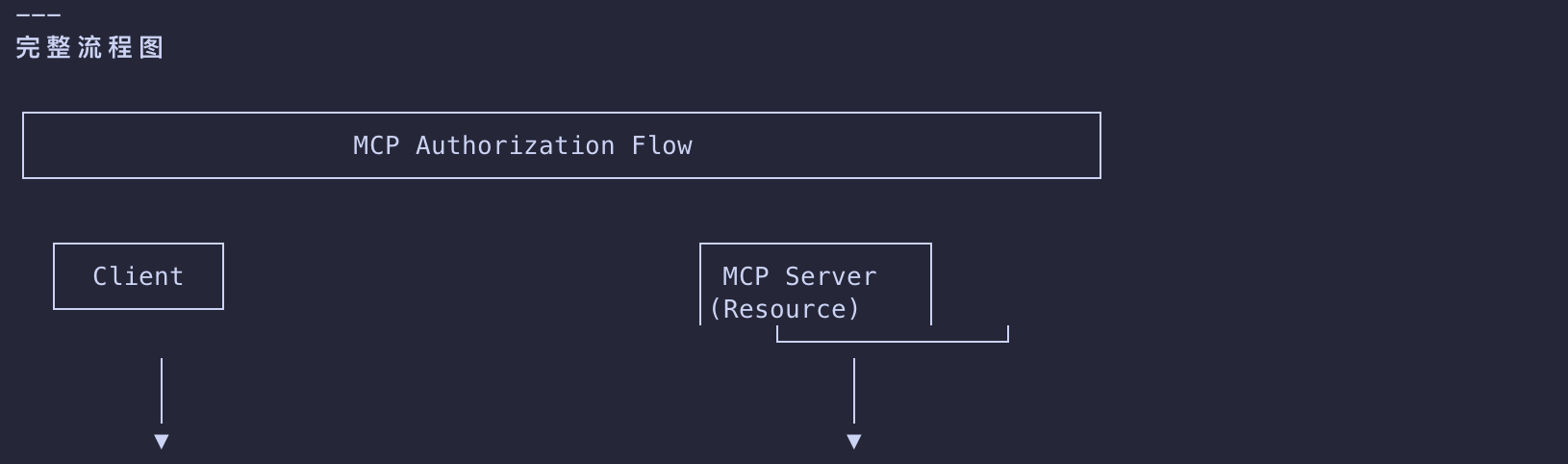
image-20260311100600414

image-20260311100648301

image-20260311100809161

image-20260311101003442

image-20260311101046858

image-20260311101143645

image-20260311101303245

image-20260311101342803

image-20260311101441007

image-20260311101523964

image-20260311101637948

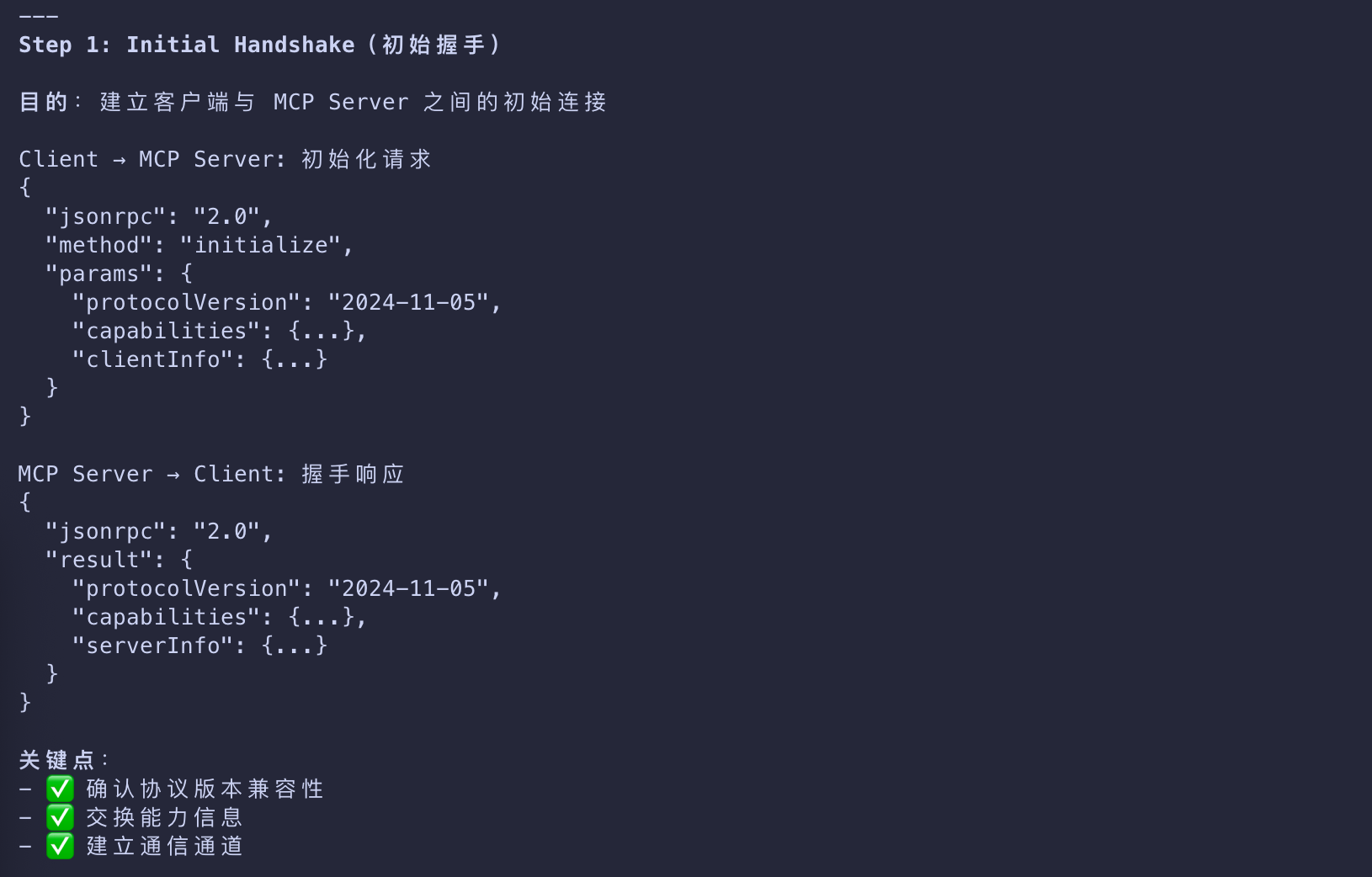
Initial Handshake

MCP(Model Context Protocol)服务器的 OAuth 2.0 授权流程初始握手阶段

  1. When your MCP client first tries to connect
  2. The document is hosted by the MCP server, follows a predictable path pattern
    • and is provided to the client in the resource_metadata parameter within the WWW-Authenticate header.
1
2
3
HTTP/1.1 401 Unauthorized
WWW-Authenticate: Bearer realm="mcp",
resource_metadata="https://your-server.com/.well-known/oauth-protected-resource"
  1. This tells the client that authorization is required for the MCP server
  2. and where to get the necessary information to kickstart the authorization flow.
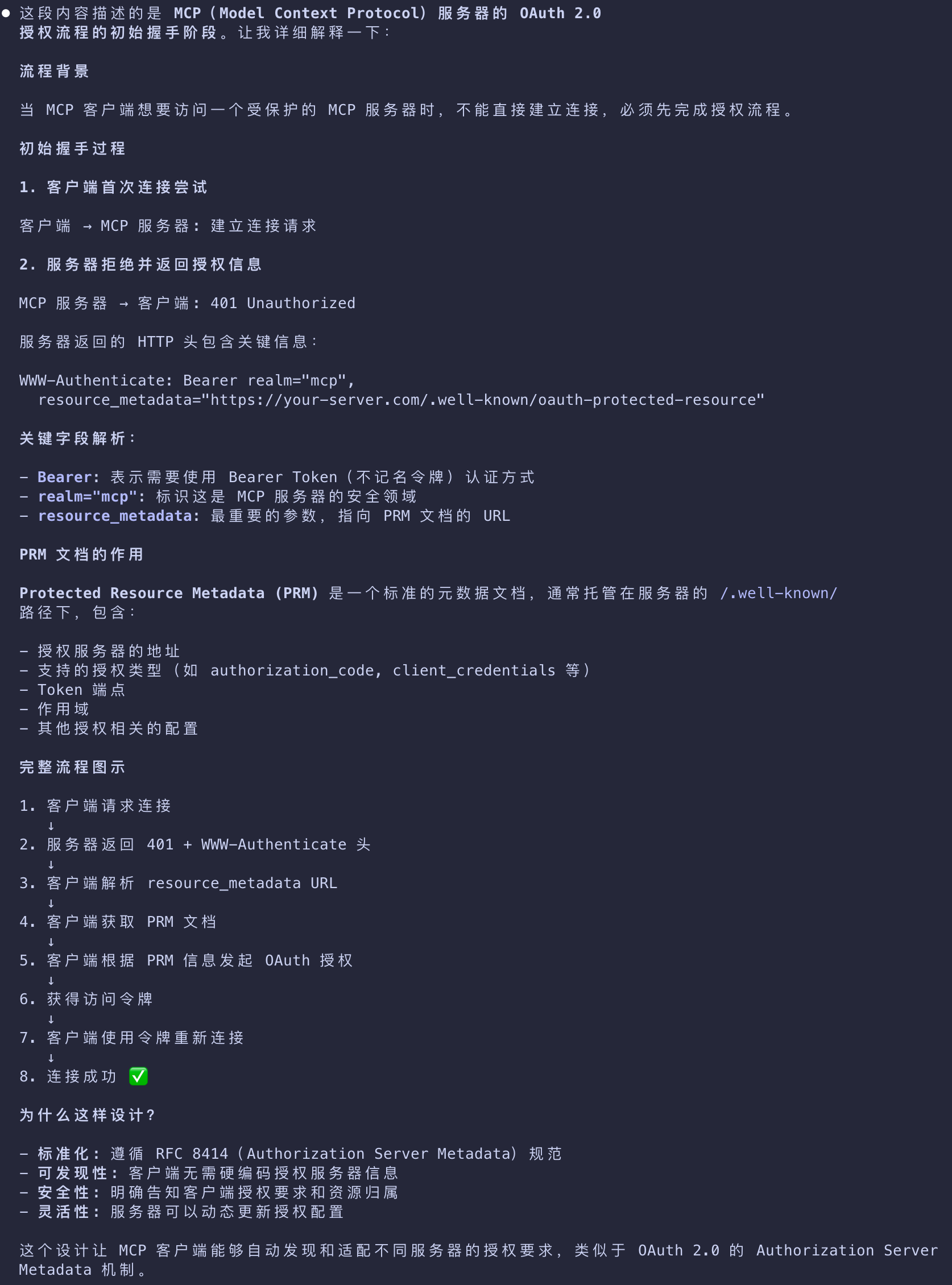
image-20260310195942760

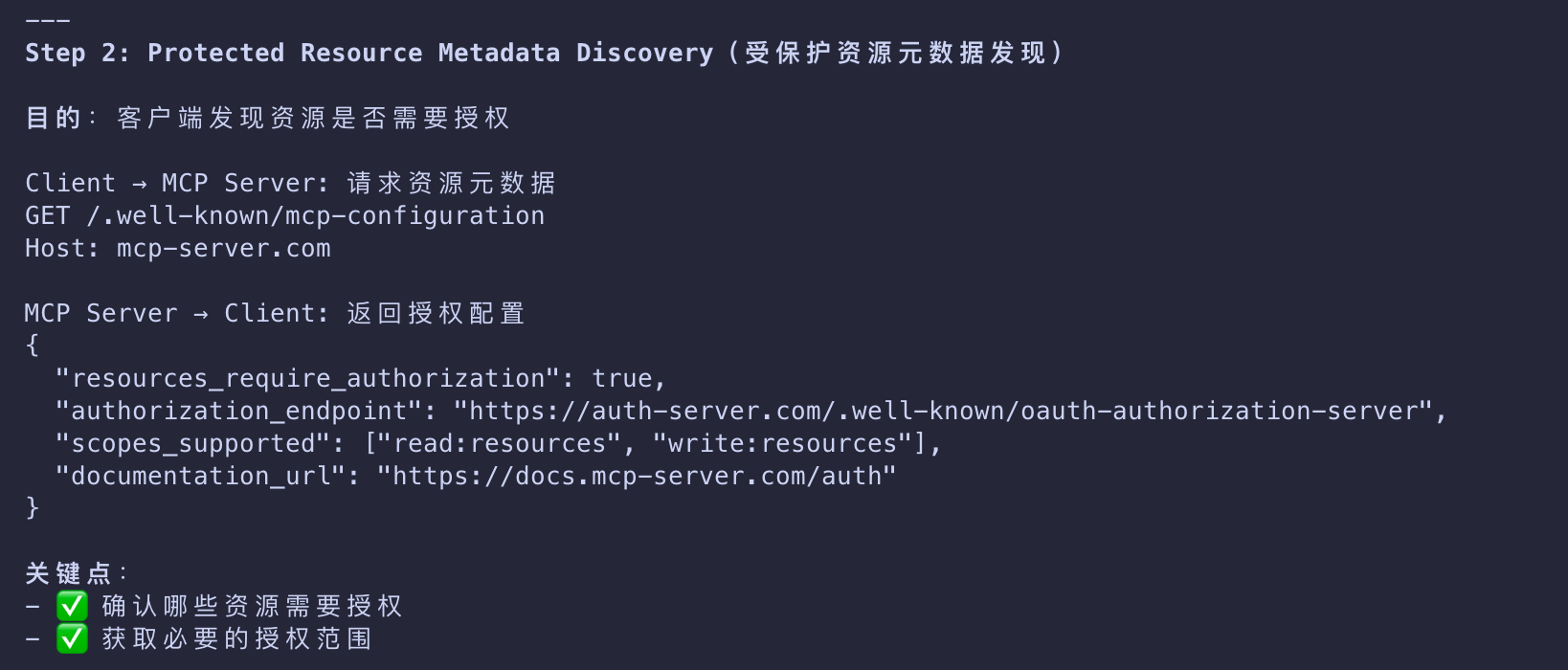
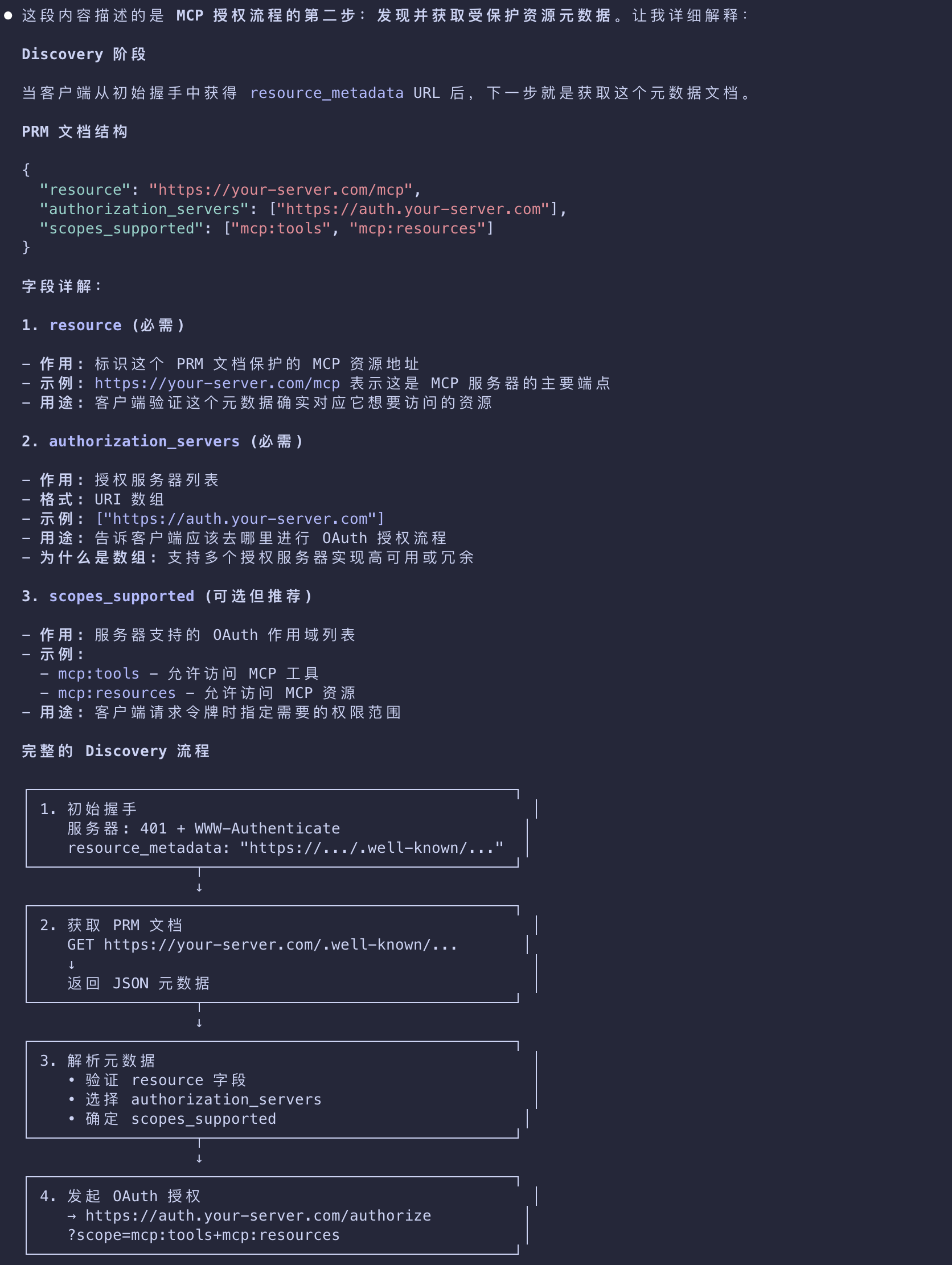
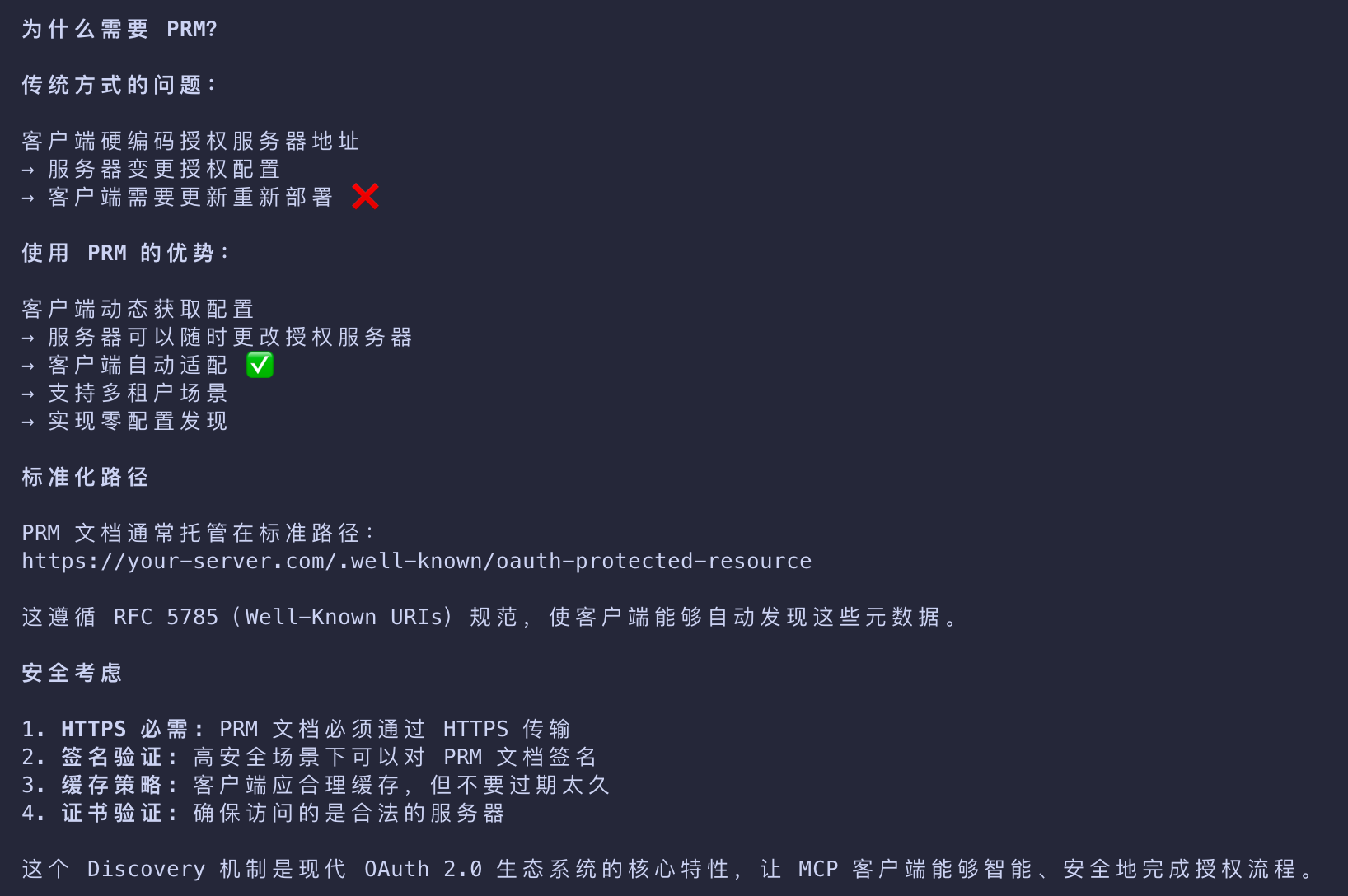
Protected Resource Metadata Discovery

发现并获取受保护资源元数据

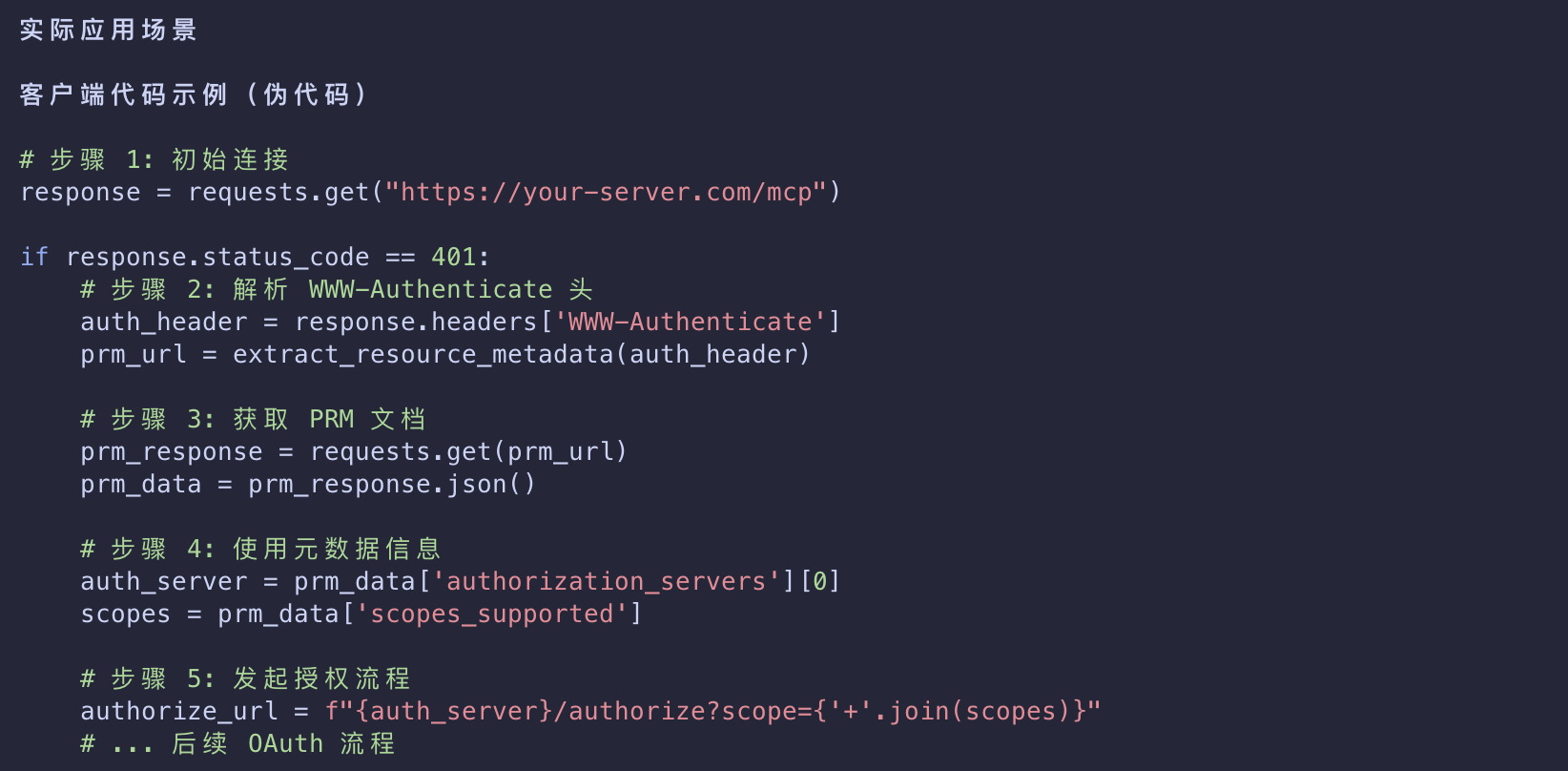
  1. With the URI pointer to the PRM document
    • the client will fetch the metadata to learn about
    • the authorization server, supported scopes, and other resource information.
  2. The data is typically encapsulated in a JSON blob, similar to the one below.
1
2
3
4
5
{
"resource": "https://your-server.com/mcp",
"authorization_servers": ["https://auth.your-server.com"],
"scopes_supported": ["mcp:tools", "mcp:resources"]
}

image-20260310200925266

image-20260310201111174

image-20260310201325710

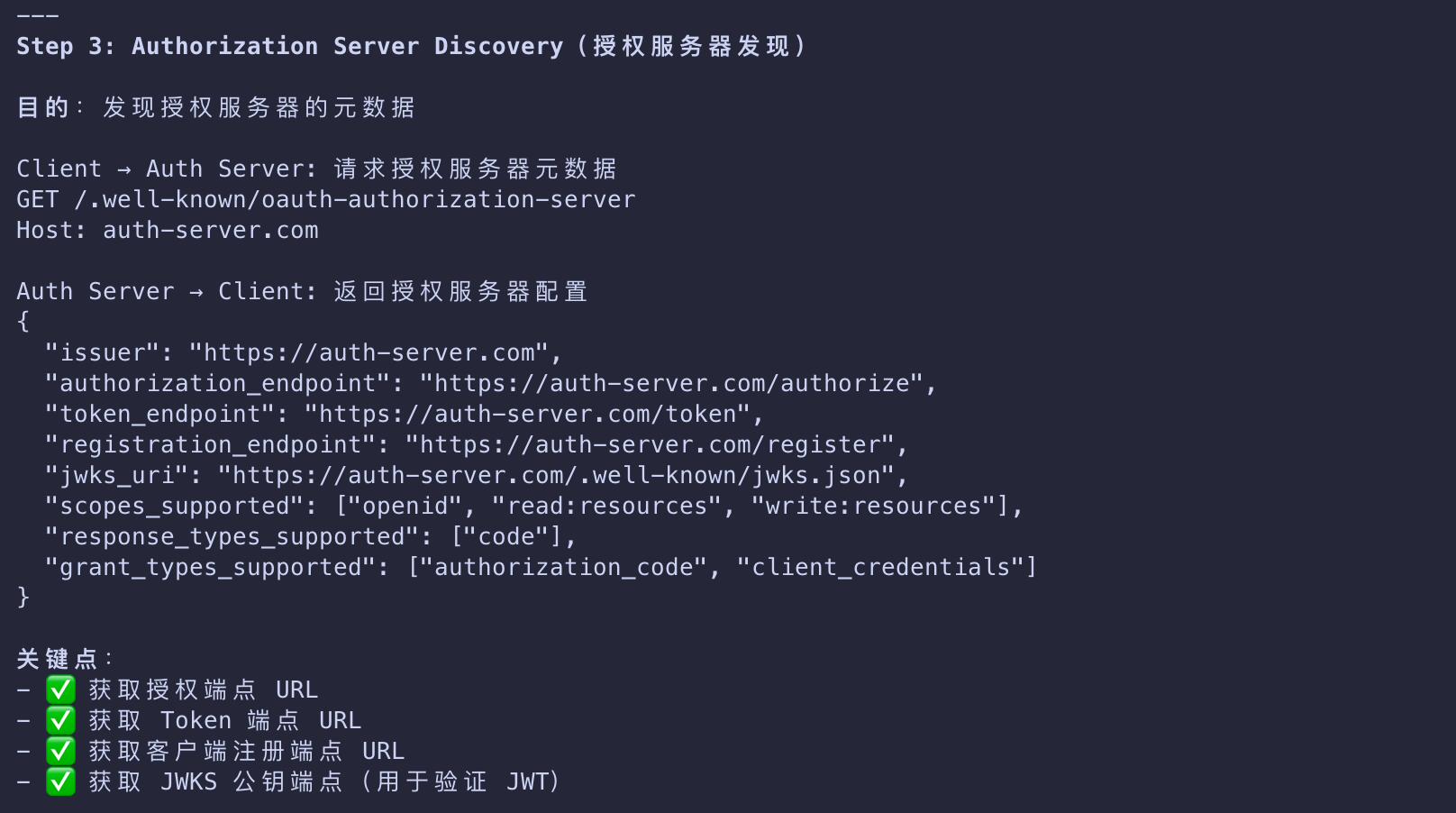
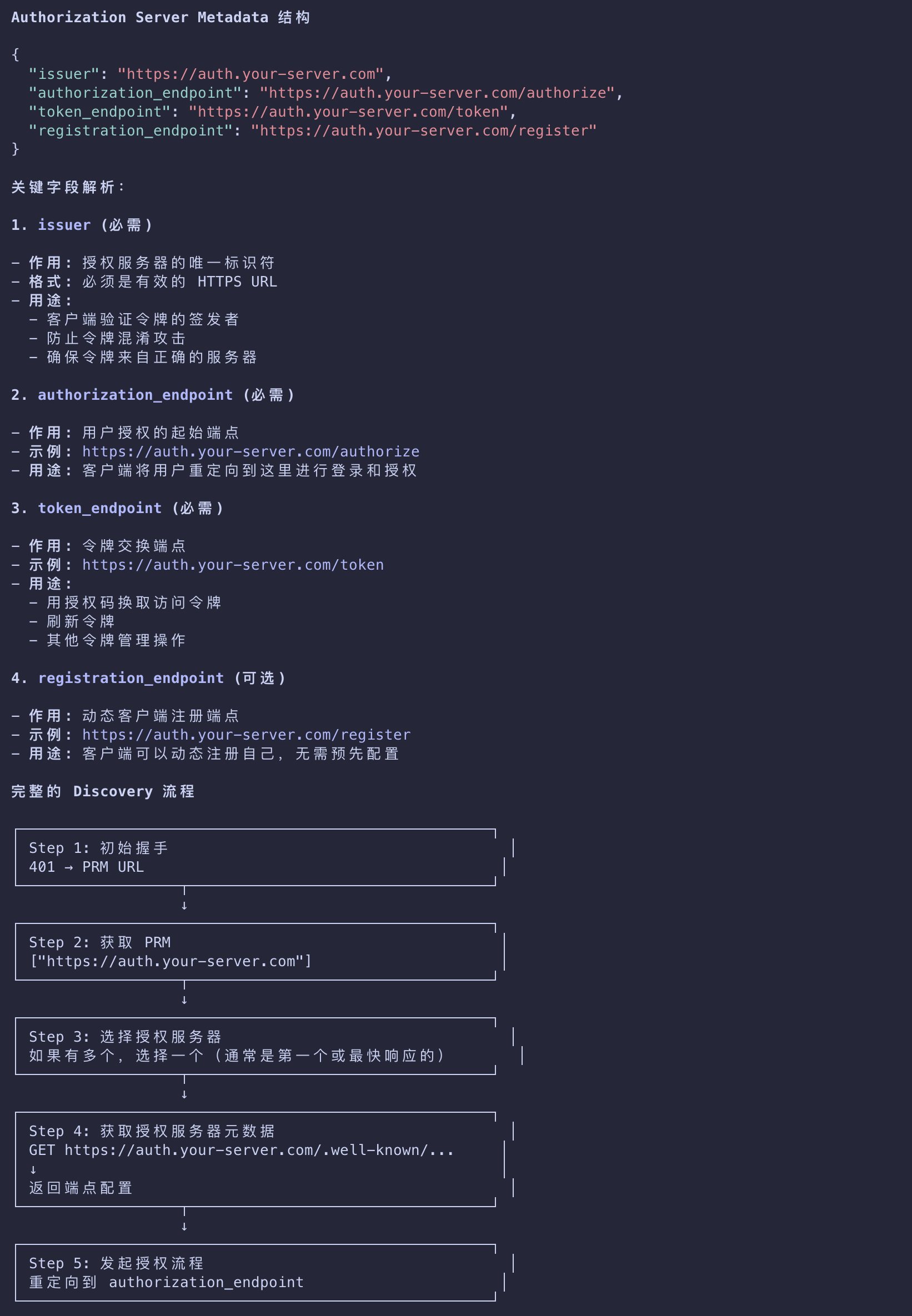
Authorization Server Discovery

发现授权服务器详细能力

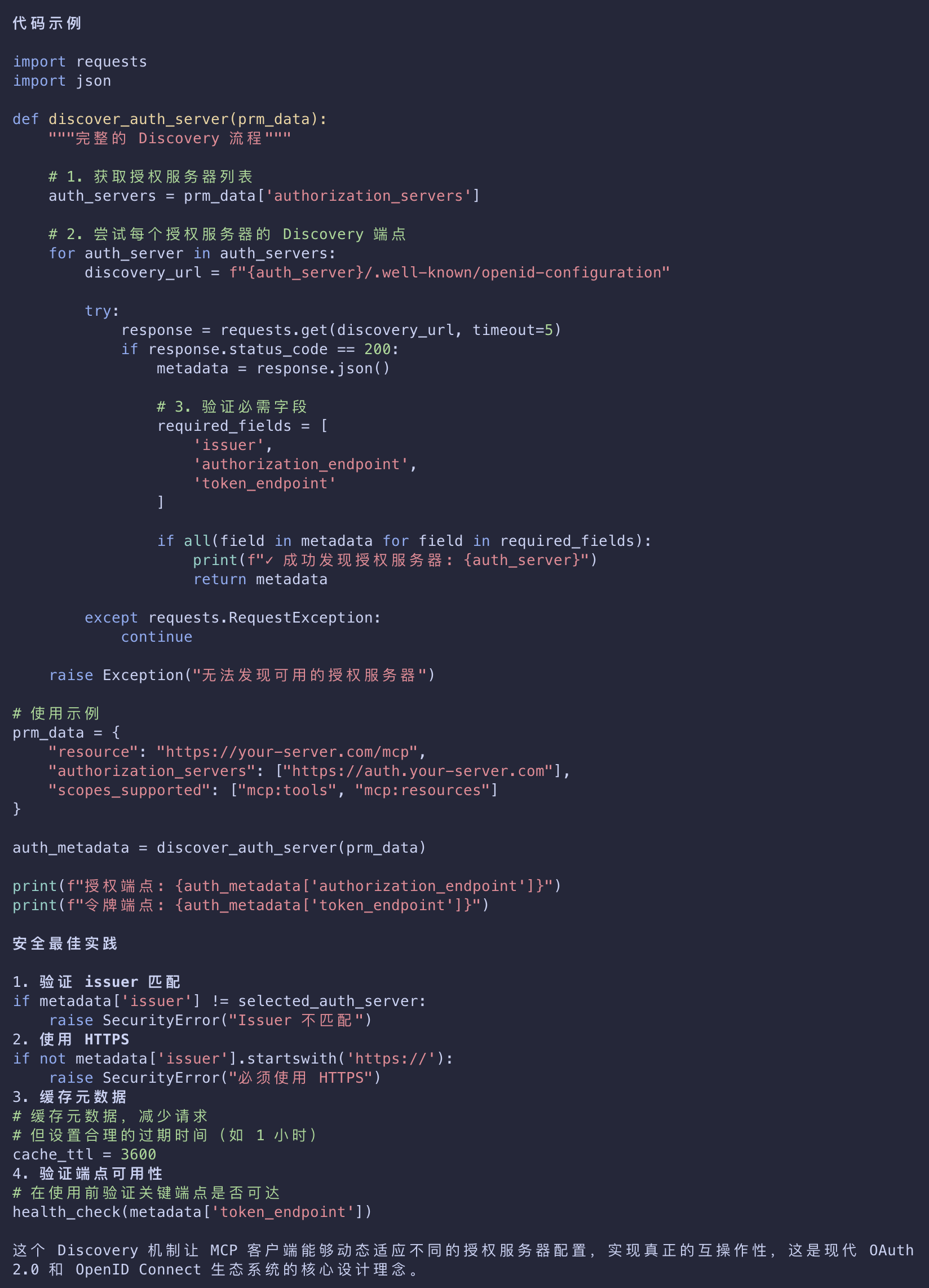
  1. Next, the client discovers what the authorization server can do by fetching its metadata.
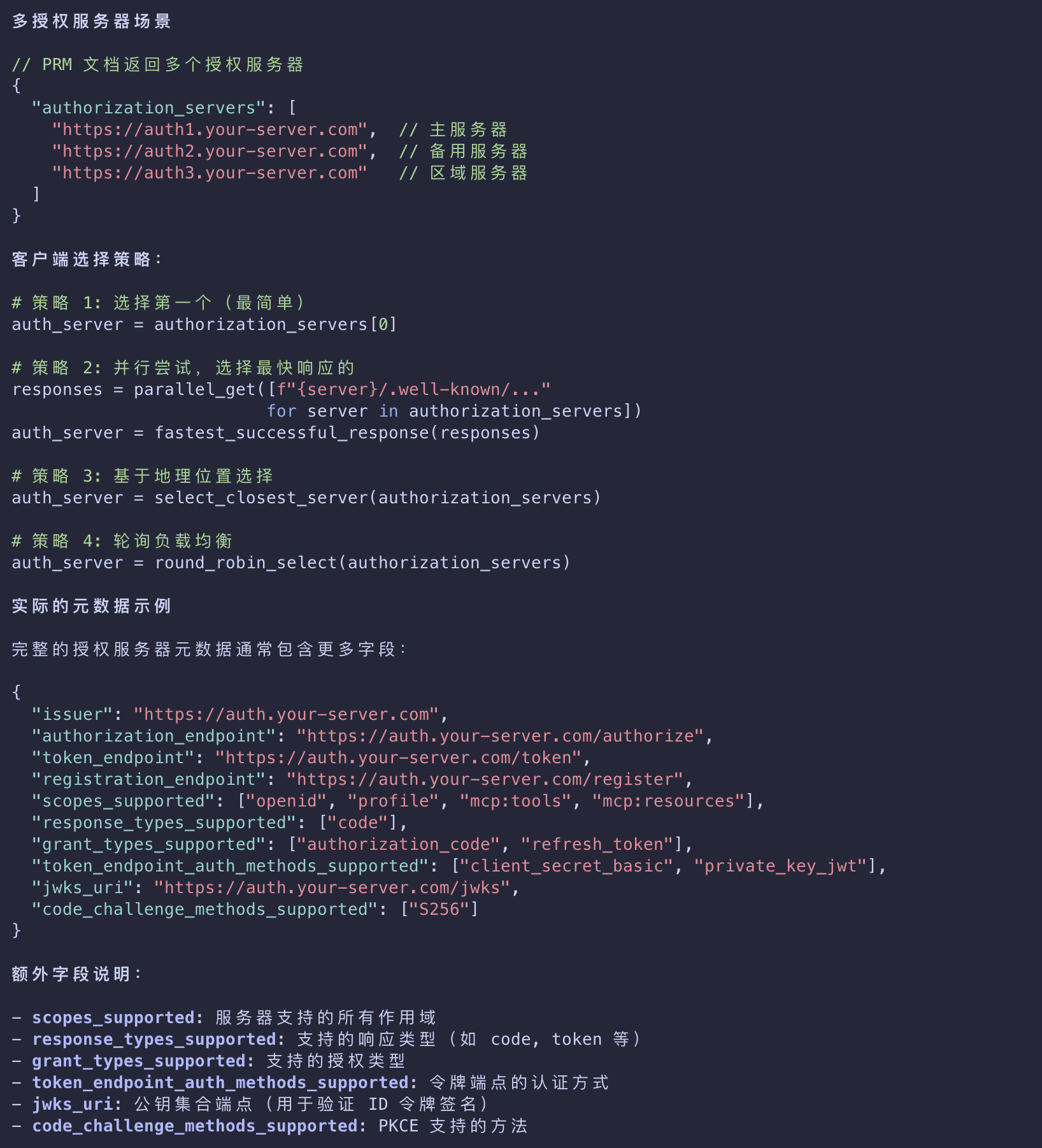
  2. If the PRM document lists more than one authorization server, the client can decide which one to use.
  3. With an authorization server selected
    • the client will then construct a standard metadata URI and issue a request to
    • the OpenID Connect (OIDC) Discovery or OAuth 2.0 Auth Server Metadata endpoints
      • depending on authorization server support
    • and retrieve another set of metadata properties
      • that will allow it to know the endpoints it needs to complete the authorization flow.
1
2
3
4
5
6
{
"issuer": "https://auth.your-server.com",
"authorization_endpoint": "https://auth.your-server.com/authorize",
"token_endpoint": "https://auth.your-server.com/token",
"registration_endpoint": "https://auth.your-server.com/register"
}

/.well-known/openid-configuration vs /.well-known/oauth-authorization-server
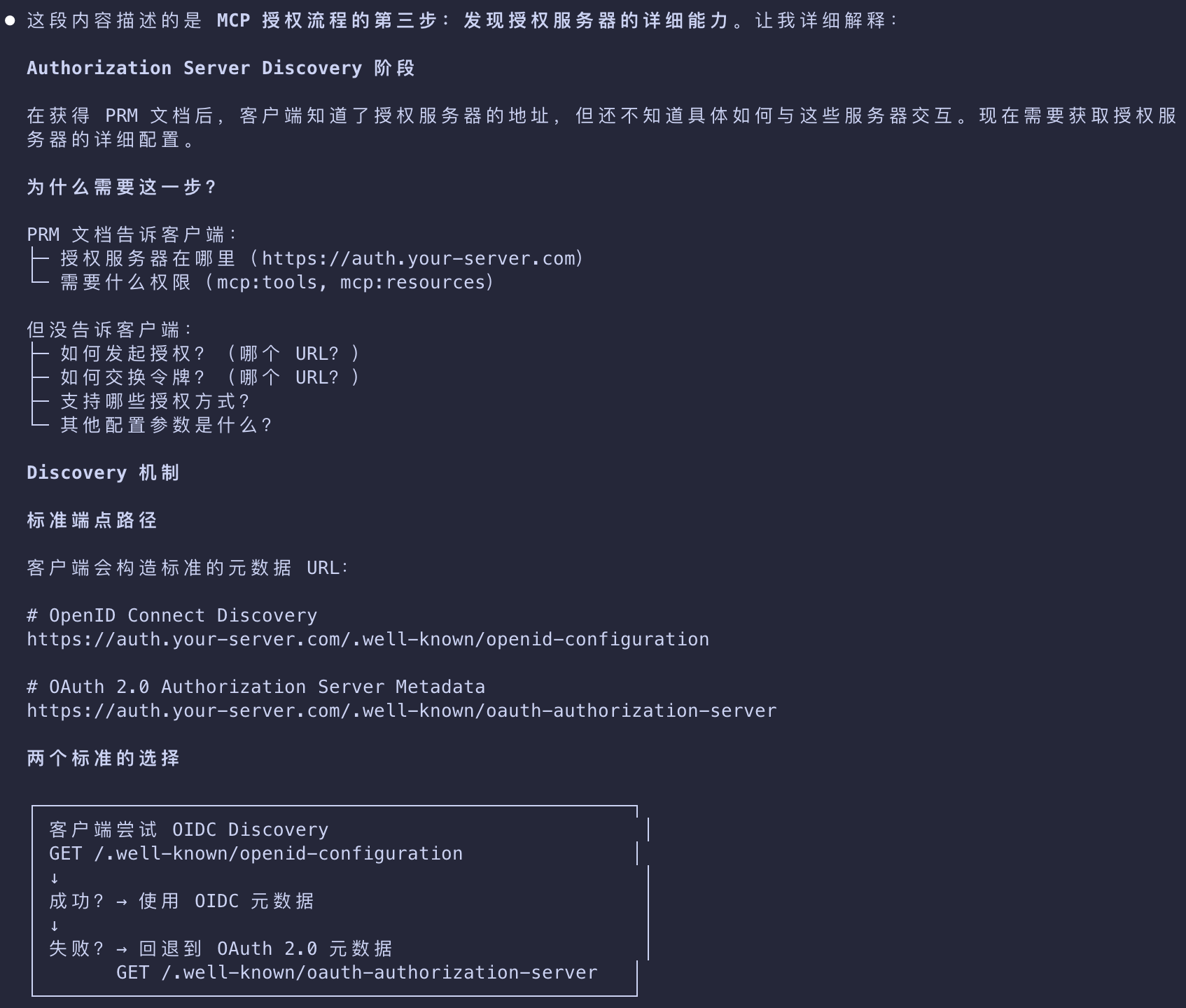
image-20260310202755315

image-20260310204445673

1
2
3
4
5
6
7
8
9
10
11
12
13
14
15
16
17
18
19
20
21
22
23
24
25
26
27
{
"issuer": "https://auth.your-server.com",
"authorization_endpoint": "https://auth.your-server.com/authorize",
"token_endpoint": "https://auth.your-server.com/token",
"registration_endpoint": "https://auth.your-server.com/register",
"scopes_supported": [
"openid",
"profile",
"mcp:tools",
"mcp:resources"
],
"response_types_supported": [
"code"
],
"grant_types_supported": [
"authorization_code",
"refresh_token"
],
"token_endpoint_auth_methods_supported": [
"client_secret_basic",
"private_key_jwt"
],
"jwks_uri": "https://auth.your-server.com/jwks",
"code_challenge_methods_supported": [
"S256"
]
}

image-20260310204900969

image-20260310205116229

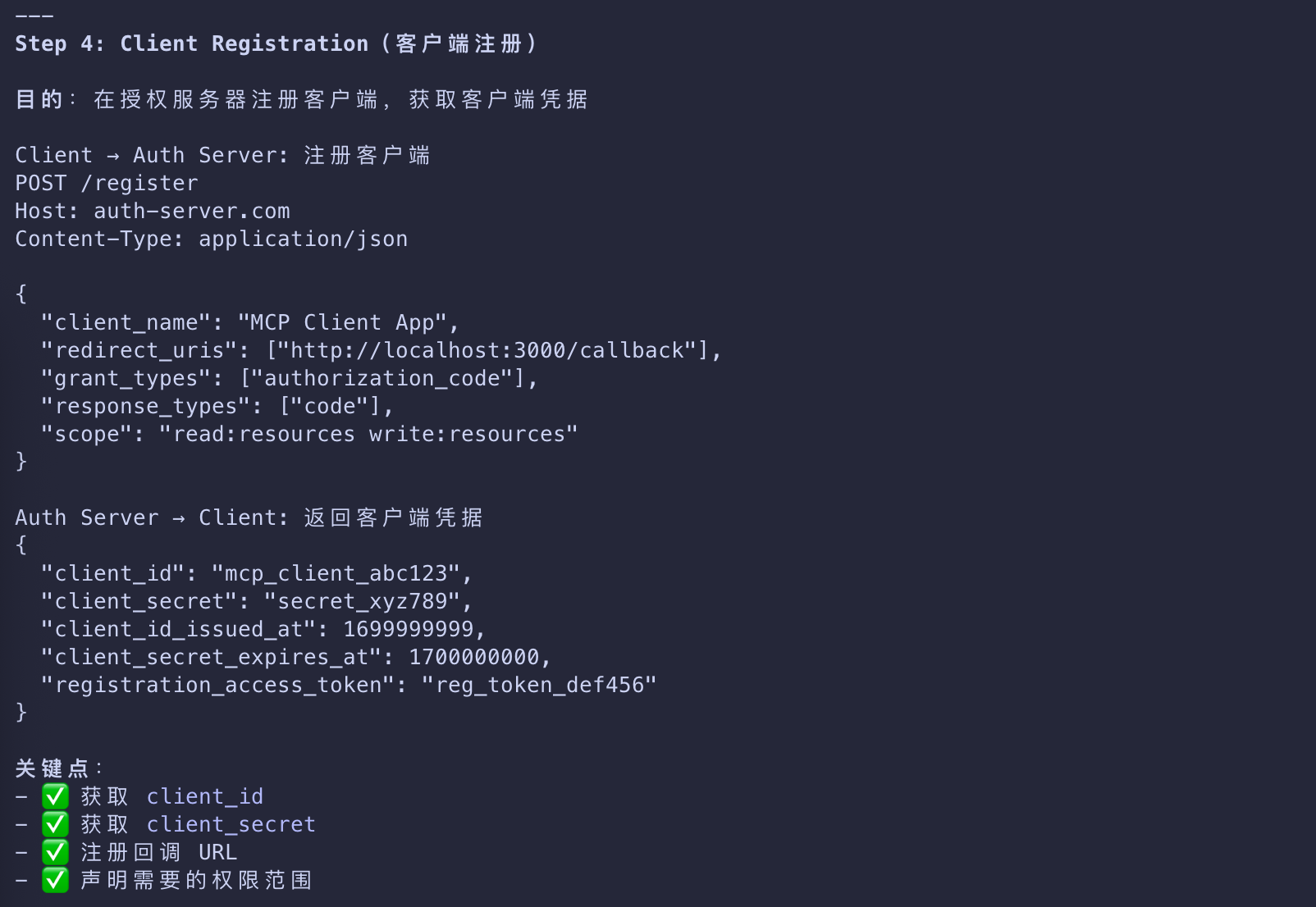
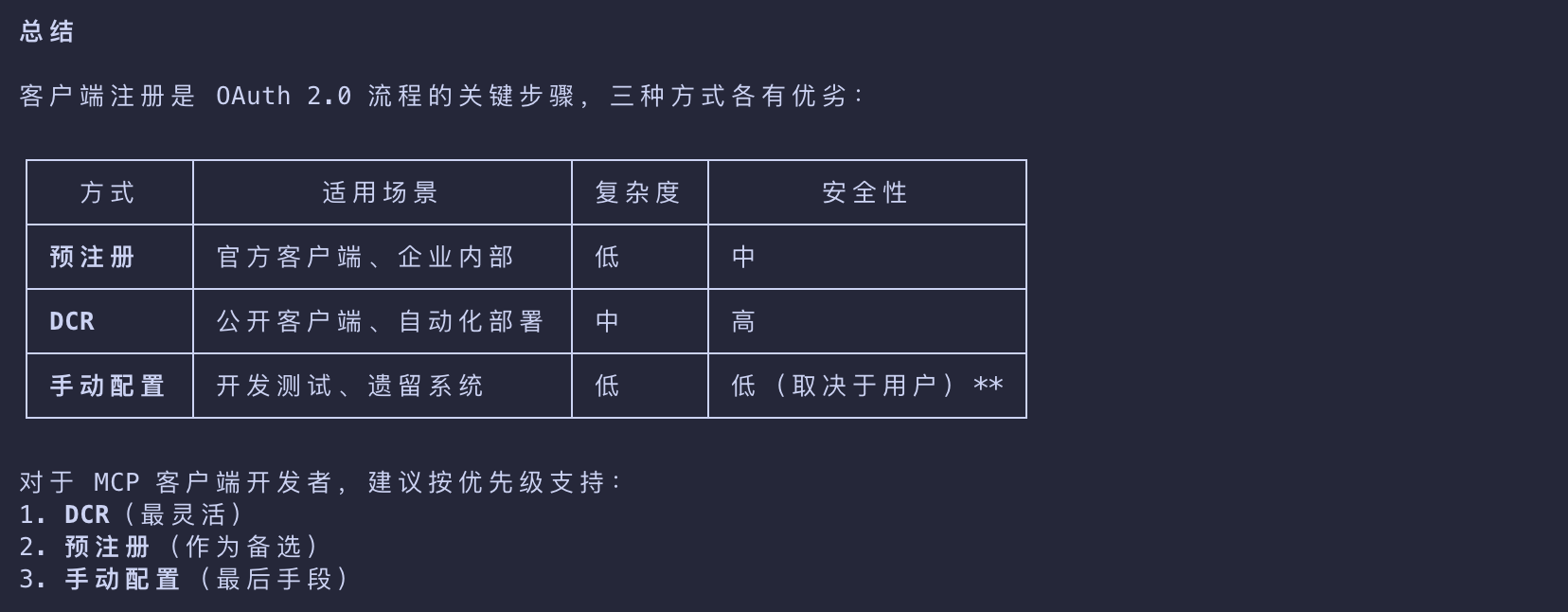
Client Registration

客户端注册 - MCP 客户端开发者

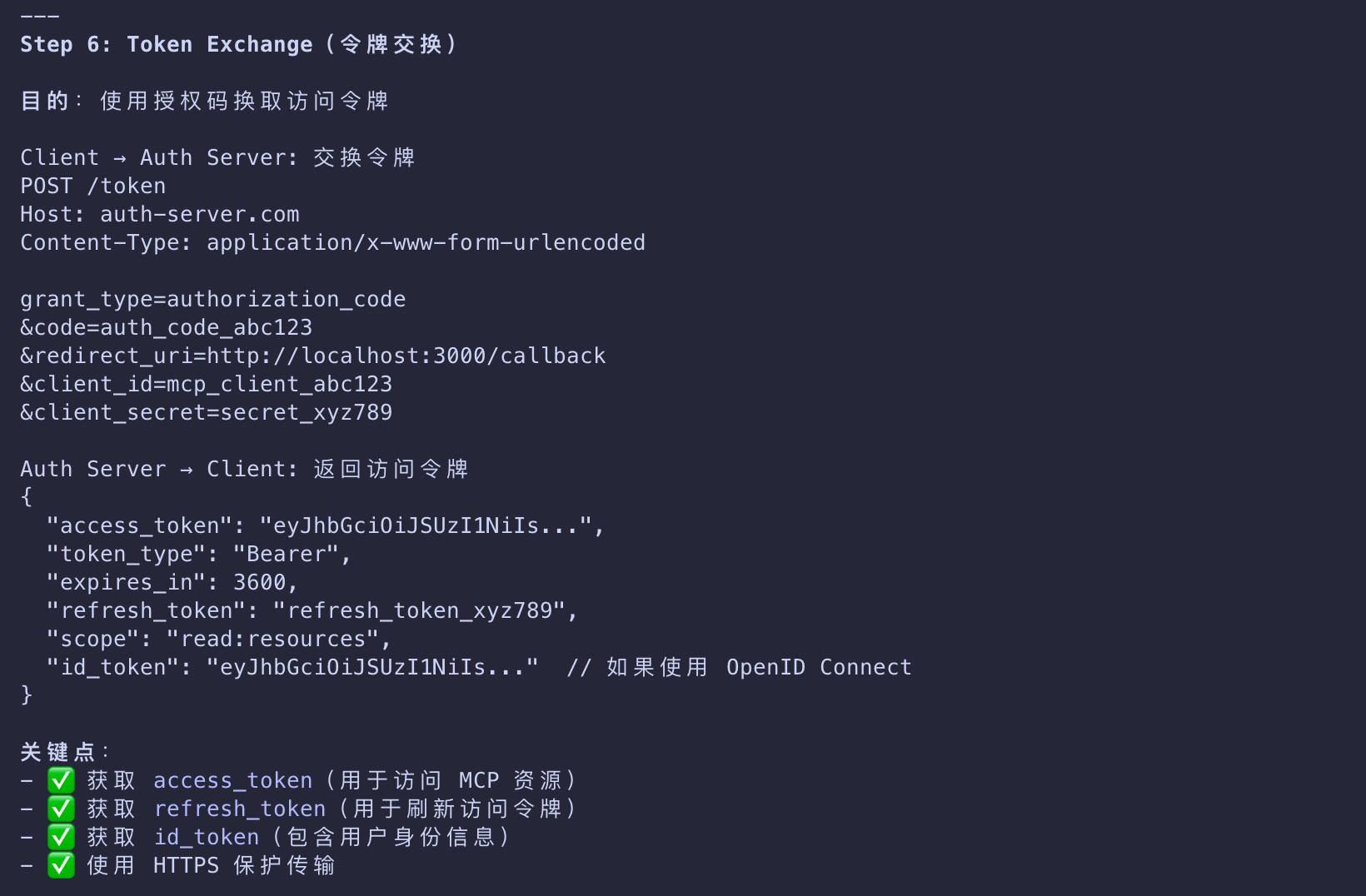
  1. With all the metadata out of the way, the client now needs to make sure that it’s registered with the authorization server.
  2. This can be done in two ways - pre-registered or Dynamic Client Registration
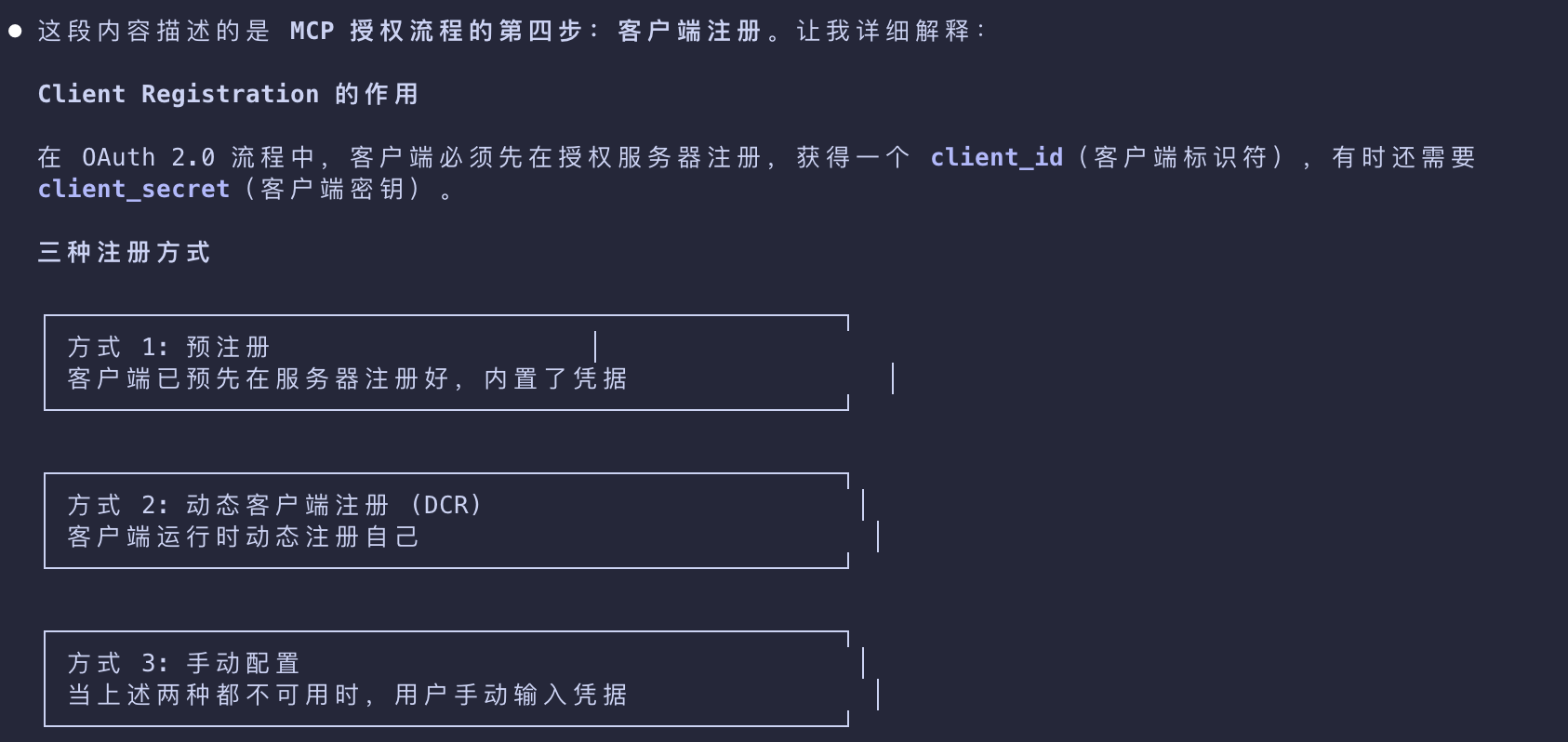
image-20260310220122769

image-20260310221213428

pre-registered

  1. First, the client can be pre-registered with a given authorization server
  2. in which case it can have embedded client registration information that it uses to complete the authorization flow.

授权服务器可以完全控制客户端列表
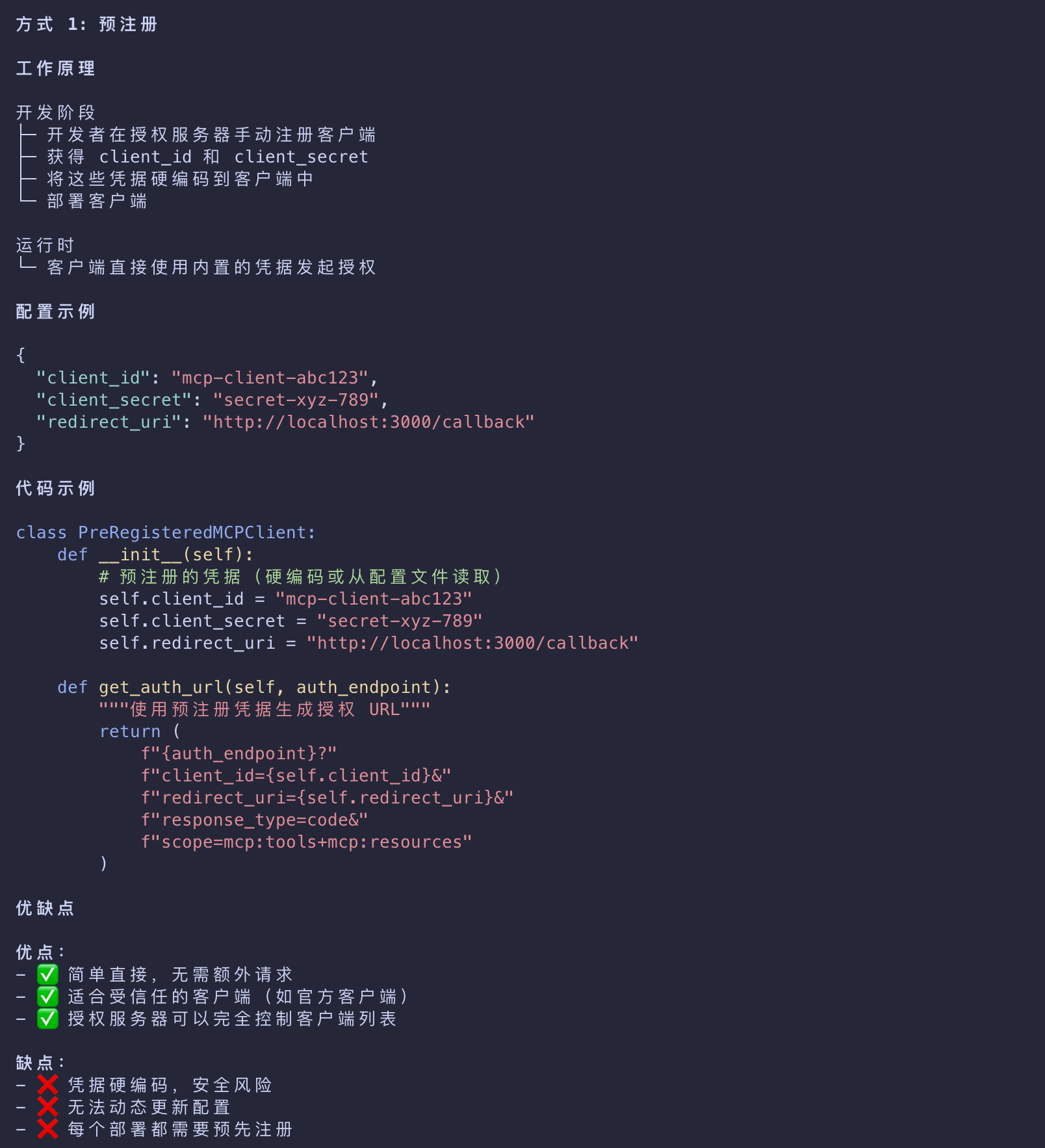
image-20260310220329007

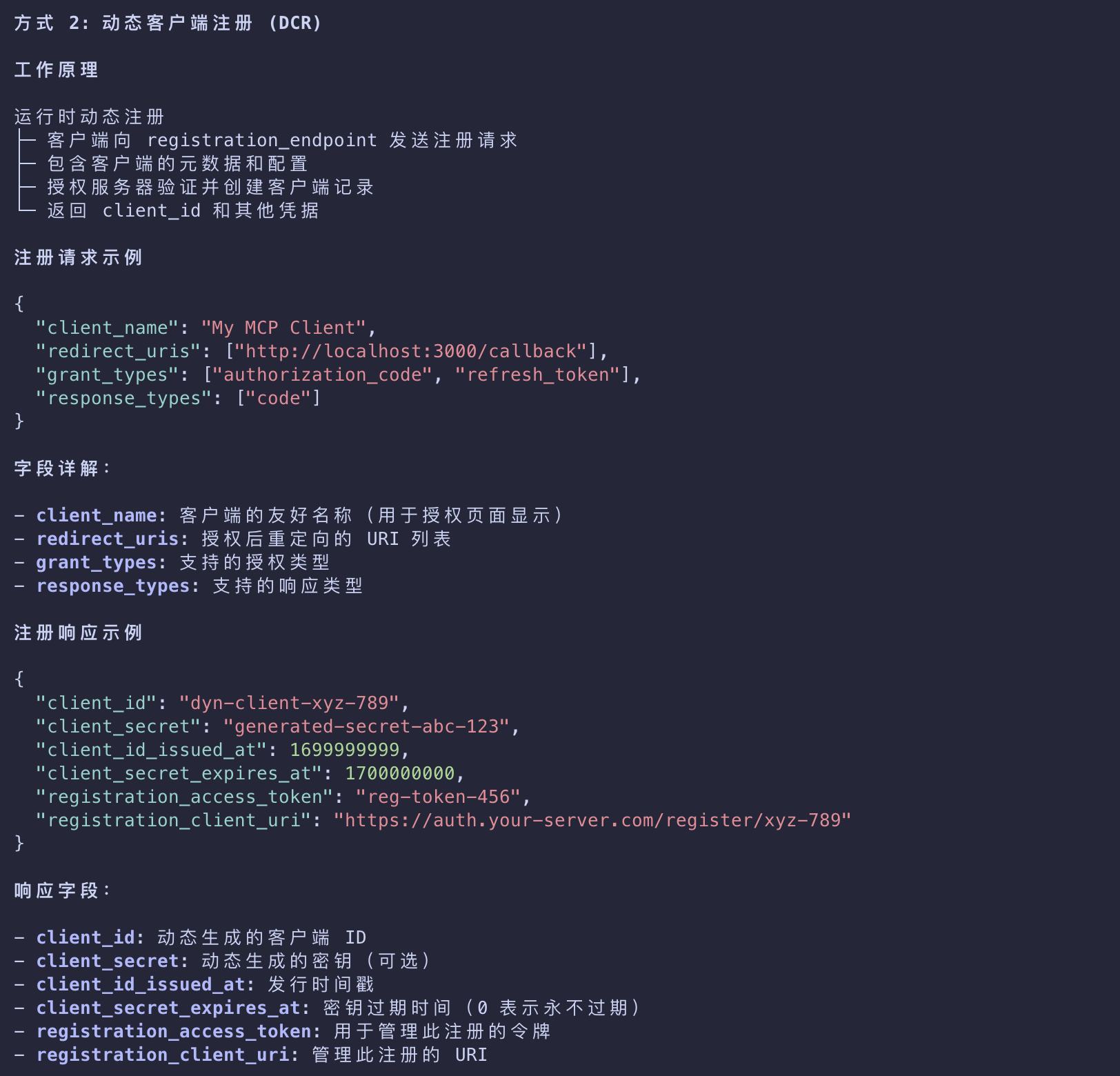
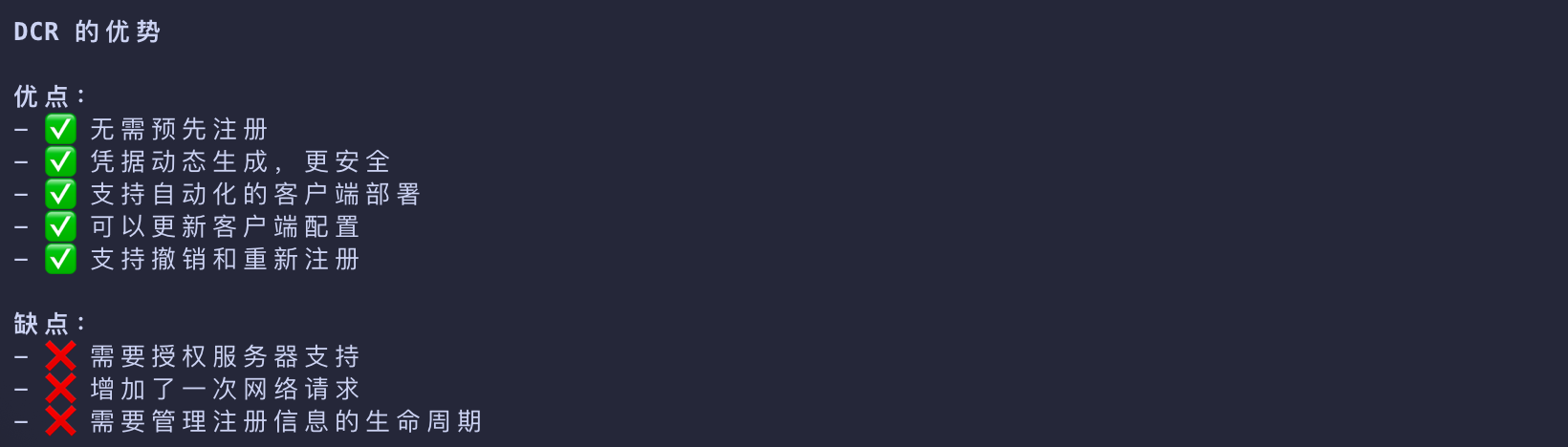
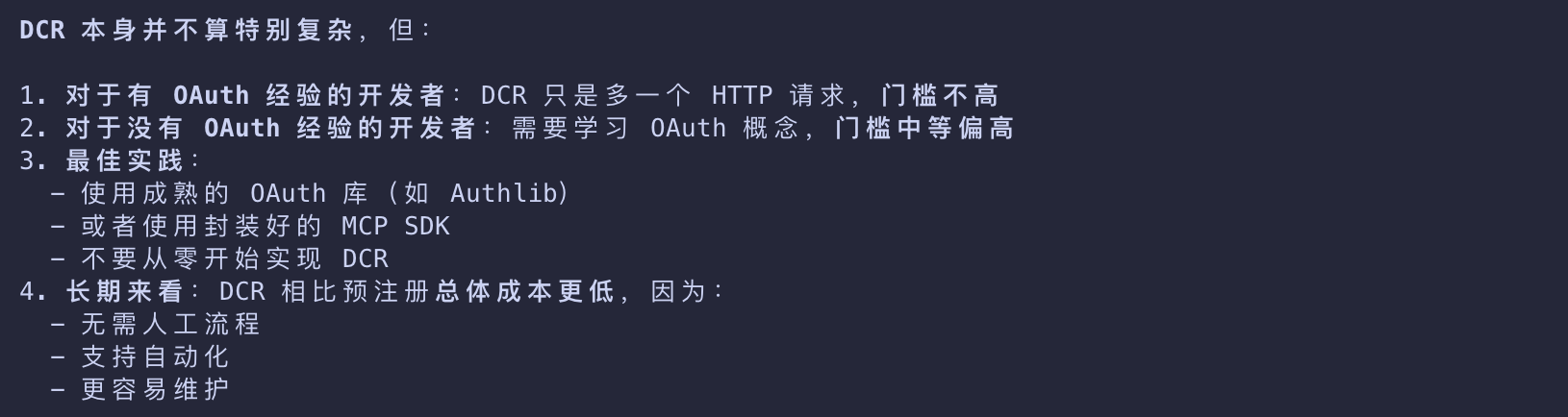
Dynamic Client Registration

  1. Alternatively, the client can use Dynamic Client Registration (DCR) to dynamically register itself with the authorization server.
  2. The latter scenario requires the authorization server to support DCR.
  3. If the authorization server does support DCR, the client will send a request to the registration_endpoint with its information
  4. If the registration succeeds, the authorization server will return a JSON blob with client registration information.
1
2
3
4
5
6
{
"client_name": "My MCP Client",
"redirect_uris": ["http://localhost:3000/callback"],
"grant_types": ["authorization_code", "refresh_token"],
"response_types": ["code"]
}

image-20260310220909215

image-20260310221011260

image-20260310221654820

No DCR or Pre-Registration

  1. In case an MCP client connects to an MCP server
    • that doesn’t use an authorization server that supports DCR
    • and the client is not pre-registered with said authorization server
  2. it’s the responsibility of the client developer to provide an affordance for the end-user to enter client information manually.
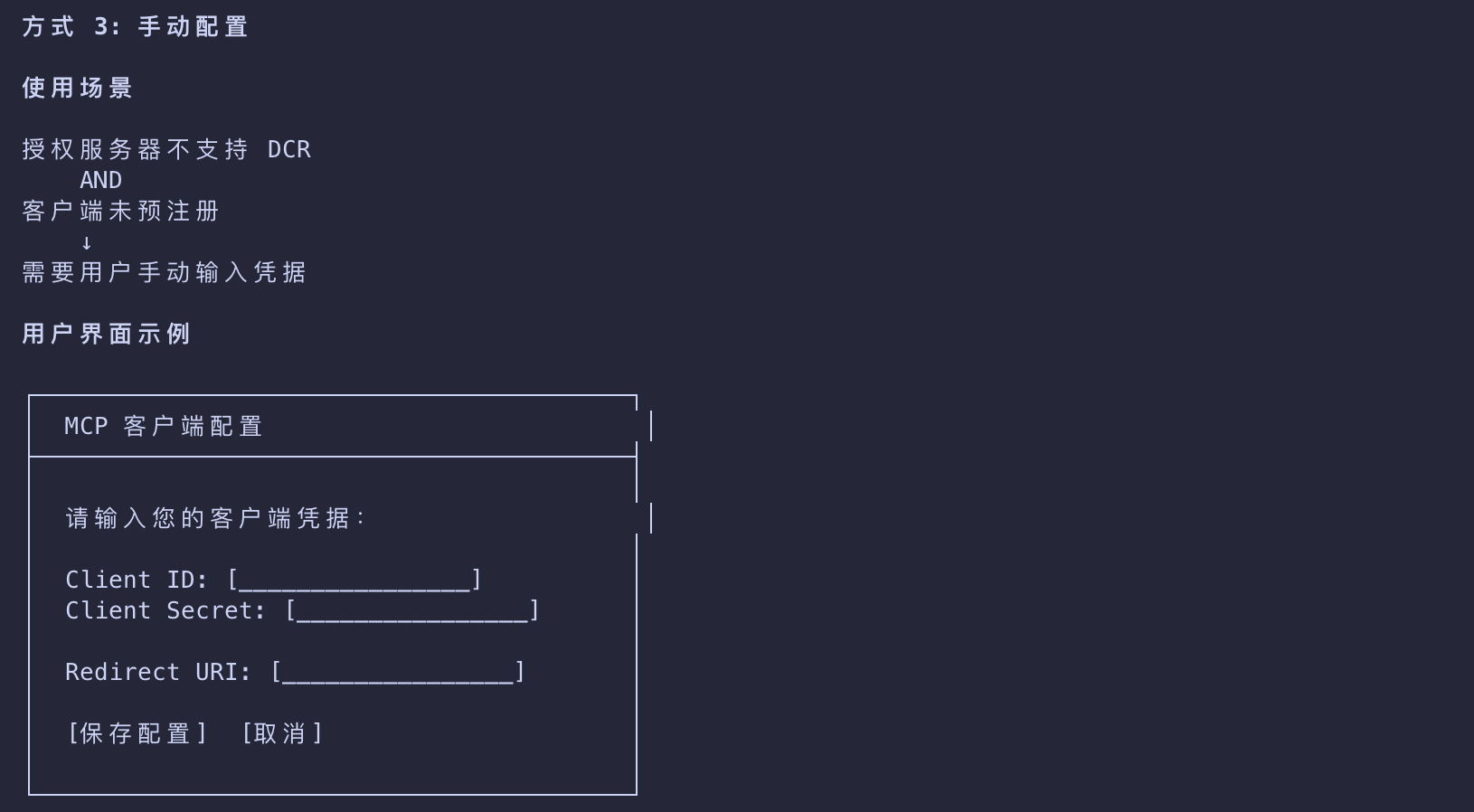
image-20260310221044330

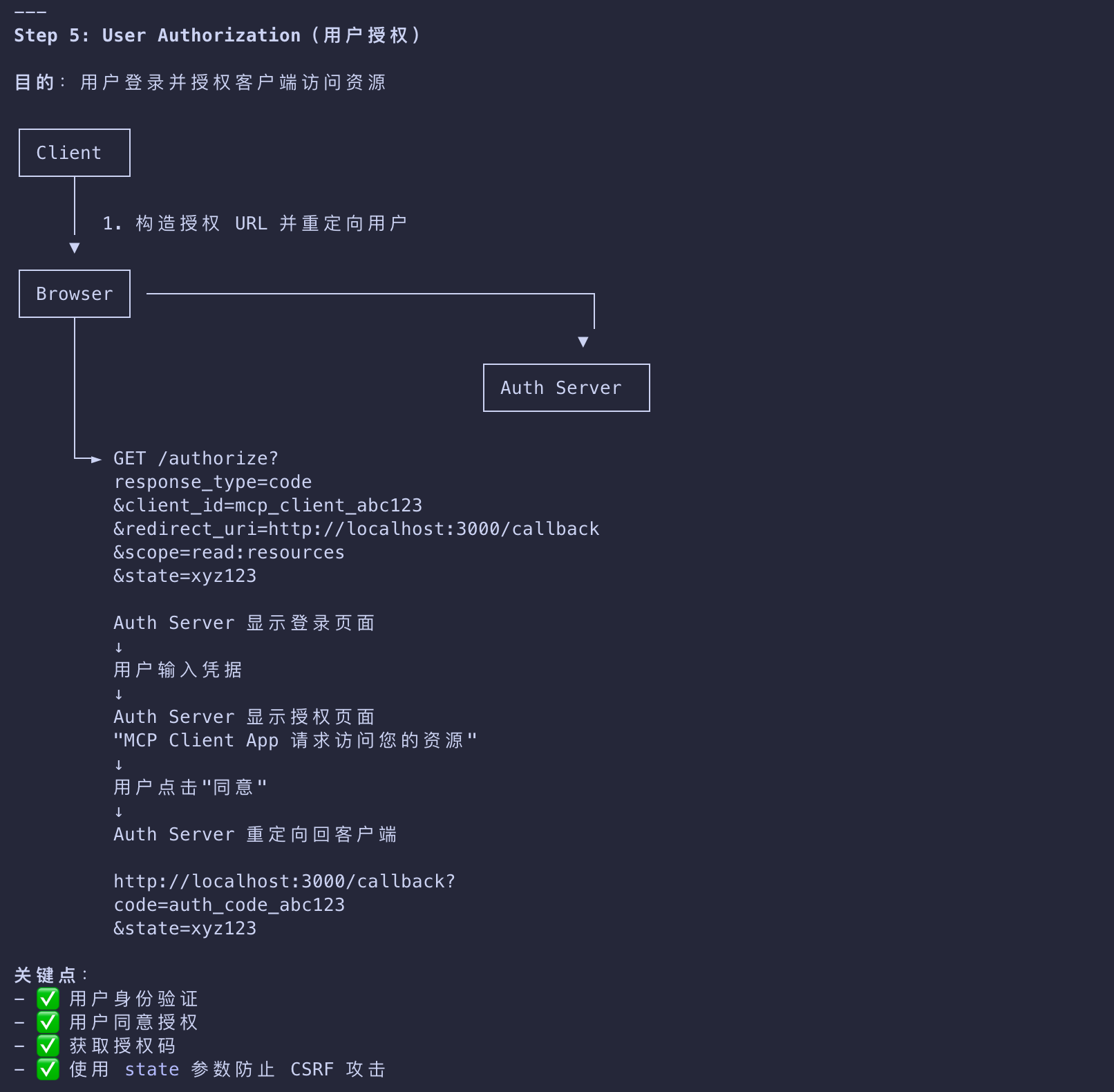
User Authorization

用户授权令牌获取

  1. The client will now need to open a browser to the /authorize endpoint
    • where the user can log in and grant the required permissions.
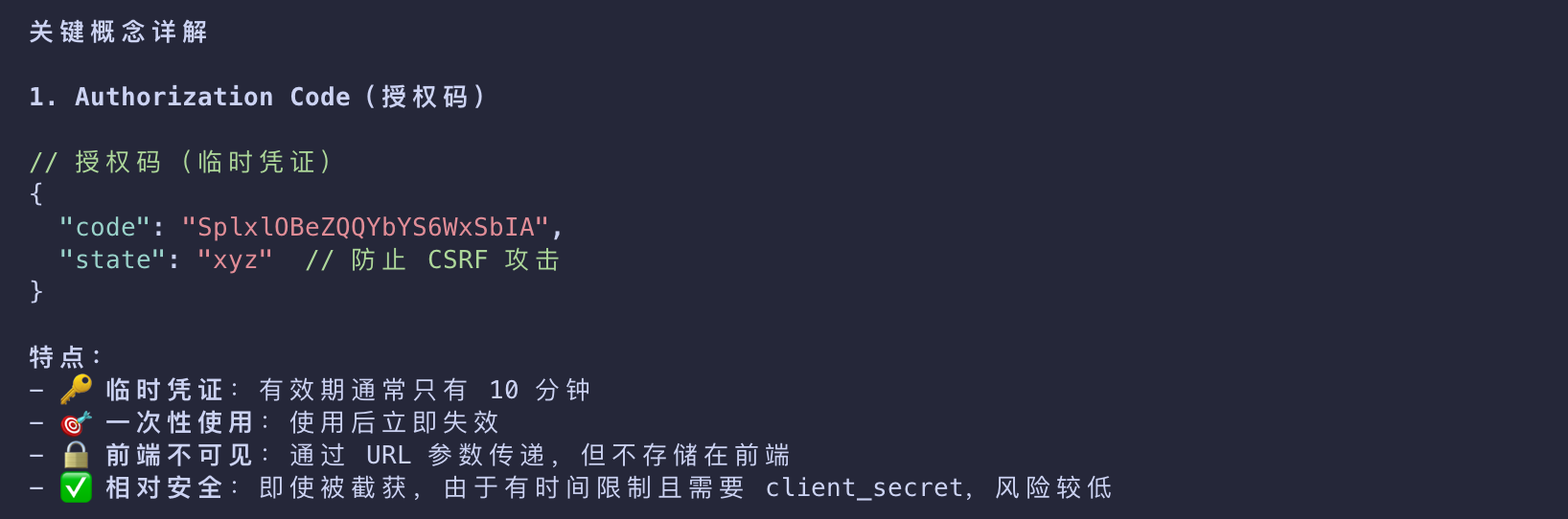
  2. The authorization server will then redirect back to the client with an authorization code
    • that the client exchanges for tokens
1
2
3
4
5
6
{
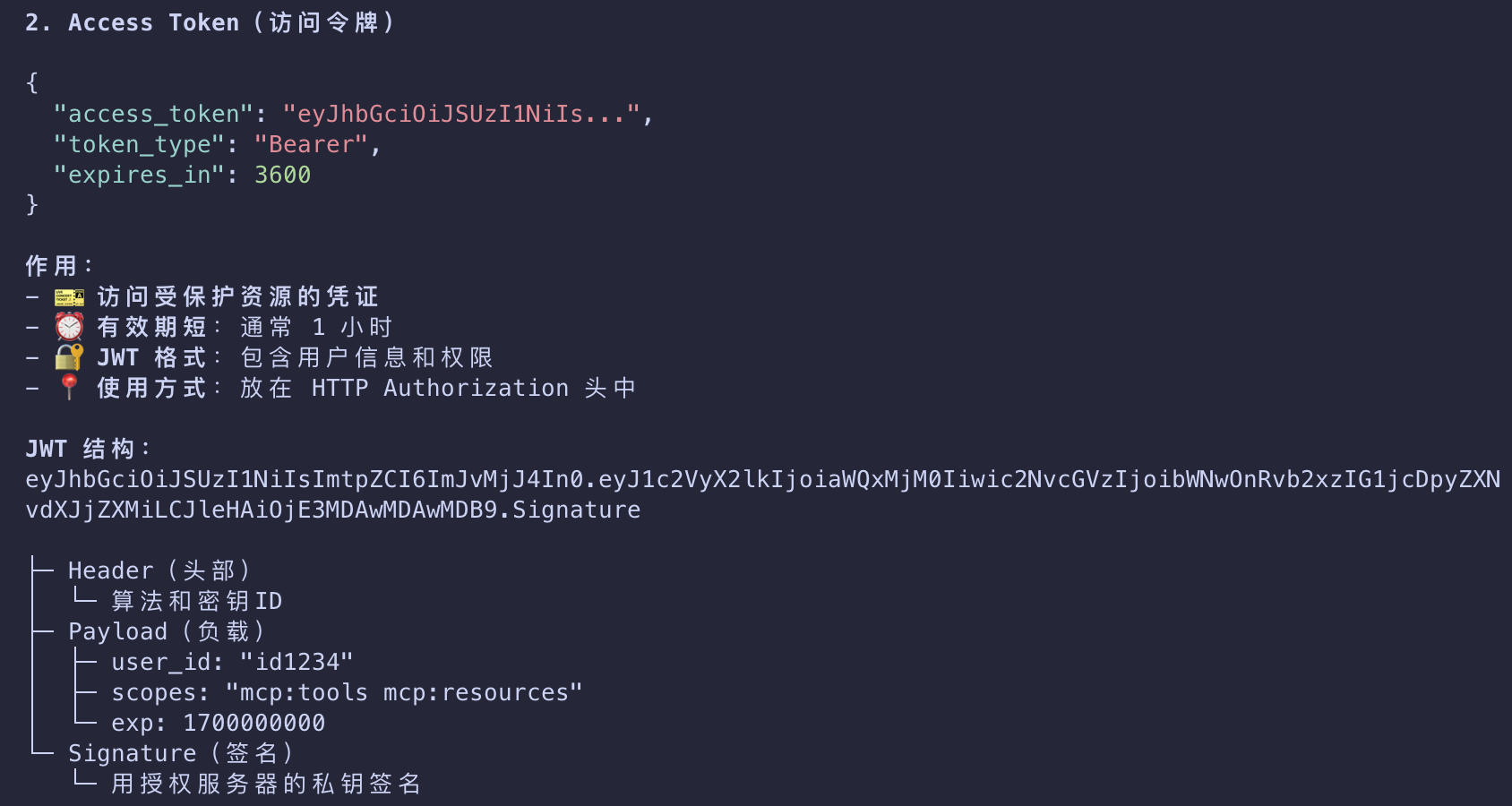
"access_token": "eyJhbGciOiJSUzI1NiIs...",
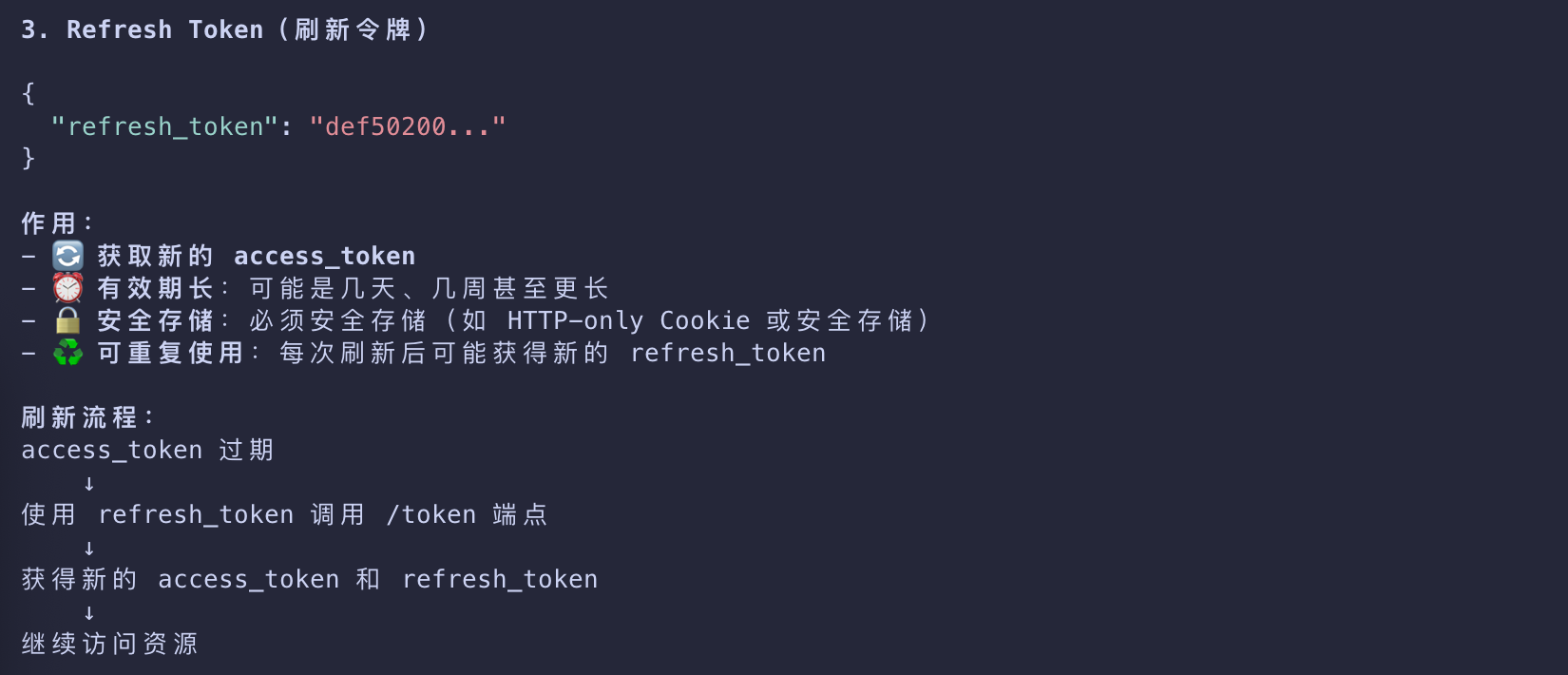
"refresh_token": "def502...",
"token_type": "Bearer",
"expires_in": 3600
}
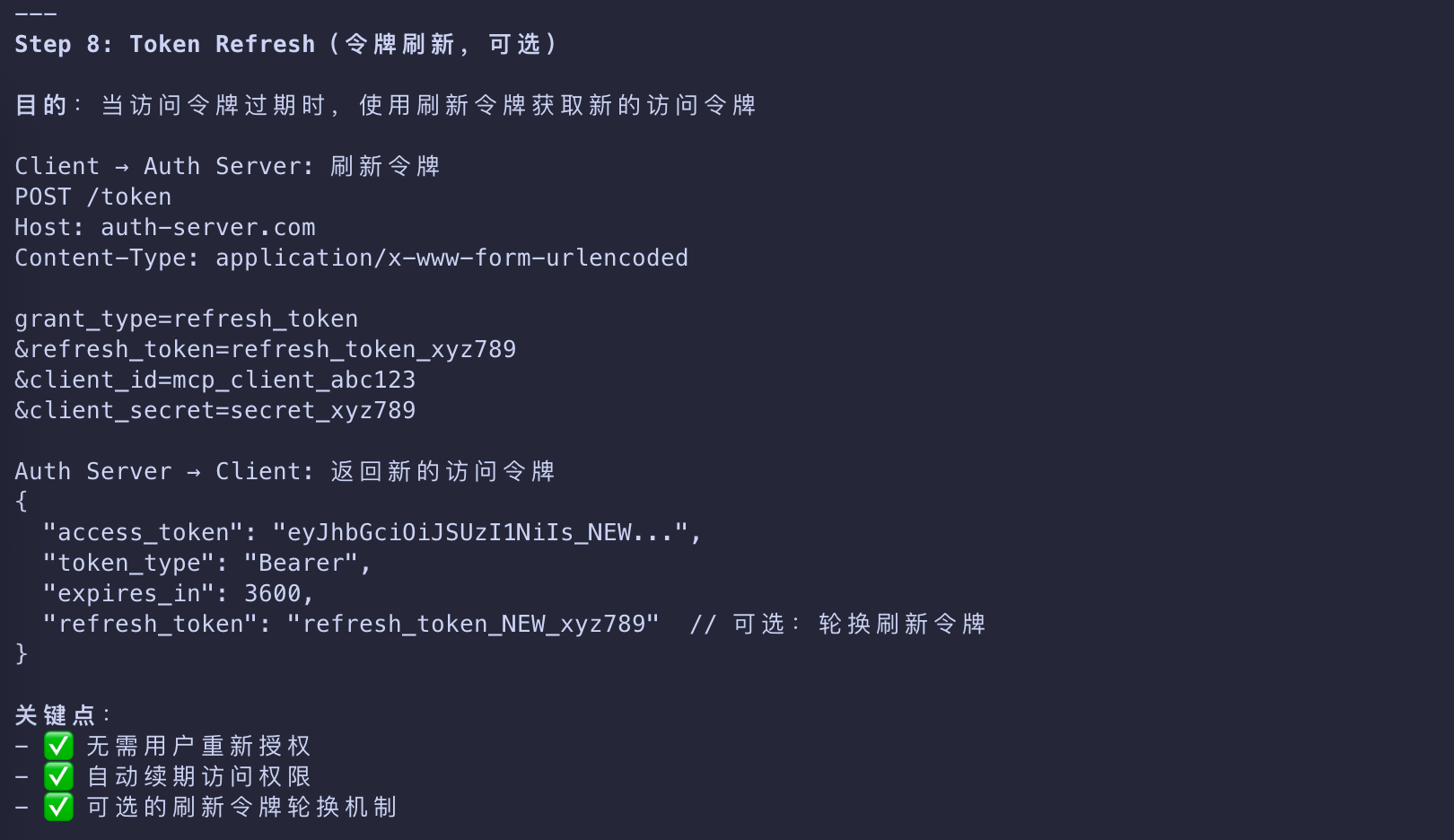
  1. The access token is what the client will use to authenticate requests to the MCP server.
  2. This step follows standard OAuth 2.1 authorization code with PKCE conventions.
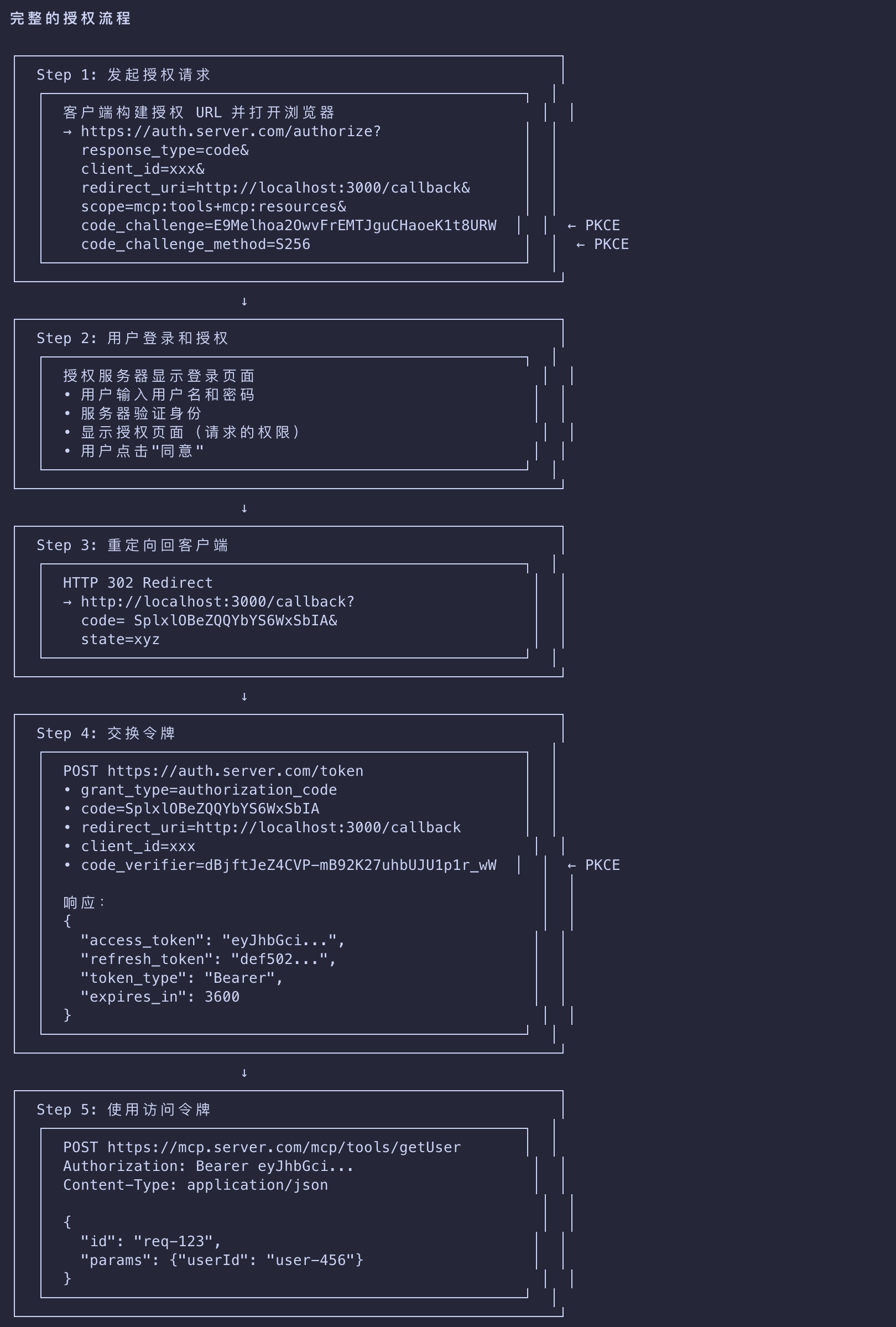
image-20260311091905531

image-20260311092134992

image-20260311092313012

image-20260311092358389

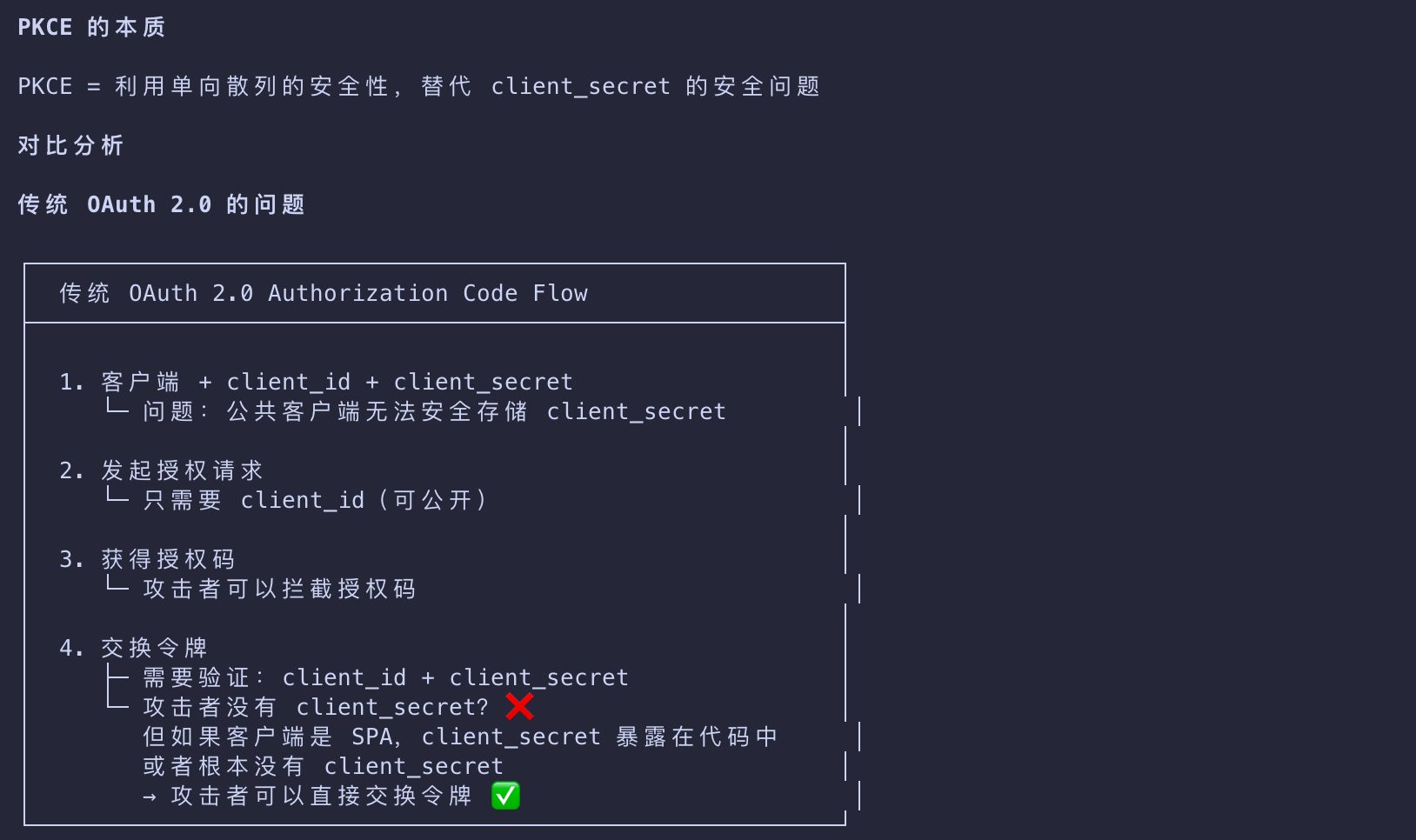
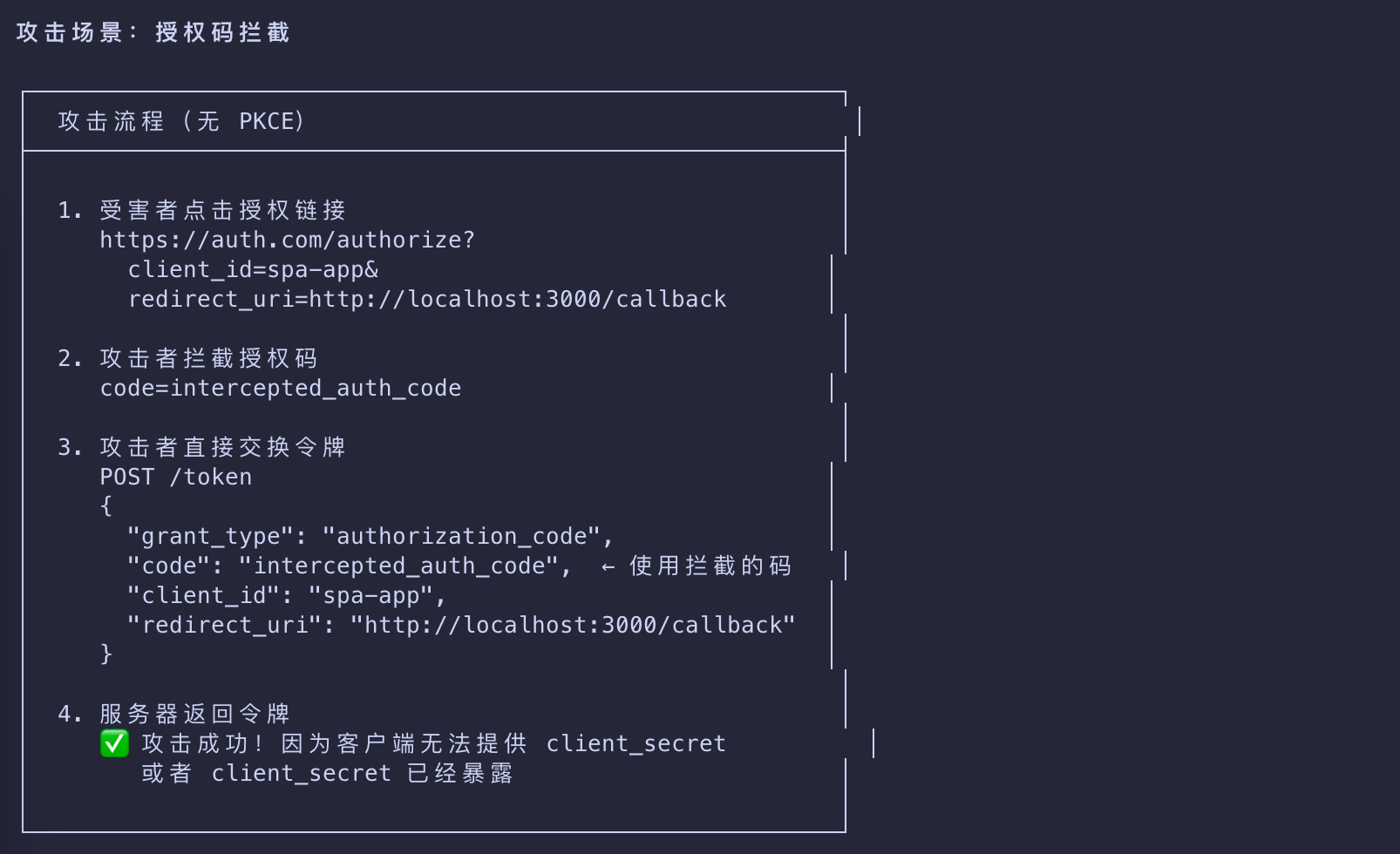
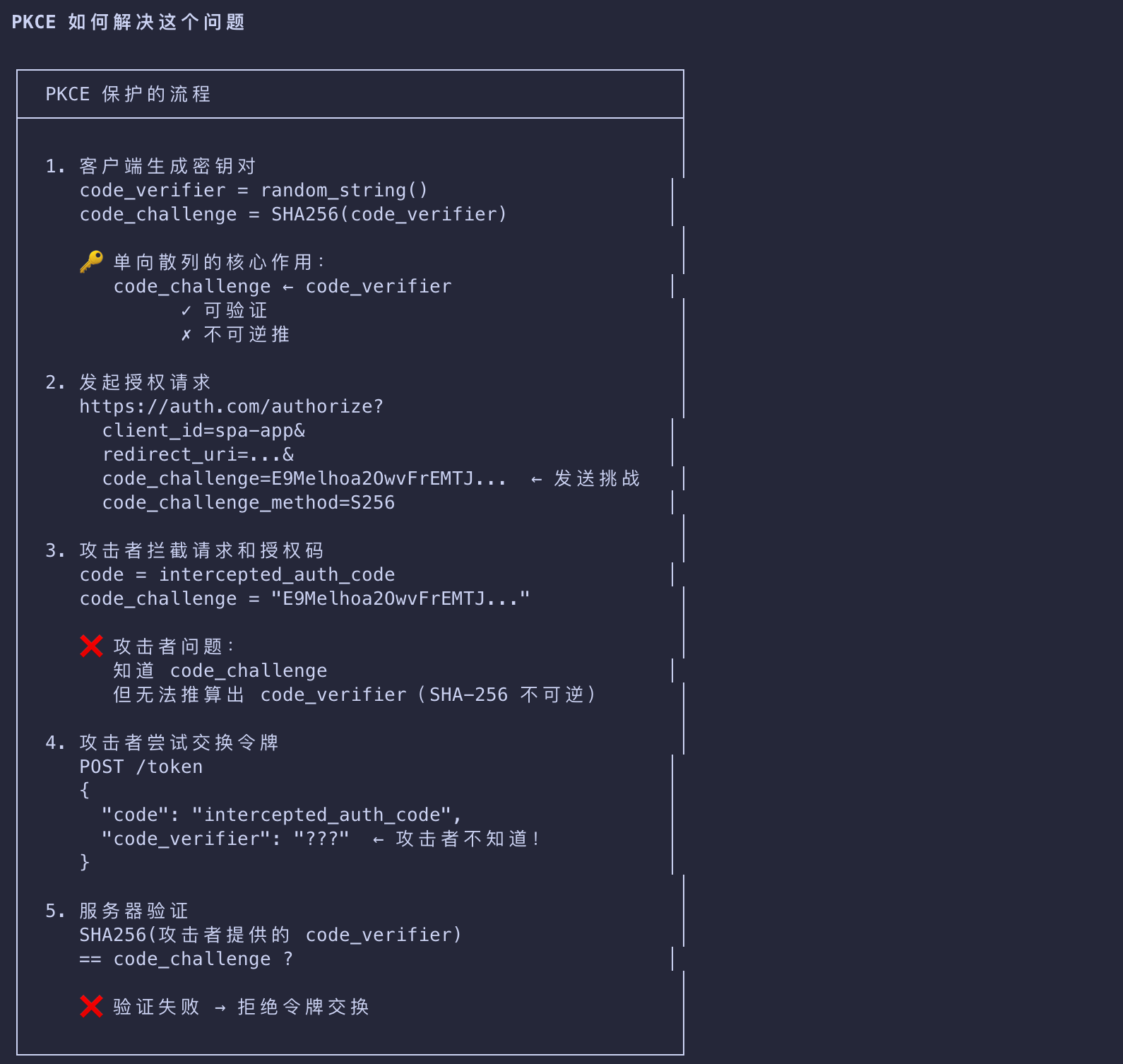
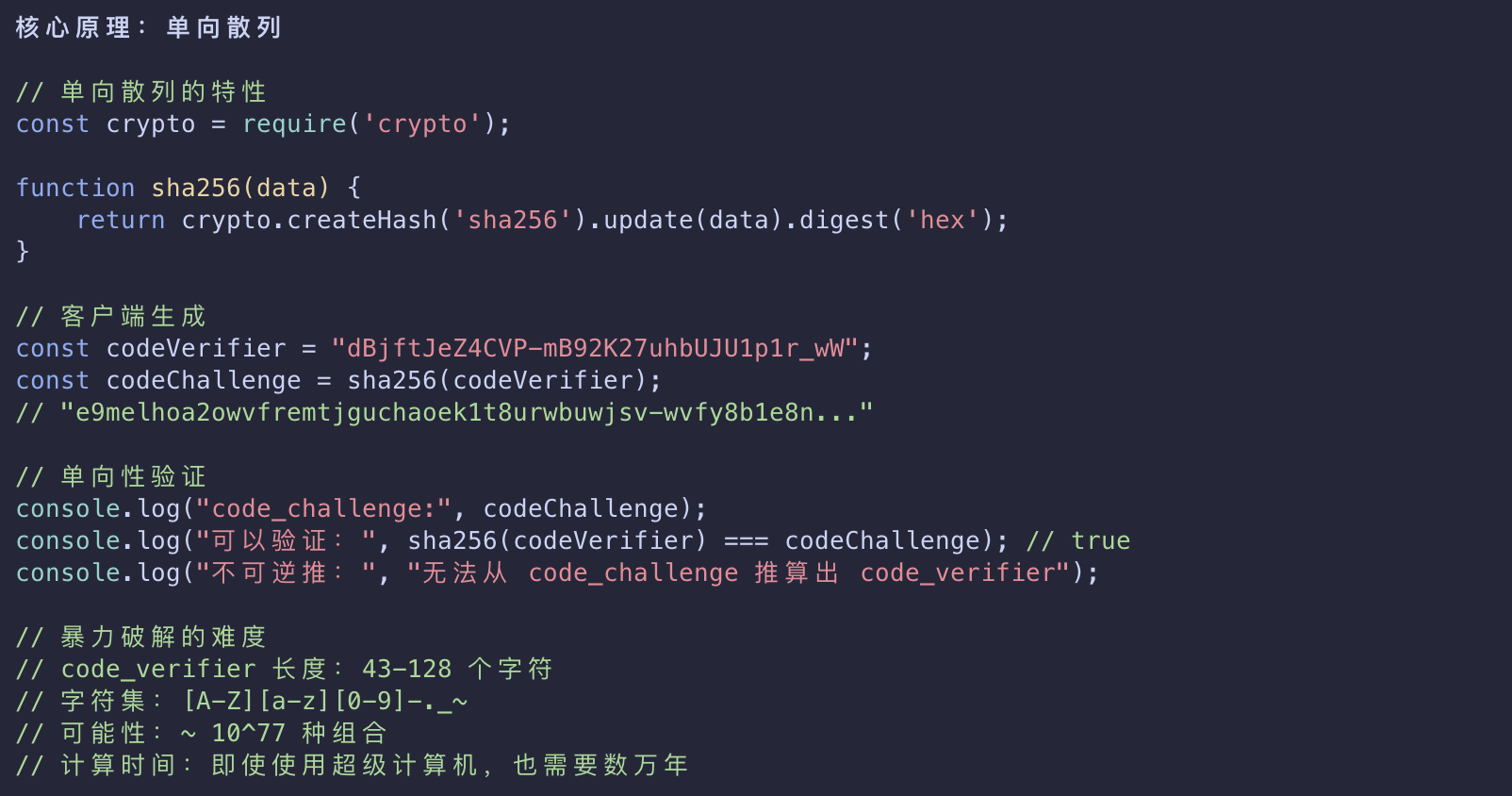
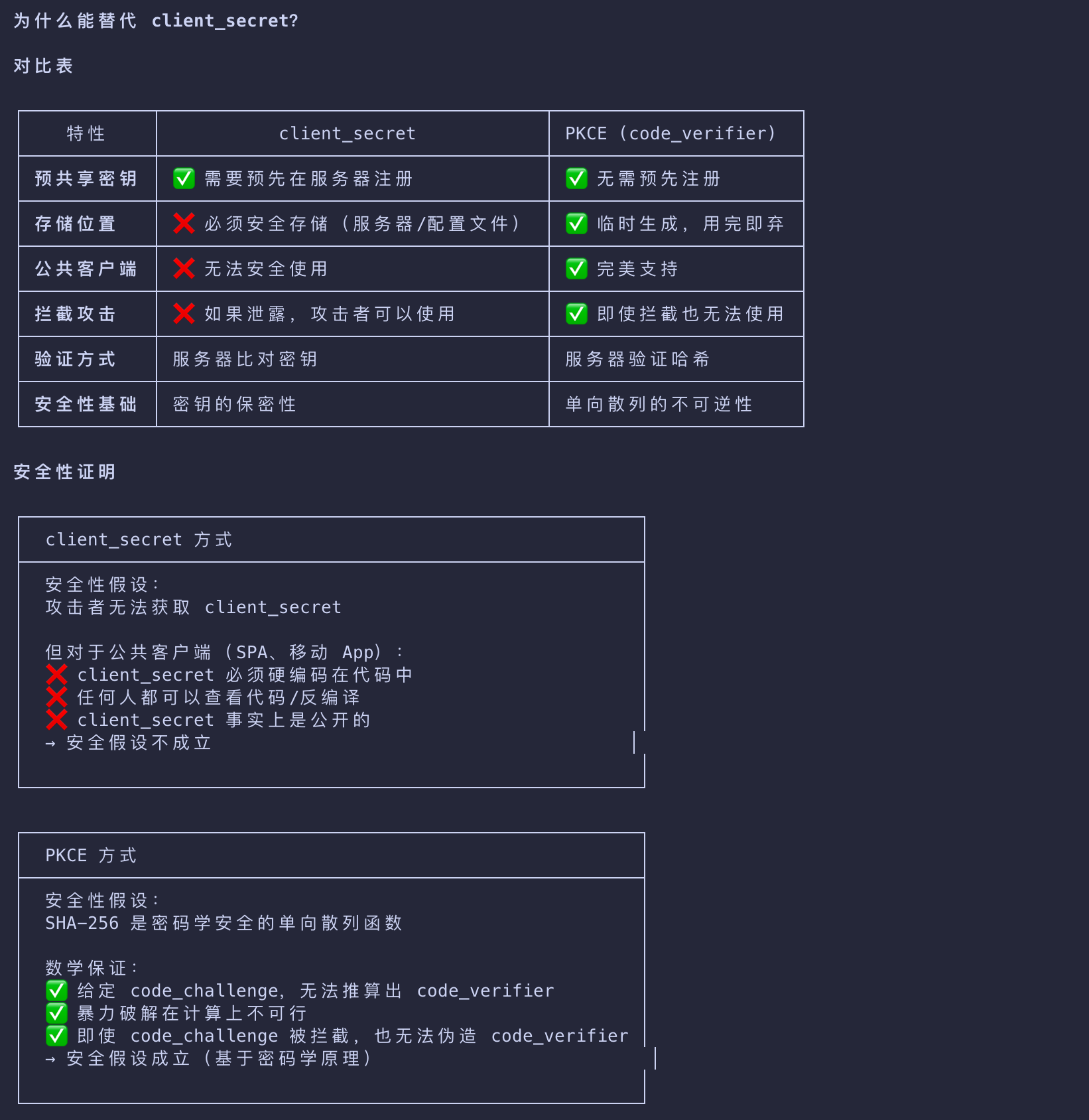
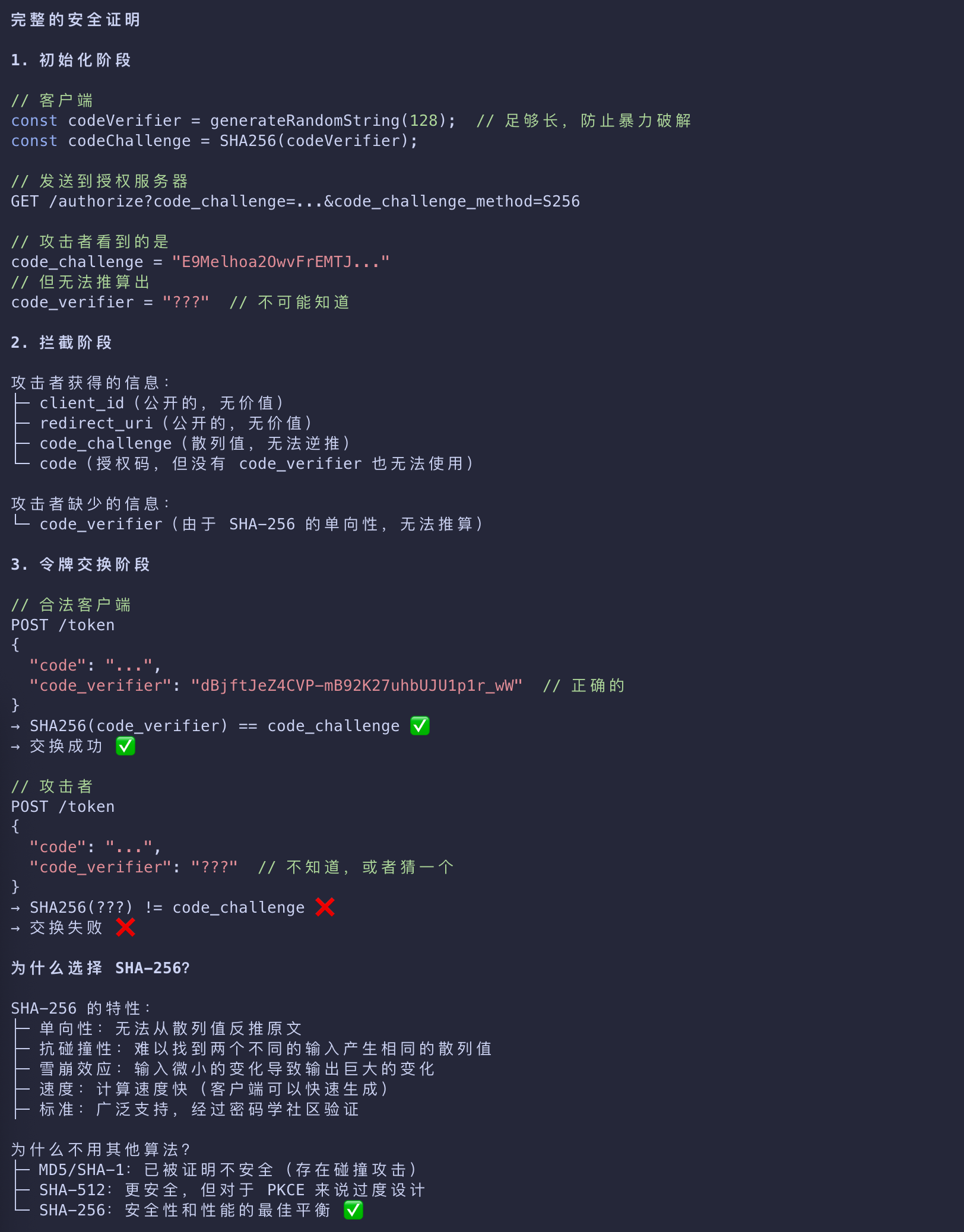
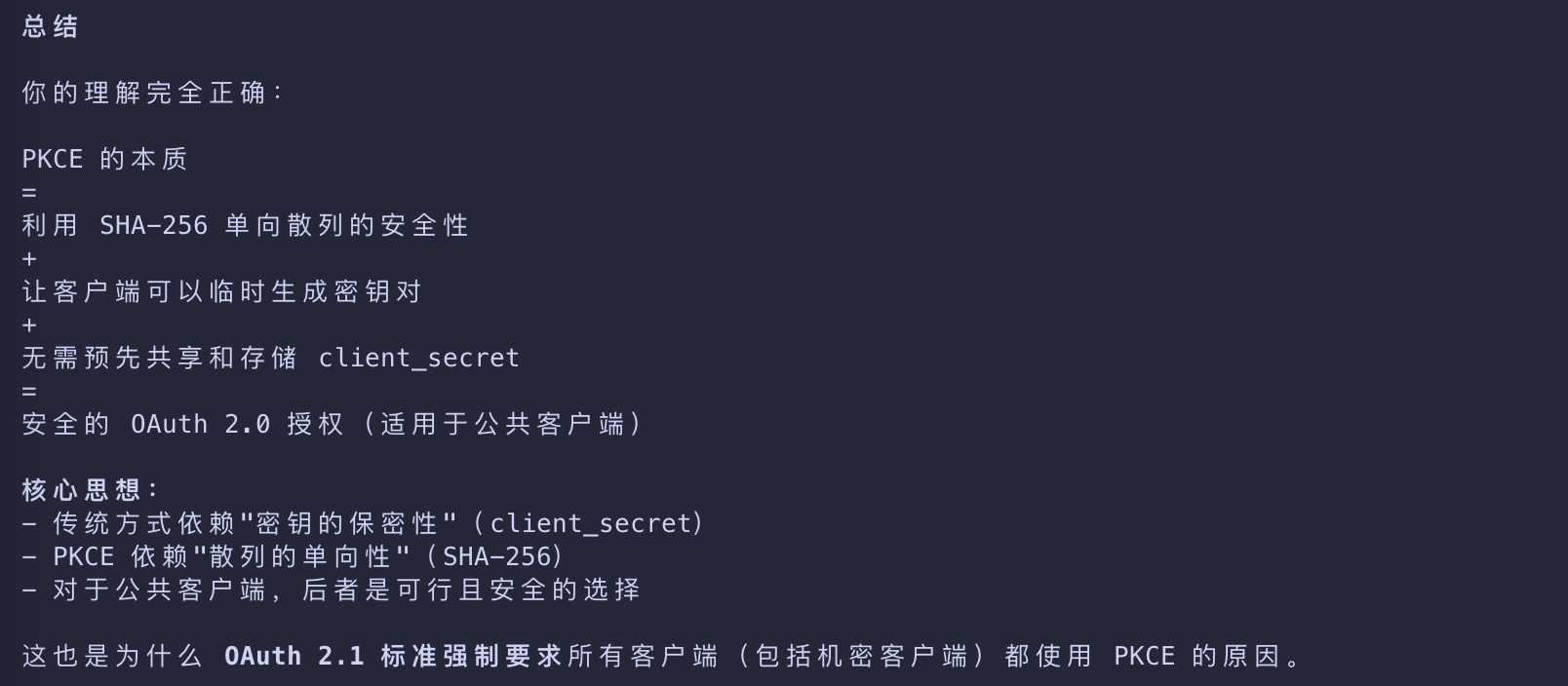
本质上是利用了单向散列的安全性,用于替代 OAuth 2.0 中存储 client_secret 的安全问题
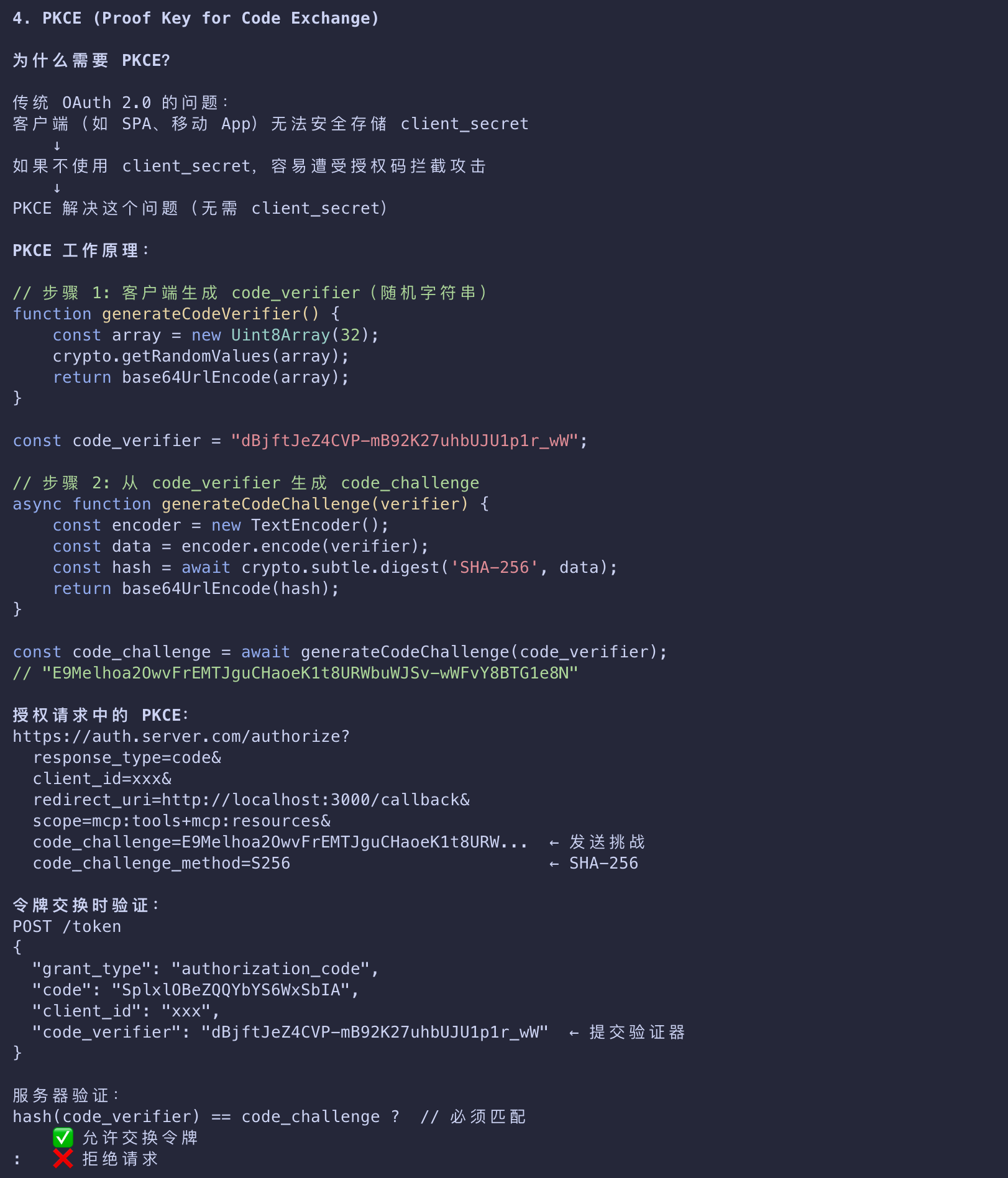
image-20260311092703675

image-20260311093621953

image-20260311093713740

image-20260311093825185

image-20260311094038308

image-20260311094218058

image-20260311094421654

image-20260311094515830

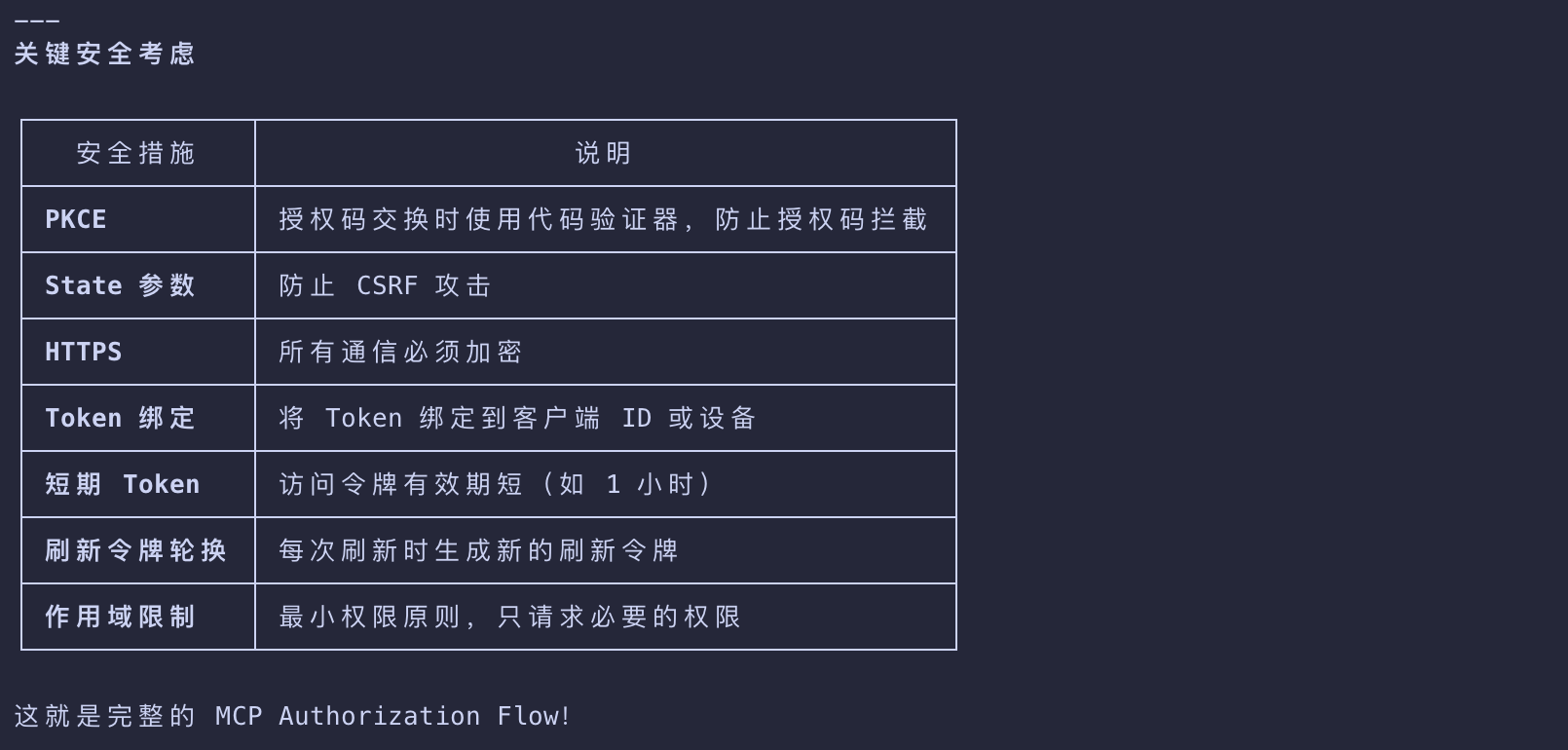
OAuth 2.1 Authorization Code with PKCE 的安全性
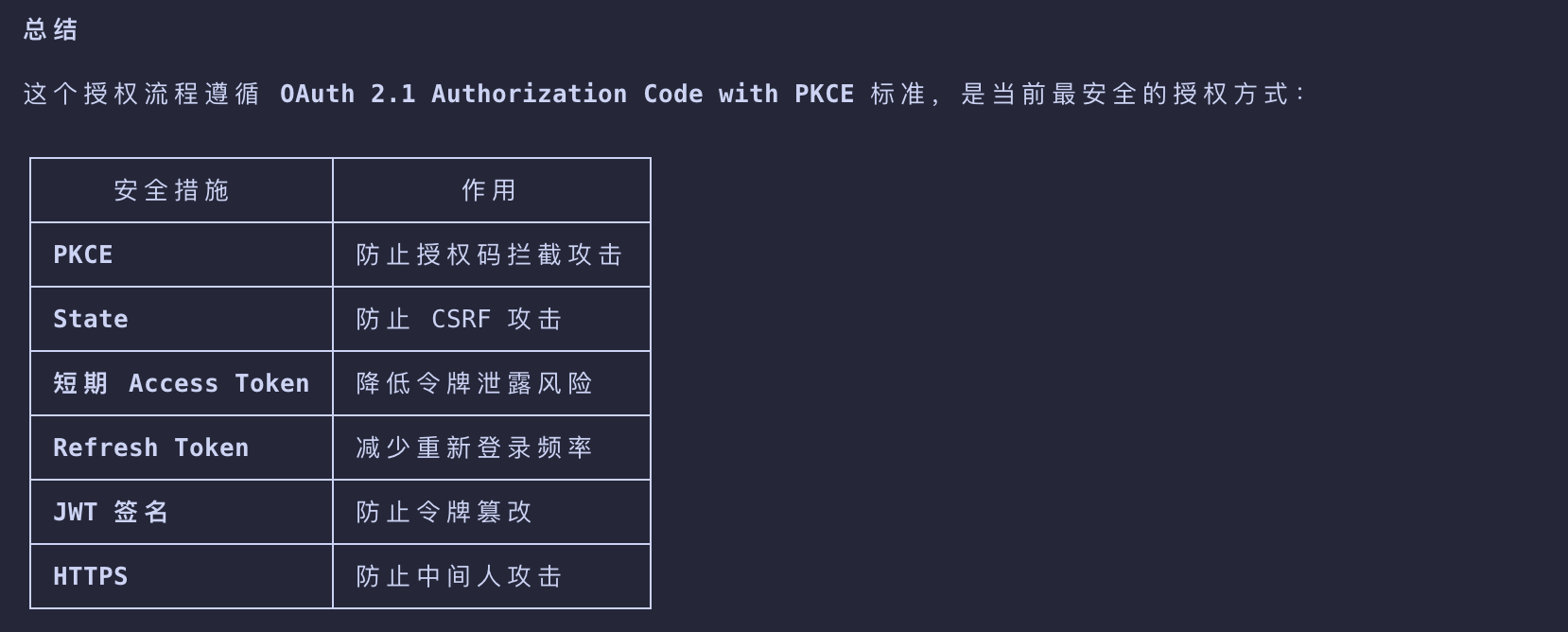
image-20260311093151159

Making Authenticated Requests

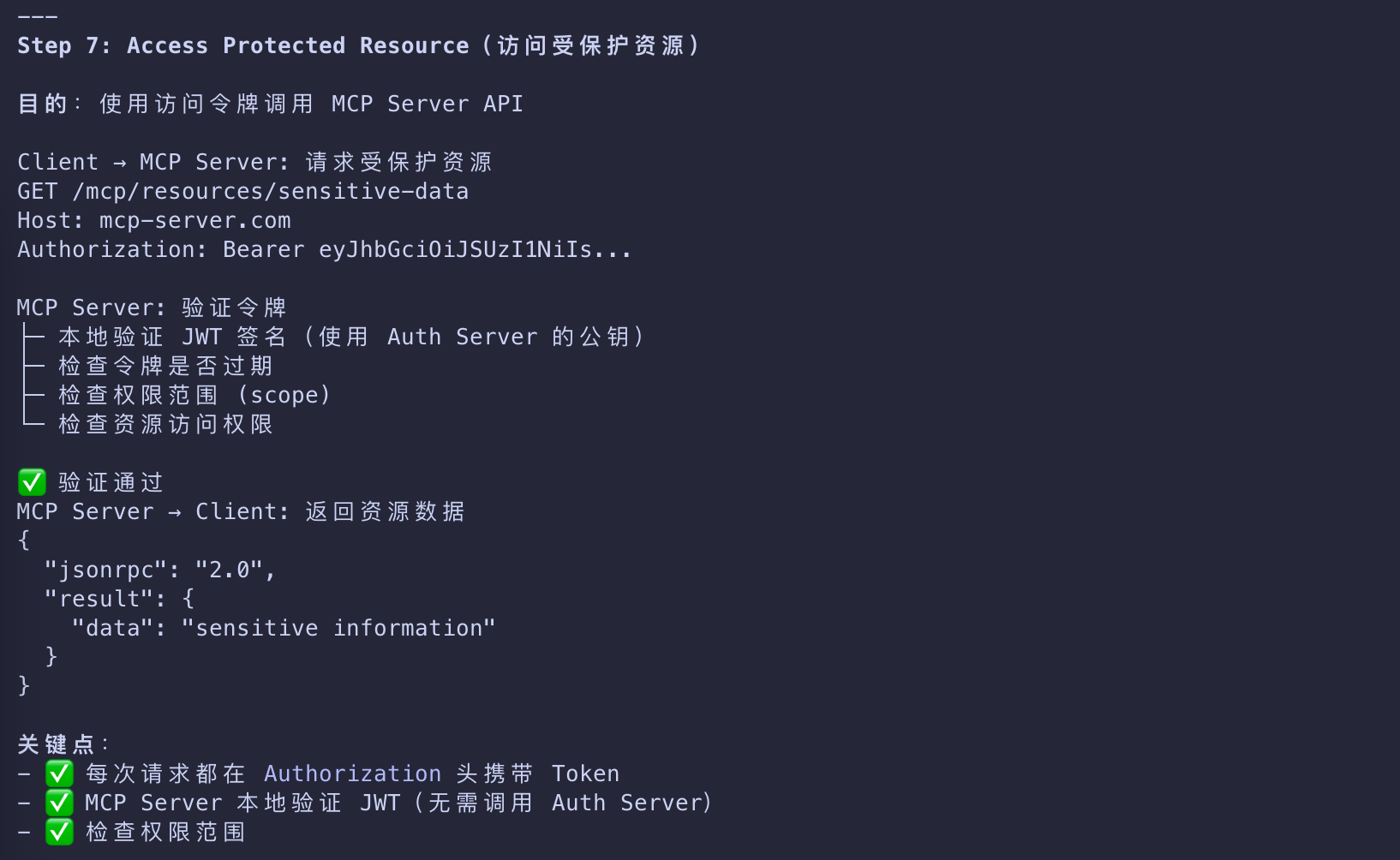
Finally, the client can make requests to your MCP server using the access token embedded in the Authorization header:

1
2
3
GET /mcp HTTP/1.1
Host: your-server.com
Authorization: Bearer eyJhbGciOiJSUzI1NiIs...

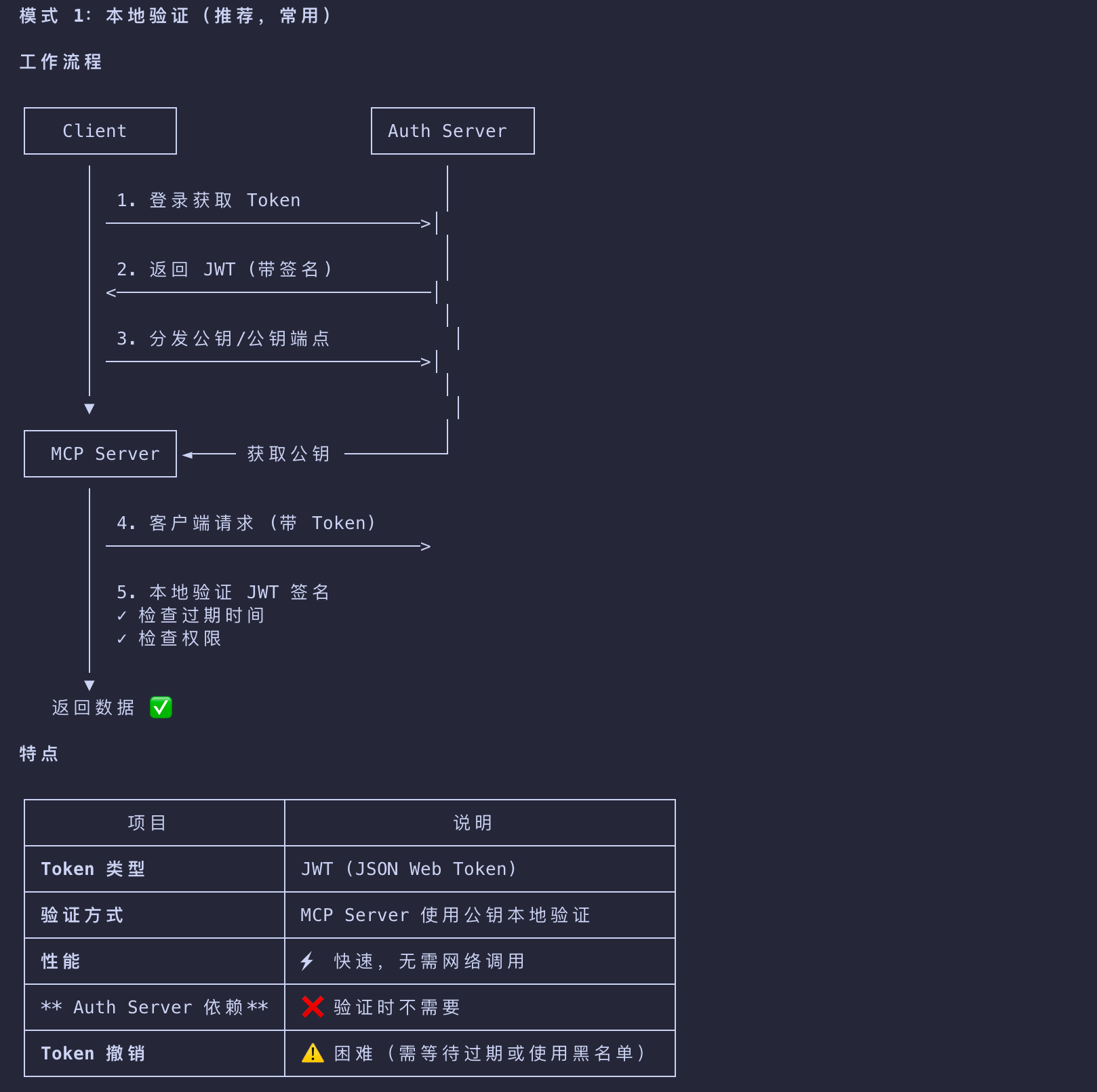
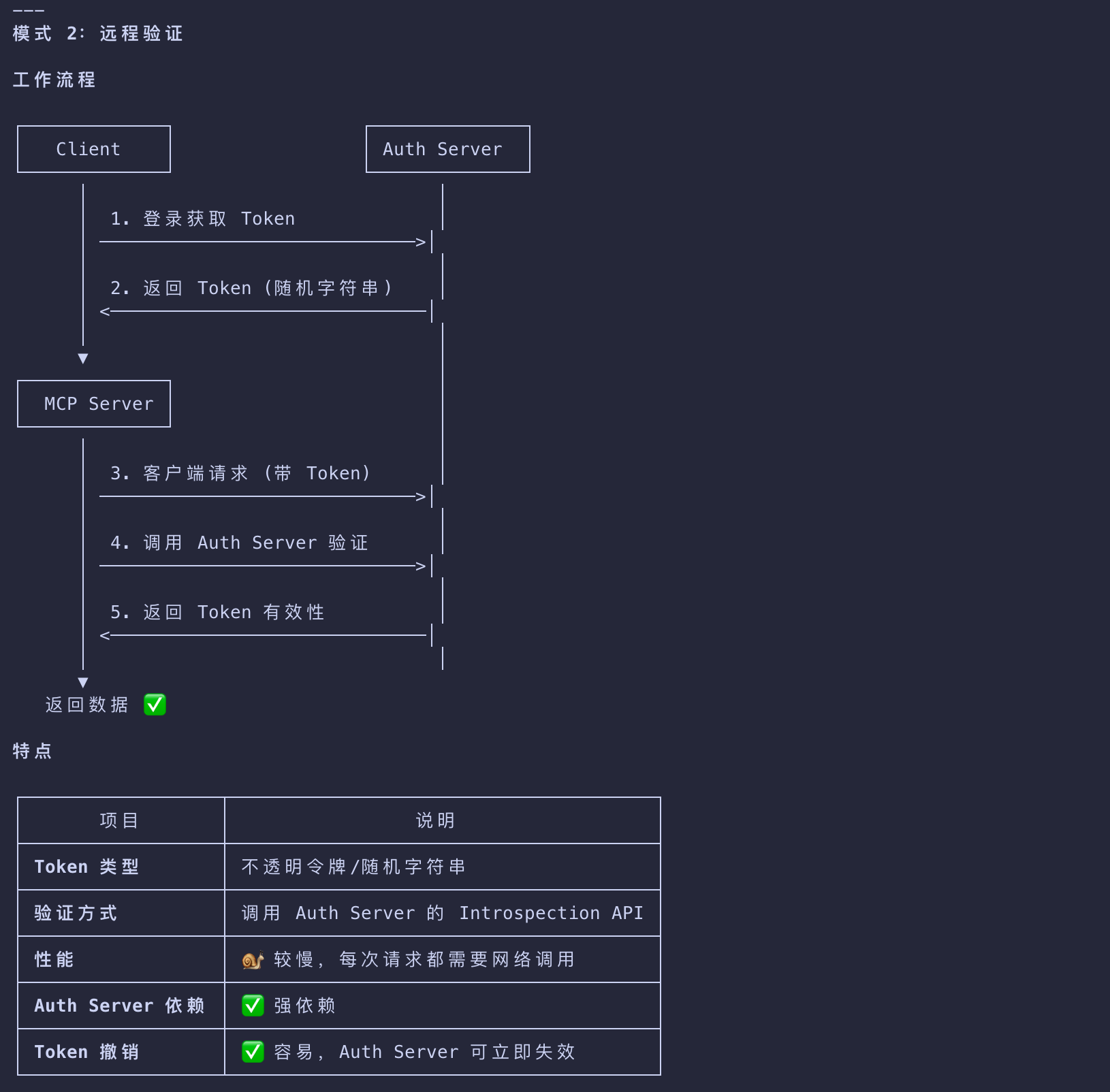
The MCP server will need to validate the token and process the request if the token is valid and has the required permissions.
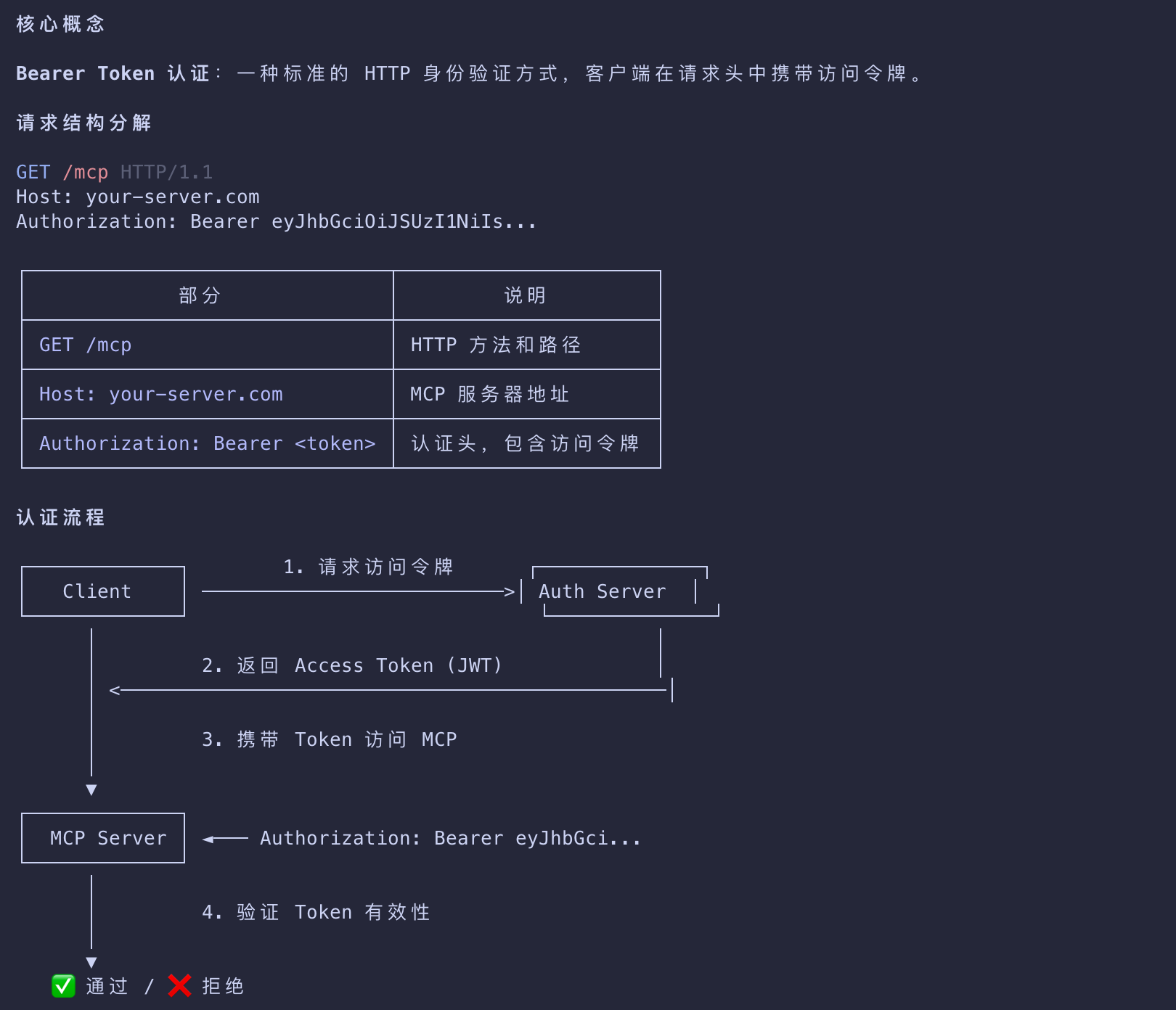
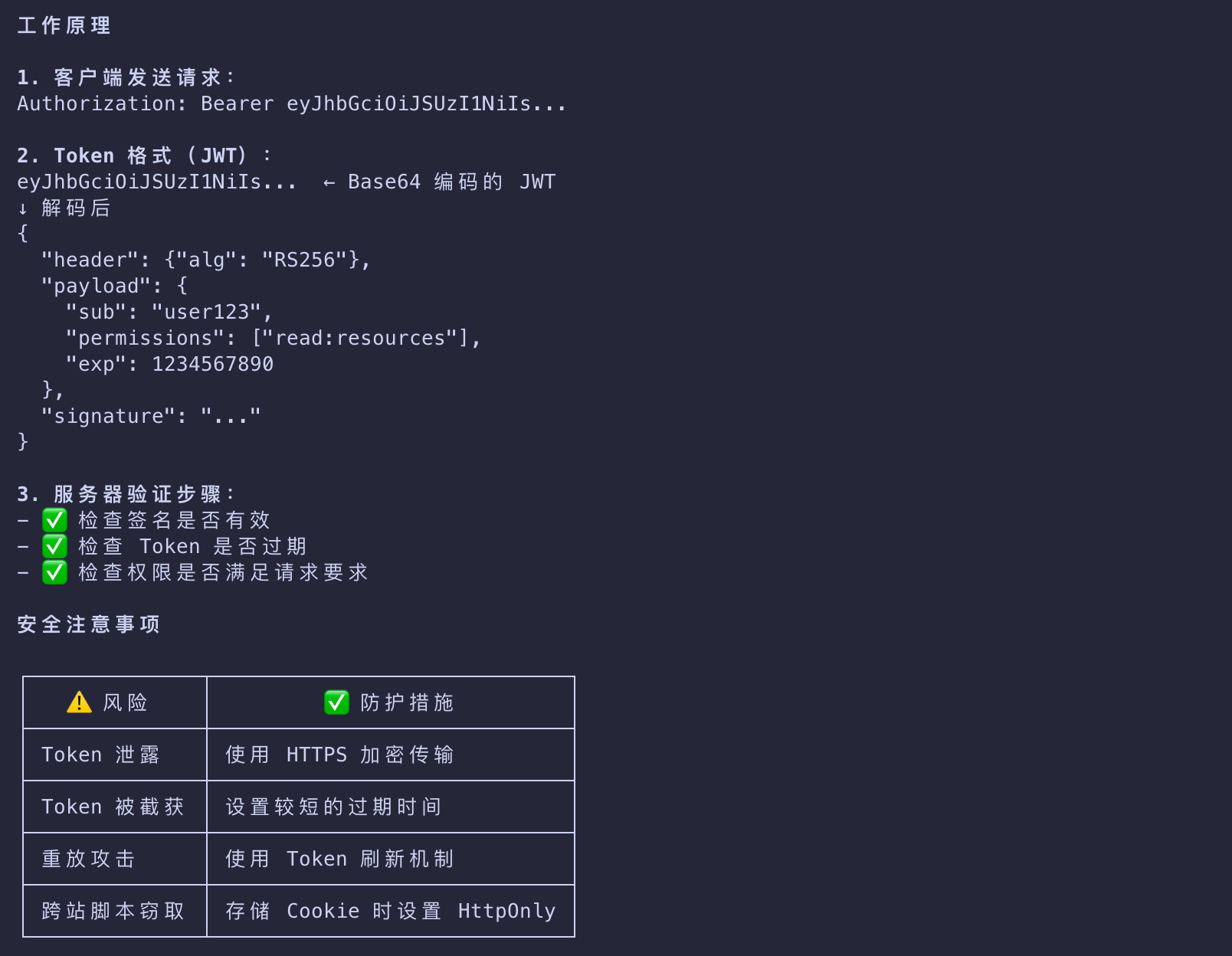
image-20260311095222804

image-20260311095346772

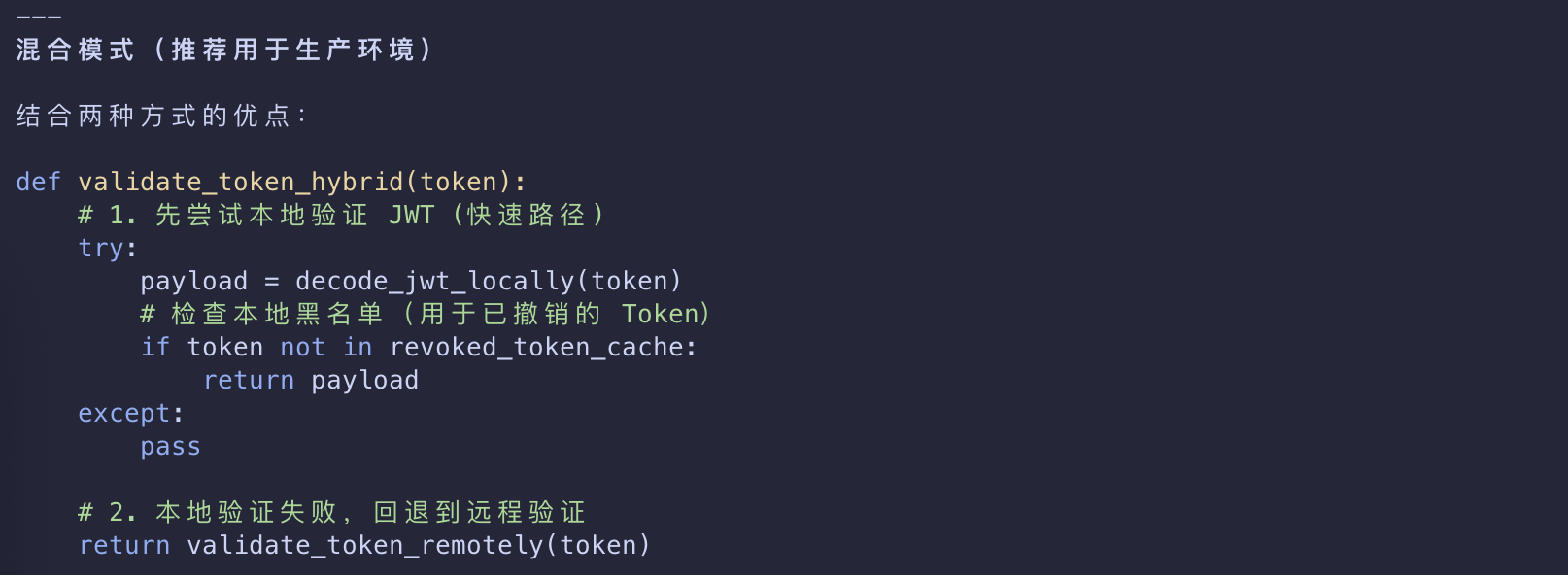
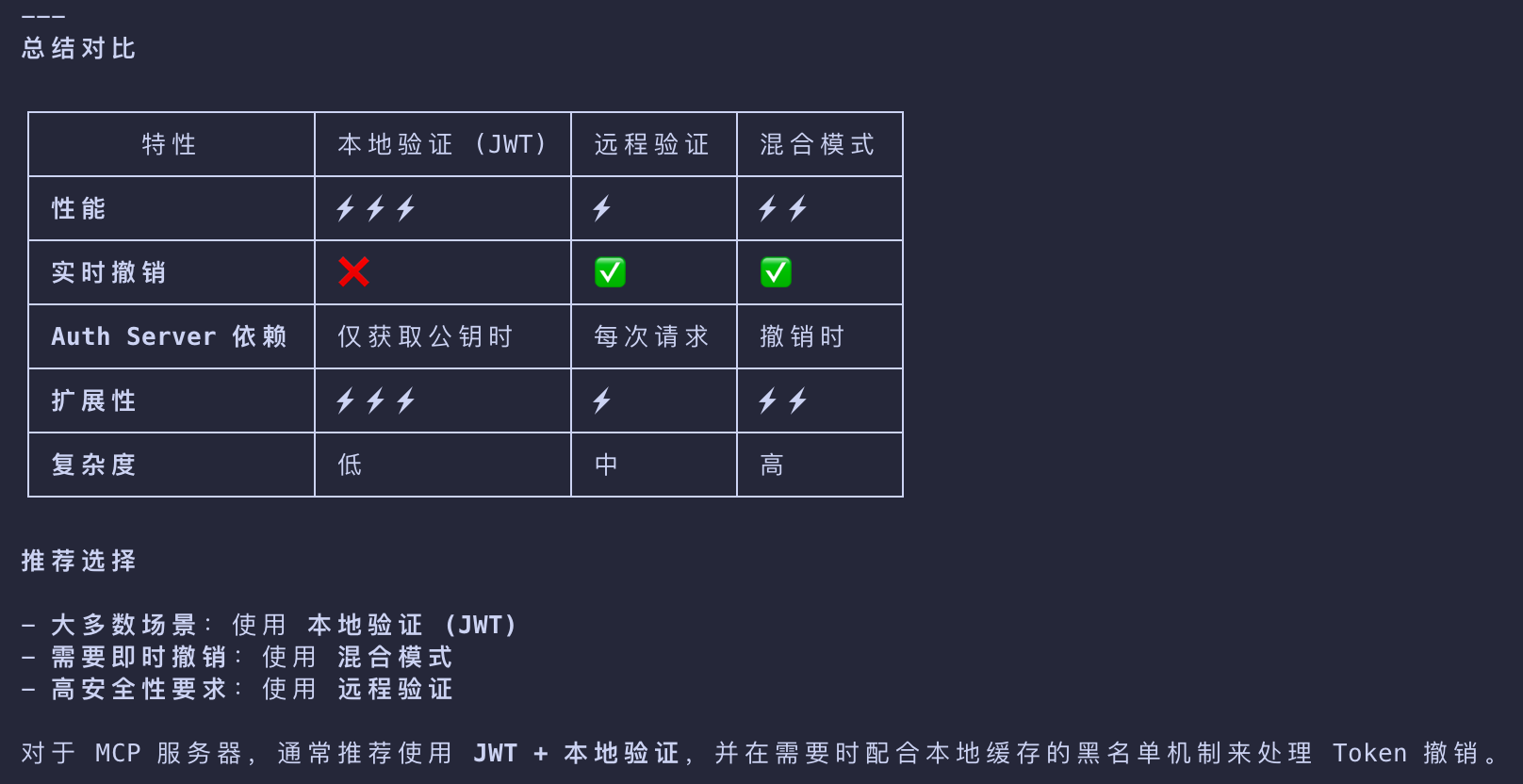
MCP Server Token 验证机制

image-20260311095750717

image-20260311095949348

image-20260311100024741

MCP 场景:JWT + 本地验证

image-20260311100148126

Implementation Example

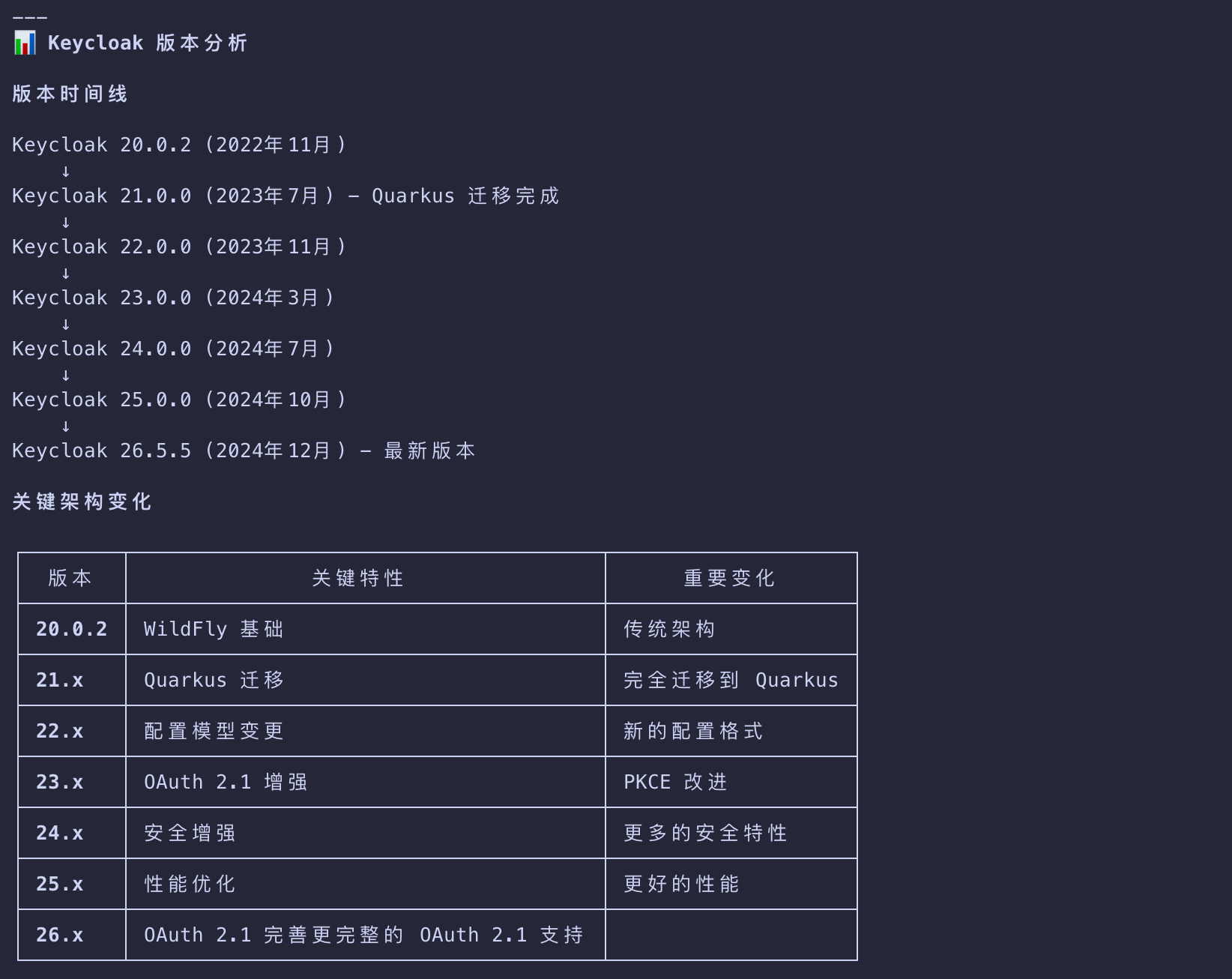
  1. To get started with a practical implementation, we will use a Keycloak authorization server hosted in a Docker container.
  2. Keycloak is an open-source authorization server that can be easily deployed locally for testing and experimentation.
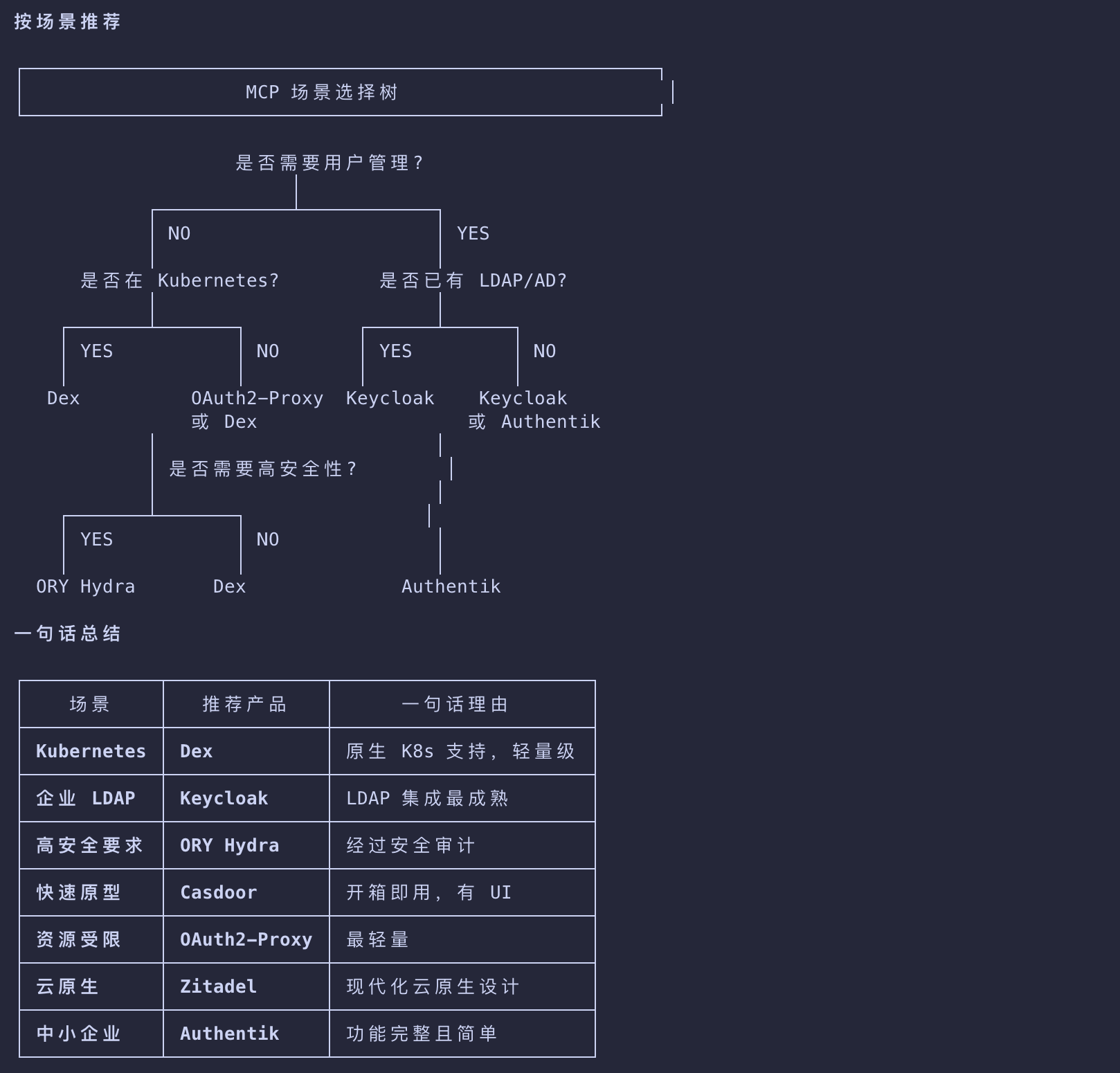
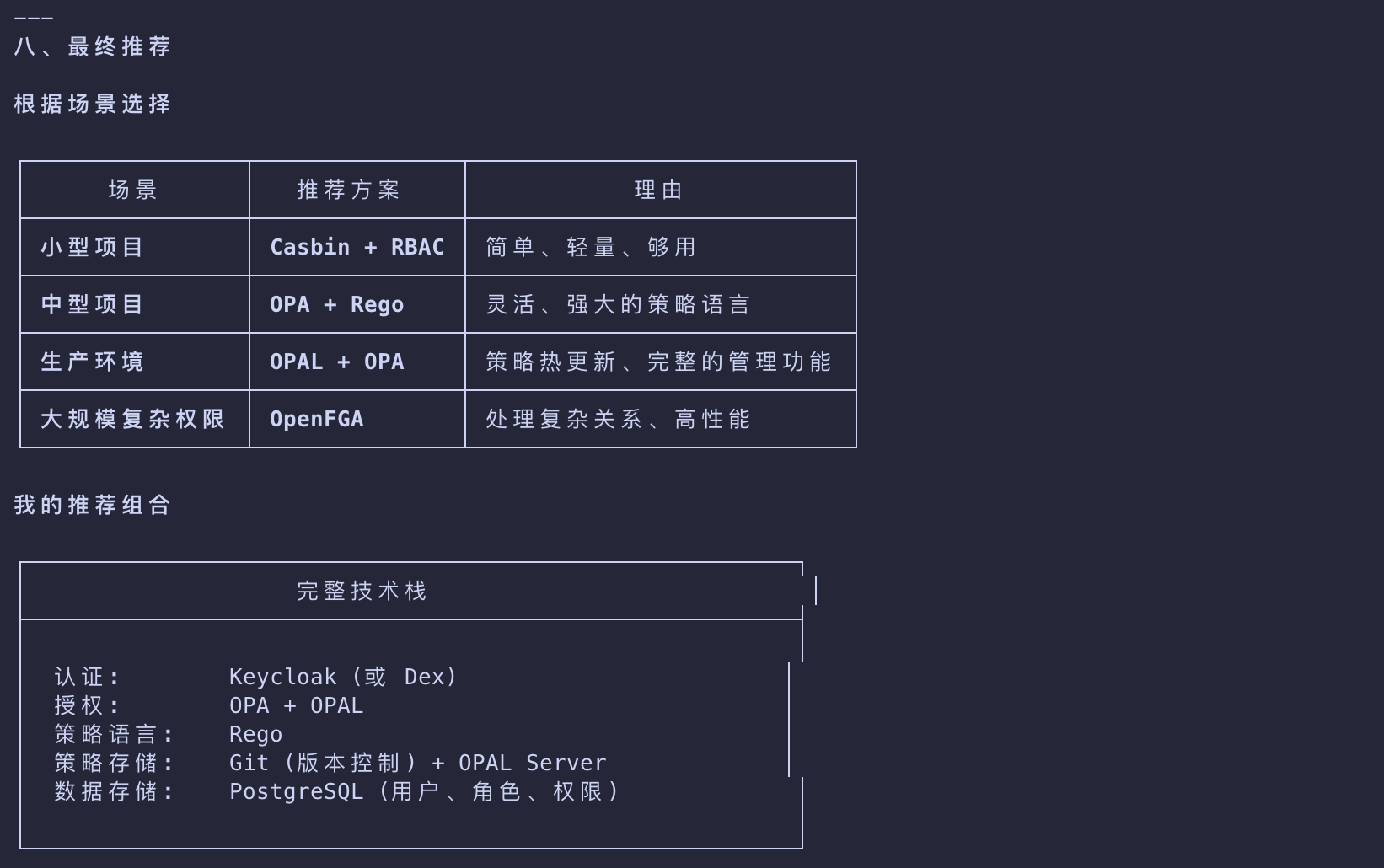
image-20260311103942673

image-20260311104433355

Keycloak Setup

From your terminal application, run the following command to start the Keycloak container:

1
docker run -p 127.0.0.1:8080:8080 -e KC_BOOTSTRAP_ADMIN_USERNAME=admin -e KC_BOOTSTRAP_ADMIN_PASSWORD=admin quay.io/keycloak/keycloak start-dev
  1. This command will pull the Keycloak container image locally and bootstrap the basic configuration.
  2. It will run on port 8080 and have an admin user with admin password.

Not for Production

  1. The configuration above may be suitable for testing and experimentation; however, you should never use it in production.
  2. Refer to the Configuring Keycloak for production guide for additional details on
    • how to deploy the authorization server for scenarios that require reliability, security, and high availability.

You will be able to access the Keycloak authorization server from your browser at http://localhost:8080.
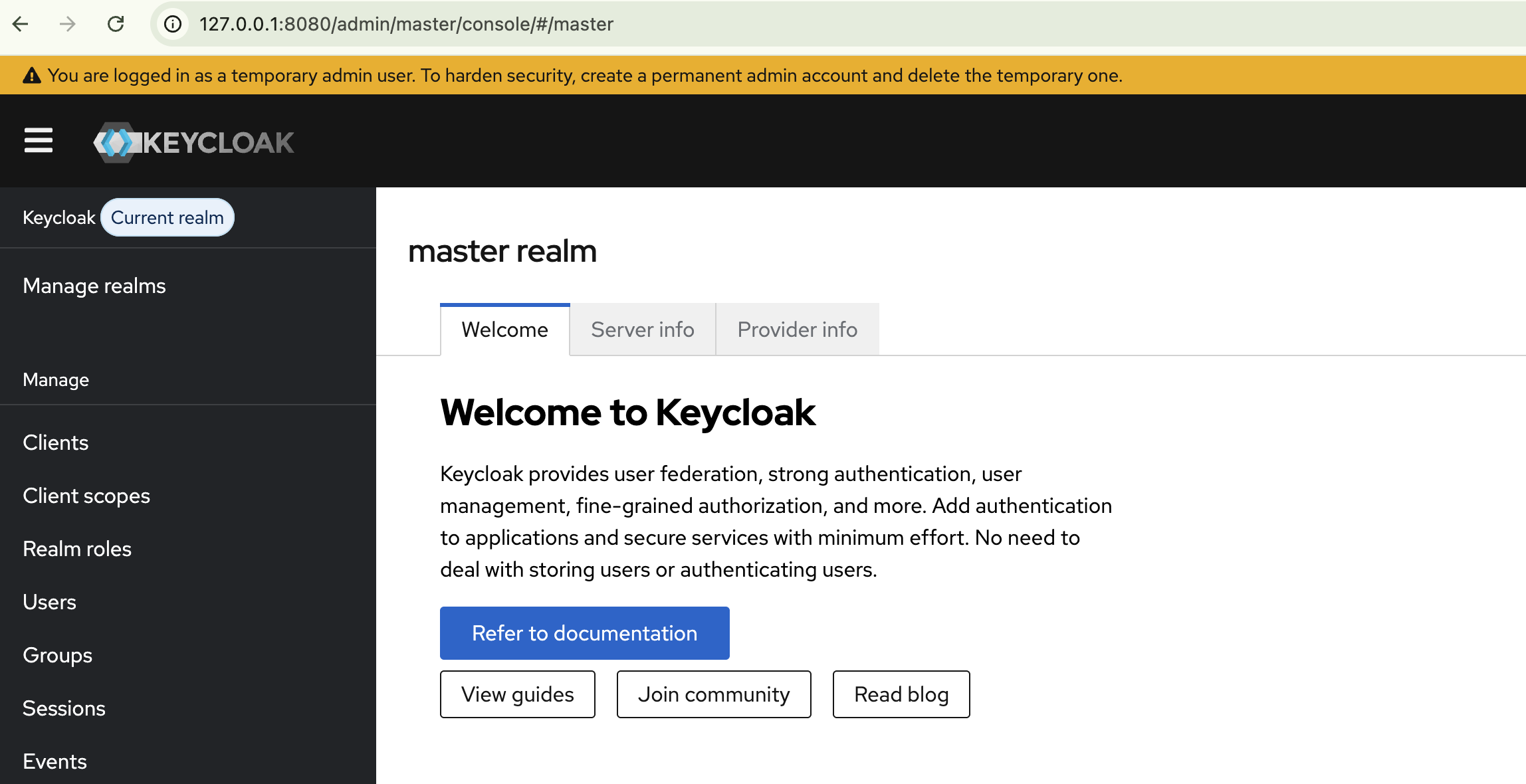
image-20260311103533253

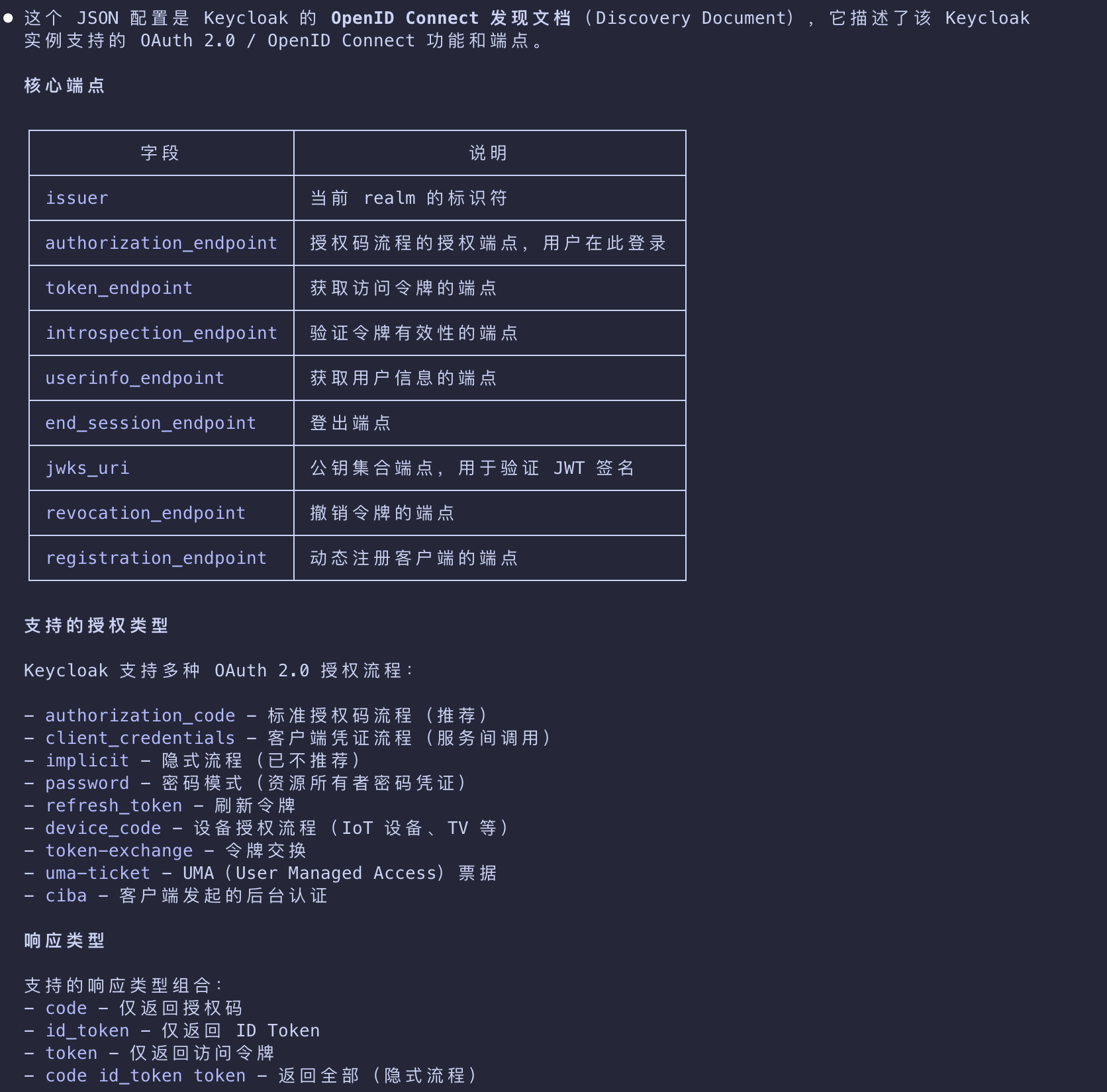
  1. When running with the default configuration
    • Keycloak will already support many of the capabilities that we need for MCP servers
    • including Dynamic Client Registration.
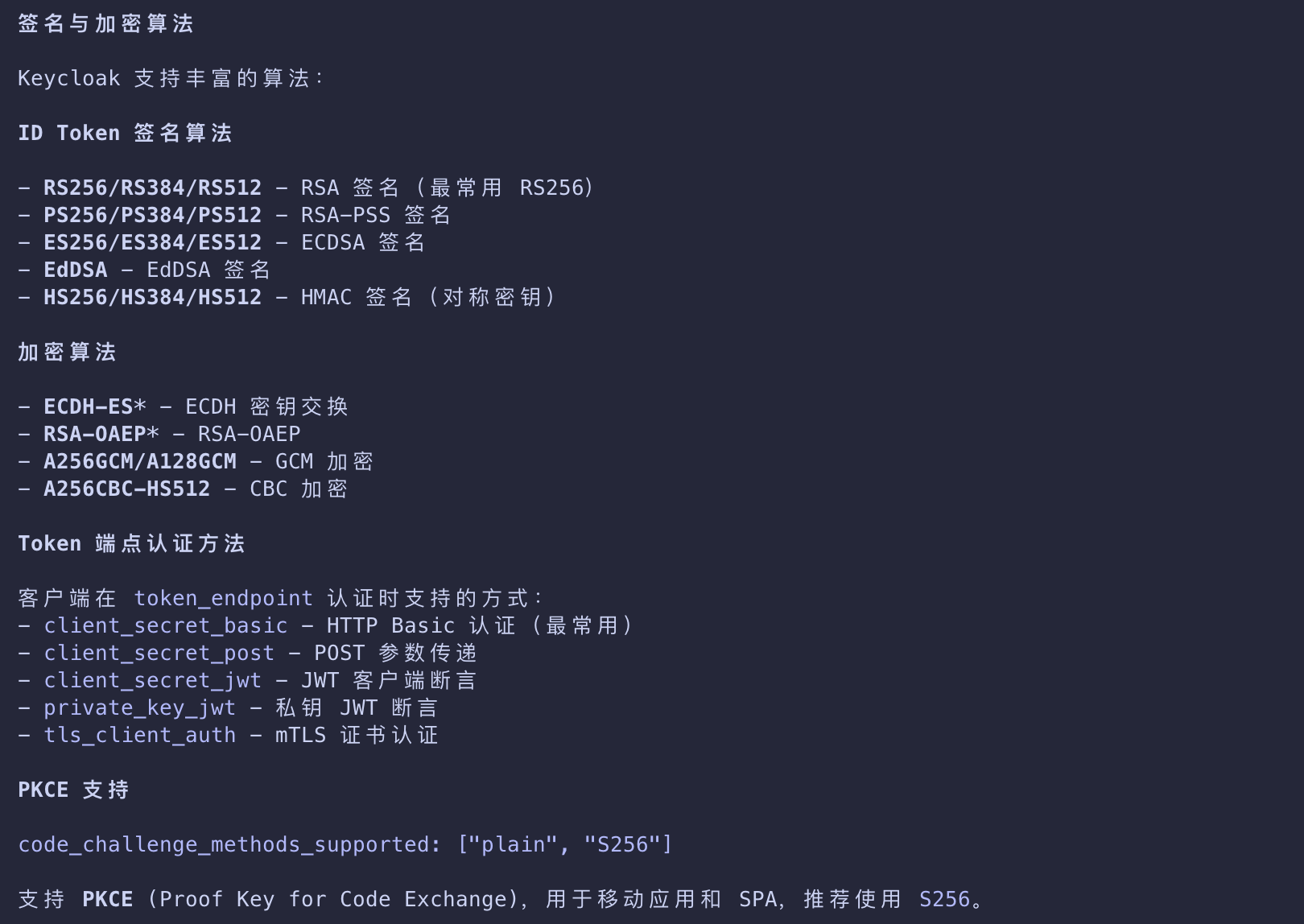
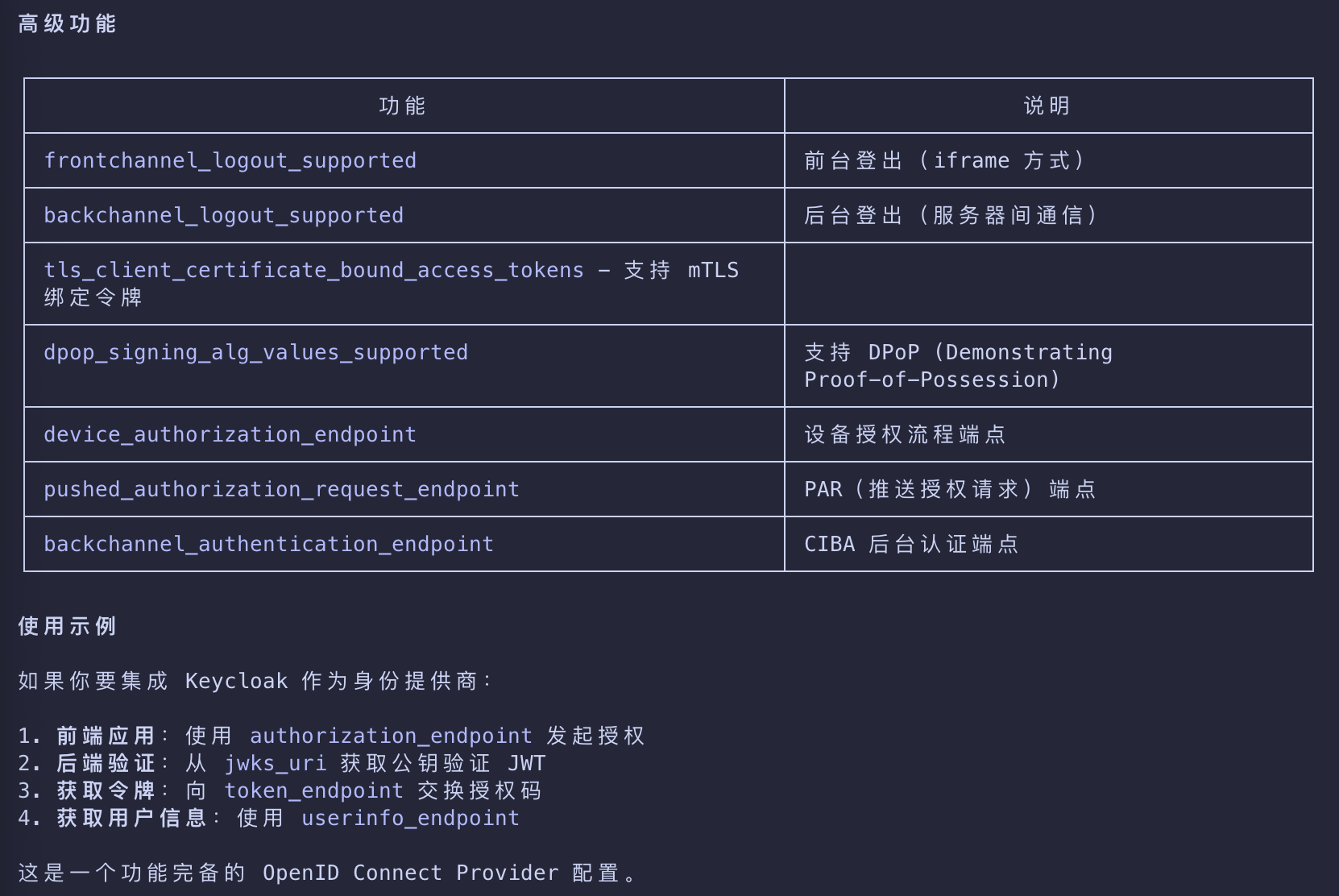
  2. You can check this by looking at the OIDC configuration, available at

http://localhost:8080/realms/master/.well-known/openid-configuration

1
2
3
4
5
6
7
8
9
10
11
12
13
14
15
16
17
18
19
20
21
22
23
24
25
26
27
28
29
30
31
32
33
34
35
36
37
38
39
40
41
42
43
44
45
46
47
48
49
50
51
52
53
54
55
56
57
58
59
60
61
62
63
64
65
66
67
68
69
70
71
72
73
74
75
76
77
78
79
80
81
82
83
84
85
86
87
88
89
90
91
92
93
94
95
96
97
98
99
100
101
102
103
104
105
106
107
108
109
110
111
112
113
114
115
116
117
118
119
120
121
122
123
124
125
126
127
128
129
130
131
132
133
134
135
136
137
138
139
140
141
142
143
144
145
146
147
148
149
150
151
152
153
154
155
156
157
158
159
160
161
162
163
164
165
166
167
168
169
170
171
172
173
174
175
176
177
178
179
180
181
182
183
184
185
186
187
188
189
190
191
192
193
194
195
196
197
198
199
200
201
202
203
204
205
206
207
208
209
210
211
212
213
214
215
216
217
218
219
220
221
222
223
224
225
226
227
228
229
230
231
232
233
234
235
236
237
238
239
240
241
242
243
244
245
246
247
248
249
250
251
252
253
254
255
256
257
258
259
260
261
262
263
264
265
266
267
268
269
270
271
272
273
274
275
276
277
278
279
280
281
282
283
284
285
286
287
288
289
290
291
292
293
294
295
296
297
298
299
300
301
302
303
304
305
306
307
308
309
310
311
312
313
314
315
316
317
318
319
320
321
322
323
324
325
326
327
328
329
330
331
332
333
334
335
336
337
338
339
340
341
{
"issuer": "http://localhost:8080/realms/master",
"authorization_endpoint": "http://localhost:8080/realms/master/protocol/openid-connect/auth",
"token_endpoint": "http://localhost:8080/realms/master/protocol/openid-connect/token",
"introspection_endpoint": "http://localhost:8080/realms/master/protocol/openid-connect/token/introspect",
"userinfo_endpoint": "http://localhost:8080/realms/master/protocol/openid-connect/userinfo",
"end_session_endpoint": "http://localhost:8080/realms/master/protocol/openid-connect/logout",
"frontchannel_logout_session_supported": true,
"frontchannel_logout_supported": true,
"jwks_uri": "http://localhost:8080/realms/master/protocol/openid-connect/certs",
"check_session_iframe": "http://localhost:8080/realms/master/protocol/openid-connect/login-status-iframe.html",
"grant_types_supported": [
"authorization_code",
"client_credentials",
"implicit",
"password",
"refresh_token",
"urn:ietf:params:oauth:grant-type:device_code",
"urn:ietf:params:oauth:grant-type:token-exchange",
"urn:ietf:params:oauth:grant-type:uma-ticket",
"urn:openid:params:grant-type:ciba"
],
"acr_values_supported": [
"0",
"1"
],
"response_types_supported": [
"code",
"none",
"id_token",
"token",
"id_token token",
"code id_token",
"code token",
"code id_token token"
],
"subject_types_supported": [
"public",
"pairwise"
],
"prompt_values_supported": [
"none",
"login",
"consent"
],
"id_token_signing_alg_values_supported": [
"PS384",
"RS384",
"EdDSA",
"ES384",
"HS256",
"HS512",
"ES256",
"RS256",
"HS384",
"ES512",
"PS256",
"PS512",
"RS512"
],
"id_token_encryption_alg_values_supported": [
"ECDH-ES+A256KW",
"ECDH-ES+A192KW",
"ECDH-ES+A128KW",
"RSA-OAEP",
"RSA-OAEP-256",
"RSA1_5",
"ECDH-ES"
],
"id_token_encryption_enc_values_supported": [
"A256GCM",
"A192GCM",
"A128GCM",
"A128CBC-HS256",
"A192CBC-HS384",
"A256CBC-HS512"
],
"userinfo_signing_alg_values_supported": [
"PS384",
"RS384",
"EdDSA",
"ES384",
"HS256",
"HS512",
"ES256",
"RS256",
"HS384",
"ES512",
"PS256",
"PS512",
"RS512",
"none"
],
"userinfo_encryption_alg_values_supported": [
"ECDH-ES+A256KW",
"ECDH-ES+A192KW",
"ECDH-ES+A128KW",
"RSA-OAEP",
"RSA-OAEP-256",
"RSA1_5",
"ECDH-ES"
],
"userinfo_encryption_enc_values_supported": [
"A256GCM",
"A192GCM",
"A128GCM",
"A128CBC-HS256",
"A192CBC-HS384",
"A256CBC-HS512"
],
"request_object_signing_alg_values_supported": [
"PS384",
"RS384",
"EdDSA",
"ES384",
"HS256",
"HS512",
"ES256",
"RS256",
"HS384",
"ES512",
"PS256",
"PS512",
"RS512",
"none"
],
"request_object_encryption_alg_values_supported": [
"ECDH-ES+A256KW",
"ECDH-ES+A192KW",
"ECDH-ES+A128KW",
"RSA-OAEP",
"RSA-OAEP-256",
"RSA1_5",
"ECDH-ES"
],
"request_object_encryption_enc_values_supported": [
"A256GCM",
"A192GCM",
"A128GCM",
"A128CBC-HS256",
"A192CBC-HS384",
"A256CBC-HS512"
],
"response_modes_supported": [
"query",
"fragment",
"form_post",
"query.jwt",
"fragment.jwt",
"form_post.jwt",
"jwt"
],
"registration_endpoint": "http://localhost:8080/realms/master/clients-registrations/openid-connect",
"token_endpoint_auth_methods_supported": [
"private_key_jwt",
"client_secret_basic",
"client_secret_post",
"tls_client_auth",
"client_secret_jwt"
],
"token_endpoint_auth_signing_alg_values_supported": [
"PS384",
"RS384",
"EdDSA",
"ES384",
"HS256",
"HS512",
"ES256",
"RS256",
"HS384",
"ES512",
"PS256",
"PS512",
"RS512"
],
"introspection_endpoint_auth_methods_supported": [
"private_key_jwt",
"client_secret_basic",
"client_secret_post",
"tls_client_auth",
"client_secret_jwt"
],
"introspection_endpoint_auth_signing_alg_values_supported": [
"PS384",
"RS384",
"EdDSA",
"ES384",
"HS256",
"HS512",
"ES256",
"RS256",
"HS384",
"ES512",
"PS256",
"PS512",
"RS512"
],
"authorization_signing_alg_values_supported": [
"PS384",
"RS384",
"EdDSA",
"ES384",
"HS256",
"HS512",
"ES256",
"RS256",
"HS384",
"ES512",
"PS256",
"PS512",
"RS512"
],
"authorization_encryption_alg_values_supported": [
"ECDH-ES+A256KW",
"ECDH-ES+A192KW",
"ECDH-ES+A128KW",
"RSA-OAEP",
"RSA-OAEP-256",
"RSA1_5",
"ECDH-ES"
],
"authorization_encryption_enc_values_supported": [
"A256GCM",
"A192GCM",
"A128GCM",
"A128CBC-HS256",
"A192CBC-HS384",
"A256CBC-HS512"
],
"claims_supported": [
"iss",
"sub",
"aud",
"exp",
"iat",
"auth_time",
"name",
"given_name",
"family_name",
"preferred_username",
"email",
"acr",
"azp",
"nonce"
],
"claim_types_supported": [
"normal"
],
"claims_parameter_supported": true,
"scopes_supported": [
"openid",
"microprofile-jwt",
"acr",
"service_account",
"basic",
"web-origins",
"address",
"offline_access",
"organization",
"phone",
"profile",
"email",
"roles"
],
"request_parameter_supported": true,
"request_uri_parameter_supported": true,
"require_request_uri_registration": true,
"code_challenge_methods_supported": [
"plain",
"S256"
],
"tls_client_certificate_bound_access_tokens": true,
"dpop_signing_alg_values_supported": [
"PS384",
"RS384",
"EdDSA",
"ES384",
"ES256",
"RS256",
"ES512",
"PS256",
"PS512",
"RS512"
],
"revocation_endpoint": "http://localhost:8080/realms/master/protocol/openid-connect/revoke",
"revocation_endpoint_auth_methods_supported": [
"private_key_jwt",
"client_secret_basic",
"client_secret_post",
"tls_client_auth",
"client_secret_jwt"
],
"revocation_endpoint_auth_signing_alg_values_supported": [
"PS384",
"RS384",
"EdDSA",
"ES384",
"HS256",
"HS512",
"ES256",
"RS256",
"HS384",
"ES512",
"PS256",
"PS512",
"RS512"
],
"backchannel_logout_supported": true,
"backchannel_logout_session_supported": true,
"device_authorization_endpoint": "http://localhost:8080/realms/master/protocol/openid-connect/auth/device",
"backchannel_token_delivery_modes_supported": [
"poll",
"ping"
],
"backchannel_authentication_endpoint": "http://localhost:8080/realms/master/protocol/openid-connect/ext/ciba/auth",
"backchannel_authentication_request_signing_alg_values_supported": [
"PS384",
"RS384",
"EdDSA",
"ES384",
"ES256",
"RS256",
"ES512",
"PS256",
"PS512",
"RS512"
],
"require_pushed_authorization_requests": false,
"pushed_authorization_request_endpoint": "http://localhost:8080/realms/master/protocol/openid-connect/ext/par/request",
"mtls_endpoint_aliases": {
"token_endpoint": "http://localhost:8080/realms/master/protocol/openid-connect/token",
"revocation_endpoint": "http://localhost:8080/realms/master/protocol/openid-connect/revoke",
"introspection_endpoint": "http://localhost:8080/realms/master/protocol/openid-connect/token/introspect",
"device_authorization_endpoint": "http://localhost:8080/realms/master/protocol/openid-connect/auth/device",
"registration_endpoint": "http://localhost:8080/realms/master/clients-registrations/openid-connect",
"userinfo_endpoint": "http://localhost:8080/realms/master/protocol/openid-connect/userinfo",
"pushed_authorization_request_endpoint": "http://localhost:8080/realms/master/protocol/openid-connect/ext/par/request",
"backchannel_authentication_endpoint": "http://localhost:8080/realms/master/protocol/openid-connect/ext/ciba/auth"
},
"authorization_response_iss_parameter_supported": true
}

image-20260311104649170

image-20260311104806844

Client scopes

  1. We will also need to set up Keycloak to support our scopes and allow our host (local machine) to dynamically register clients
    • as the default policies restrict anonymous dynamic client registration.
  2. Go to Client scopes in the Keycloak dashboard and create a new mcp:tools scope.
    • We will use this to access all of the tools on our MCP server.
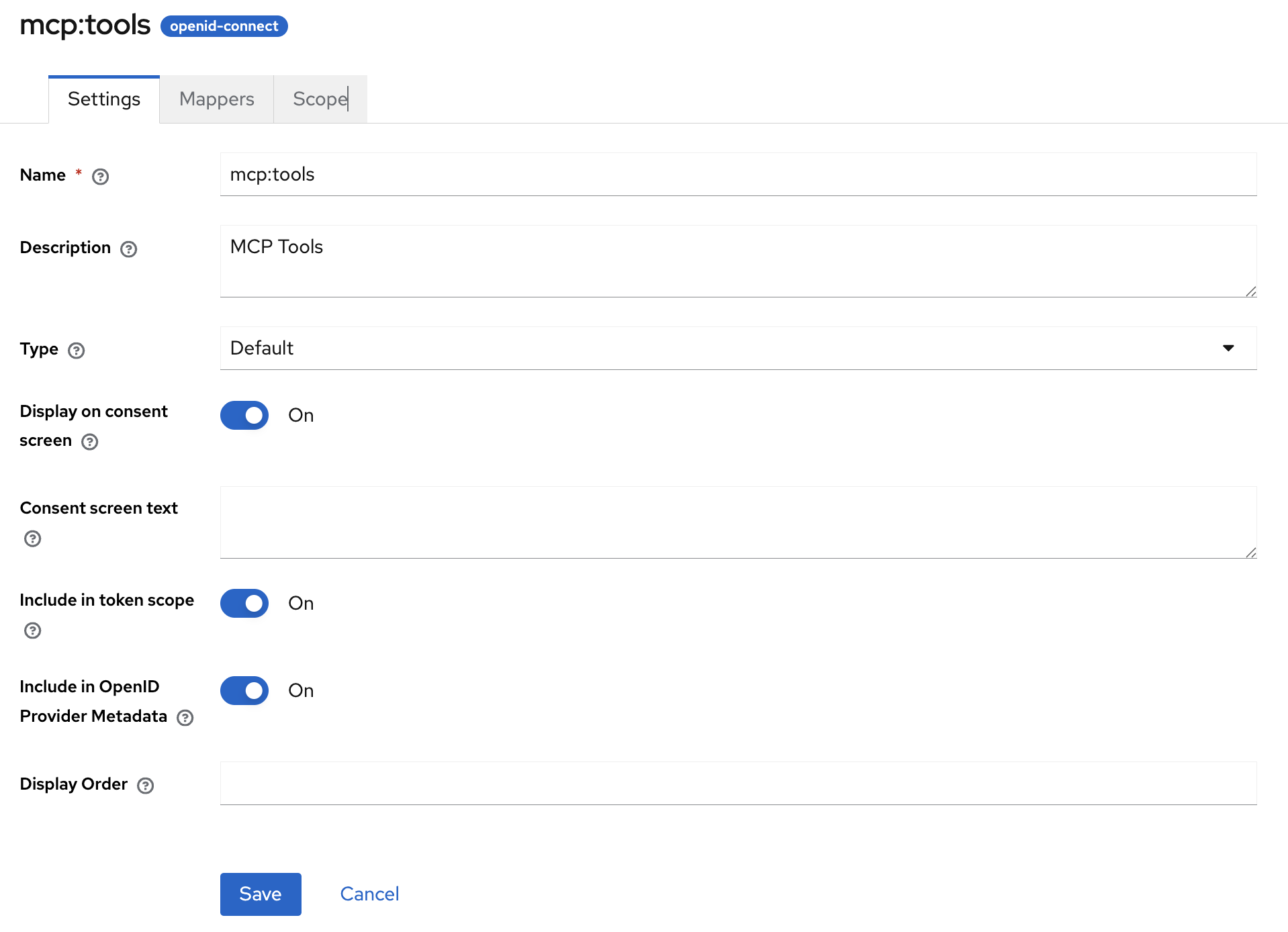
image-20260311105938115

  1. After creating the scope, make sure that you assign its type to Default and have flipped the Include in token scope switch
  2. as this will be needed for token validation.

Audience

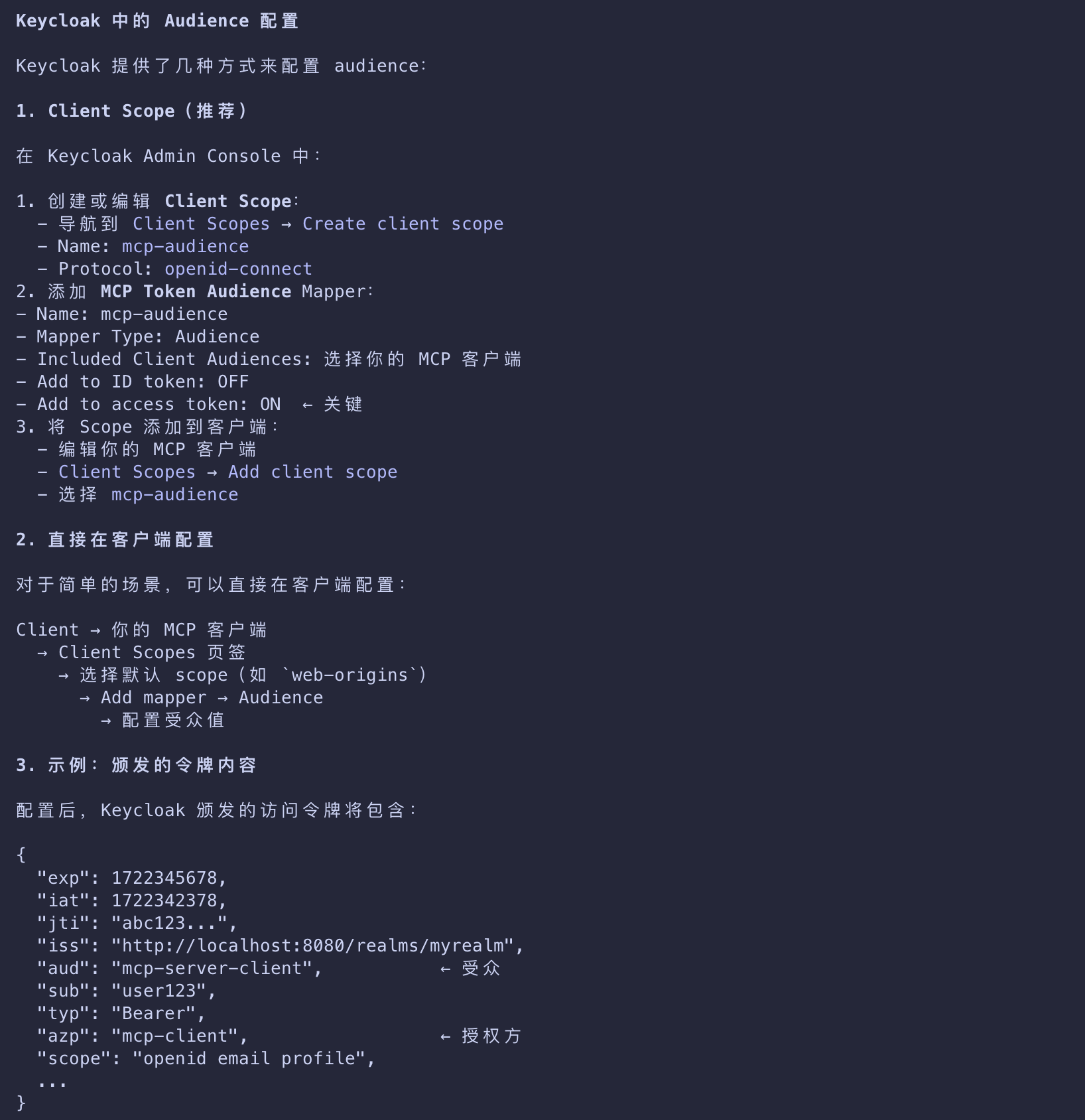
Audience (aud) 是 JWT(JSON Web Token)中的一个标准声明,用于标识该令牌是为谁发行

  1. Let’s now also set up an audience for our Keycloak-issued tokens.
  2. An audience is important to configure because it embeds the intended destination directly into the issued access token.
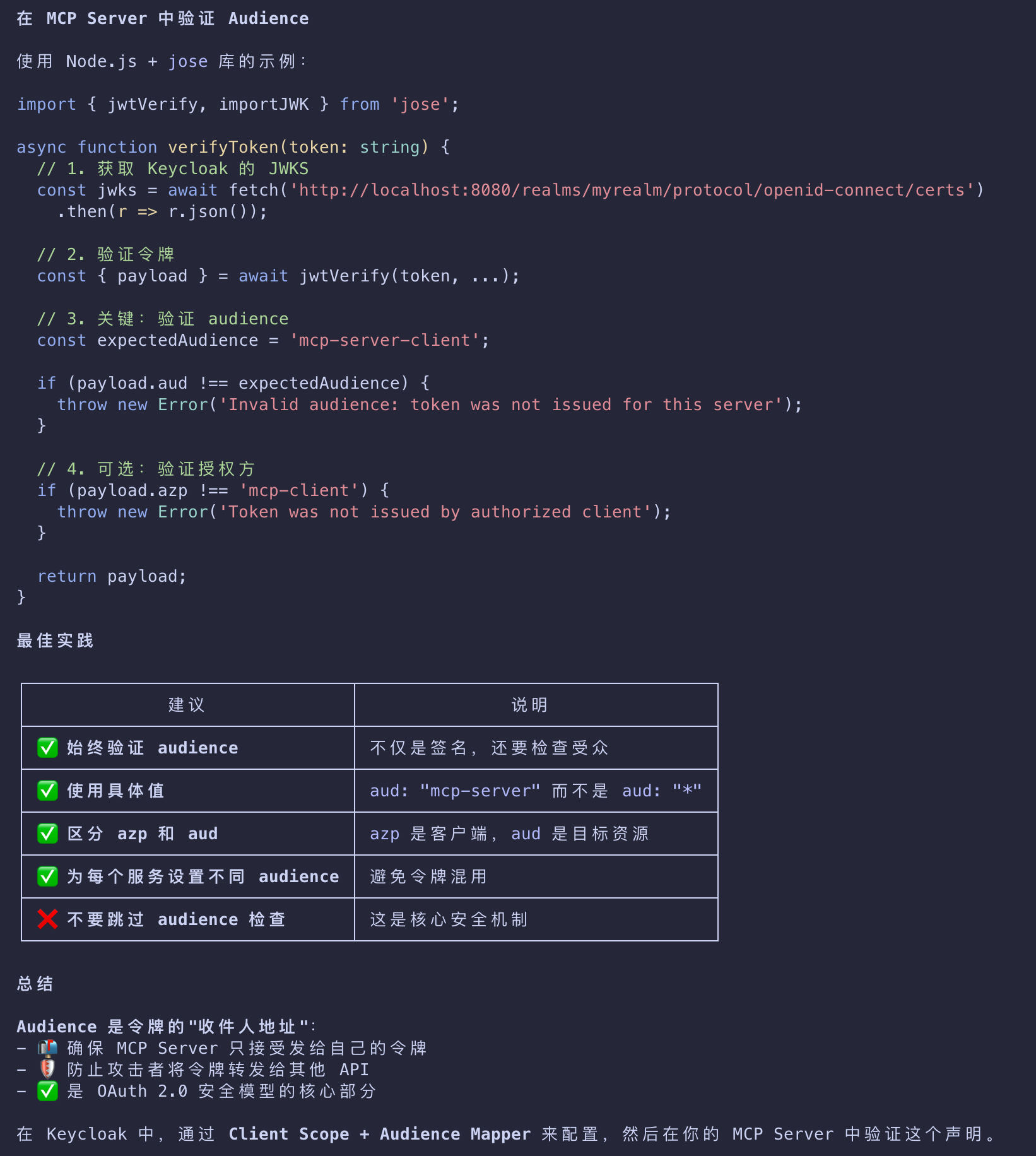
  3. This helps your MCP server to verify that the token it got was actually meant for it rather than some other API.
    • This is key to help avoid token passthrough scenarios.
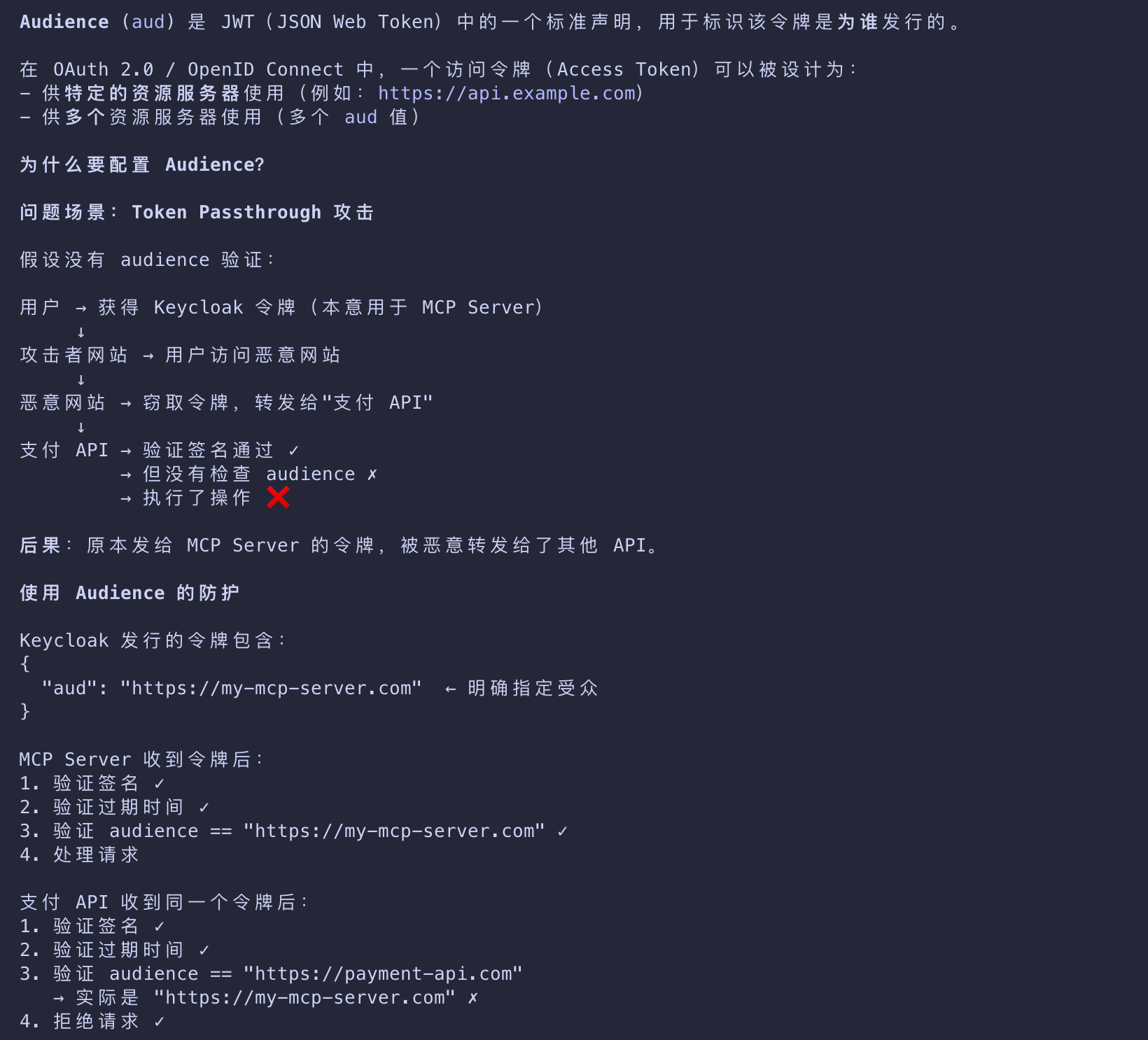
image-20260311110714423

image-20260311110930424

image-20260311121651085

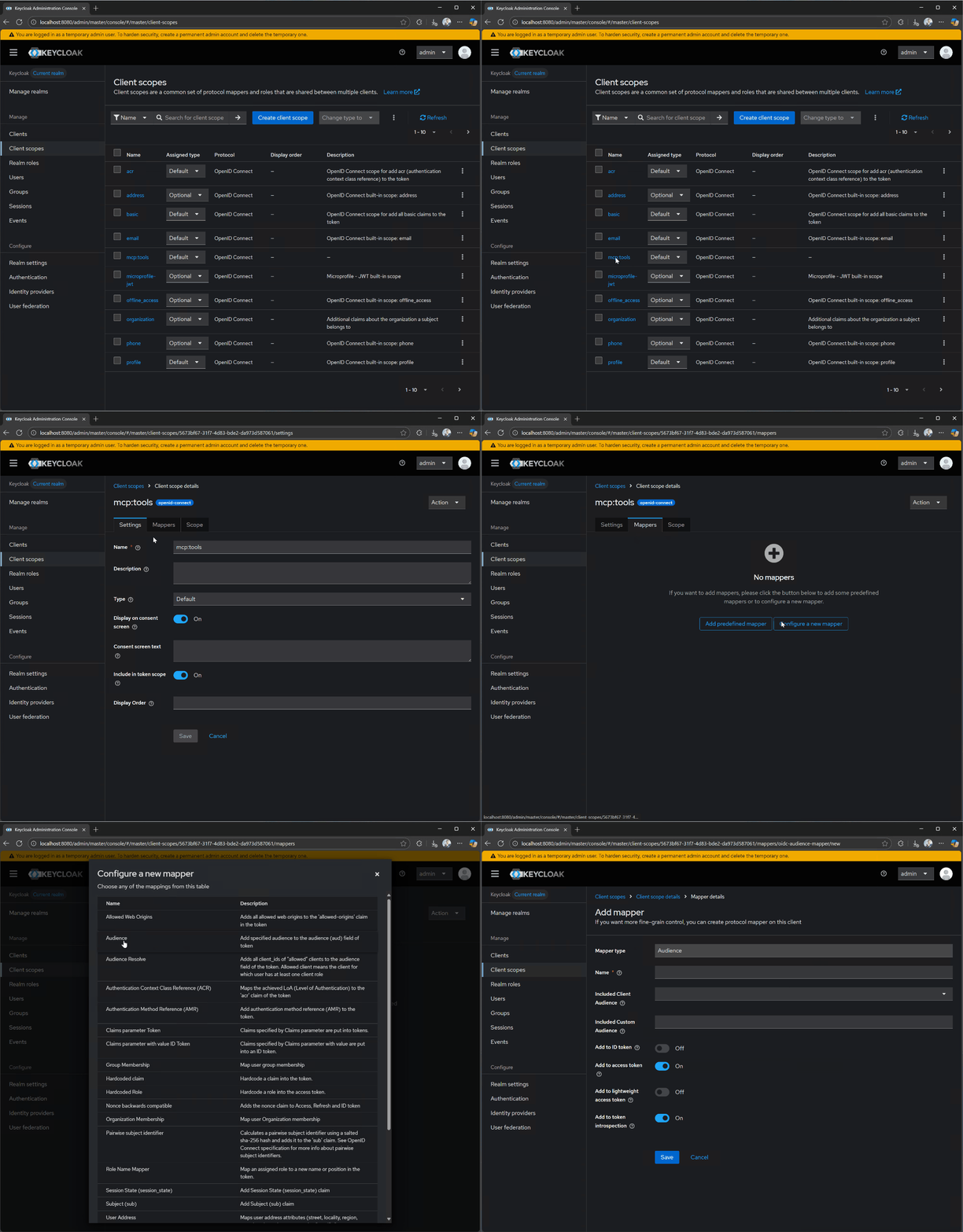
To do this, open your mcp:tools client scope and click on Mappers, followed by Configure a new mapper. Select Audience.
scope-add-audience

  1. For Name, use audience-config. Add a value for Included Custom Audience, set to http://localhost:3000.
  2. This will be the URI of our test MCP server.
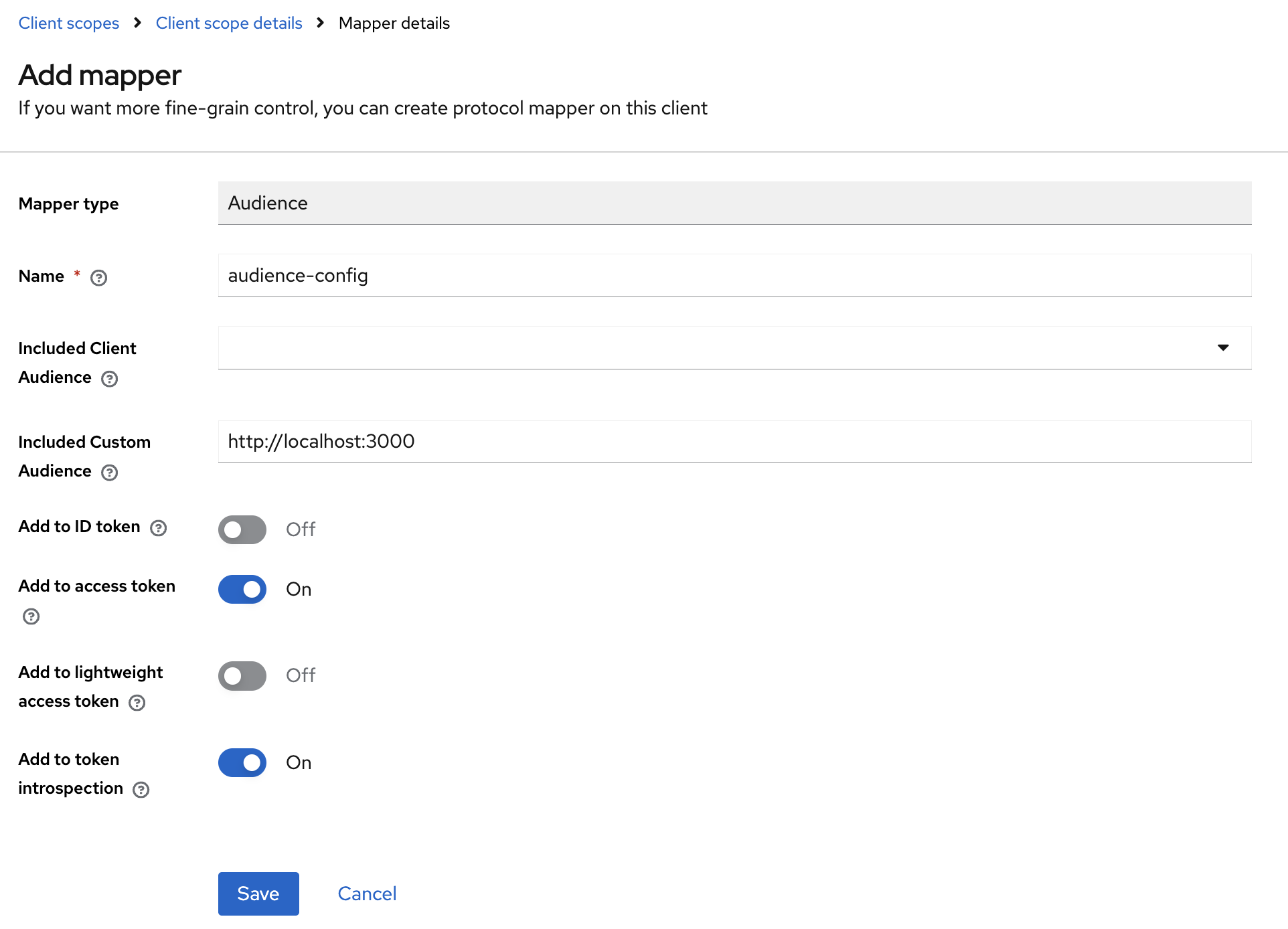
image-20260311122040358

Not for Production

  1. The audience configuration above is meant for testing.
  2. For production scenarios
    • additional set-up and configuration will be required to ensure that audiences
    • are properly constrained for issued tokens.
  3. Specifically, the audience needs to be based on the resource parameter passed from the client, not a fixed value.

Trusted Hosts

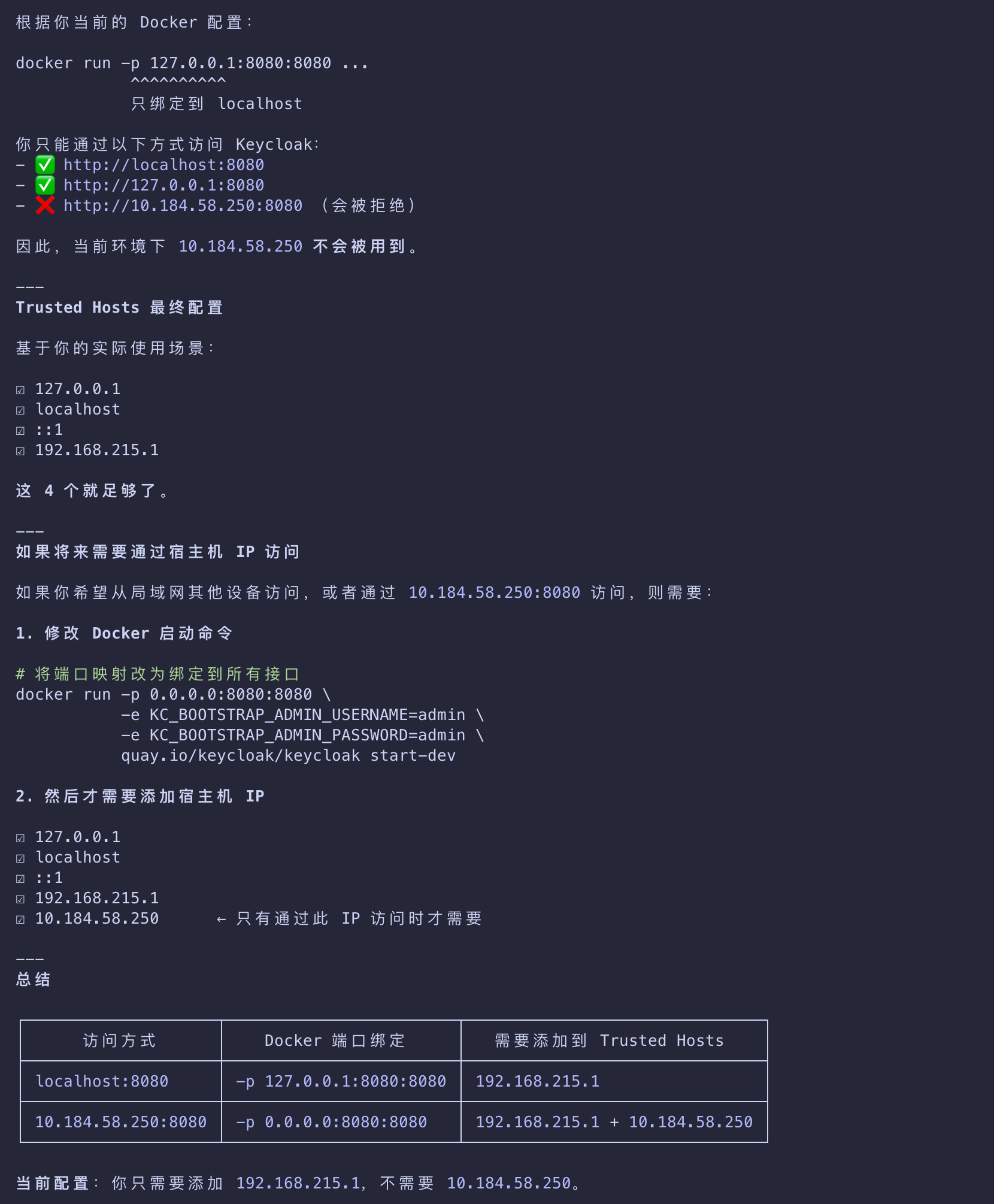
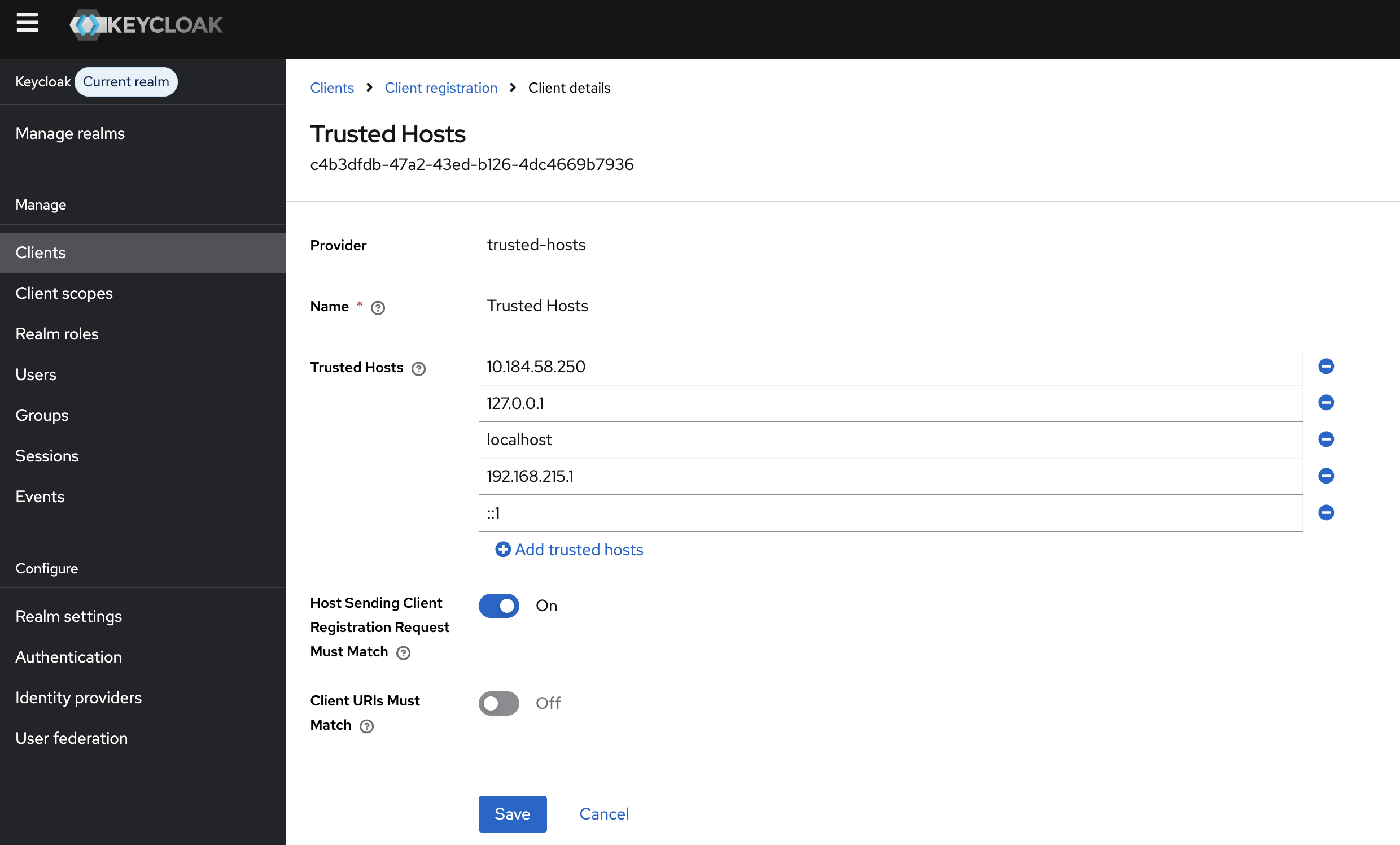
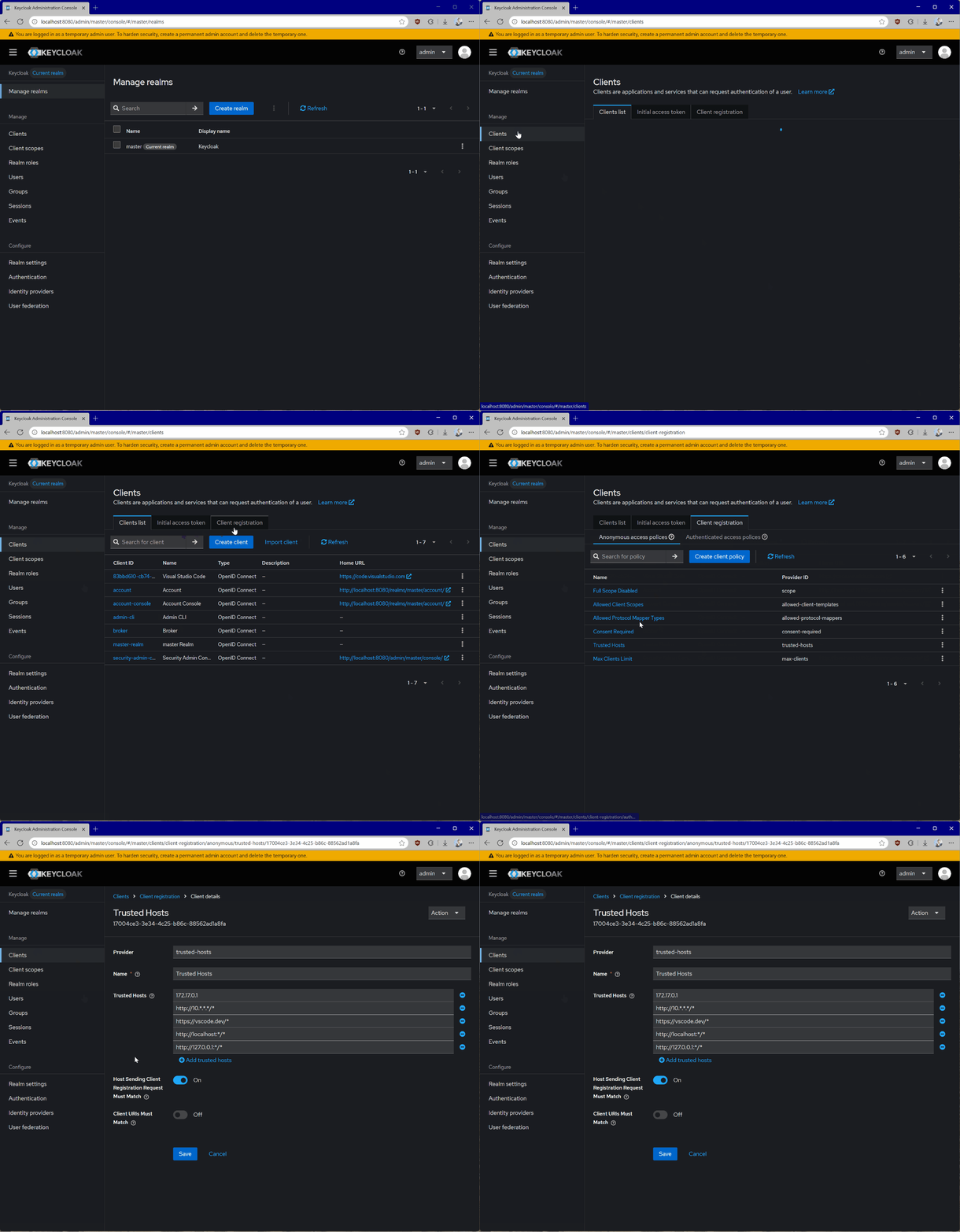
  1. Now, navigate to Clients, then Client registration, and then Trusted Hosts.
  2. Disable the Client URIs Must Match setting and add the hosts from which you’re testing.
  3. You can get your current host IP by running the ifconfig command on Linux or macOS, or ipconfig on Windows.
  4. You can see the IP address you need to add by looking at the keycloak logs for a line that looks like
    • Failed to verify remote host : 192.168.215.1.
  5. Check that the IP address is associated with your host.
    • This may be for a bridge network depending on your docker setup.
keycloak-client

image-20260311135619736

image-20260311135646104

Getting the Host

If you are running Keycloak from a container, you will also be able to see the host IP from the Terminal in the container logs.

Client

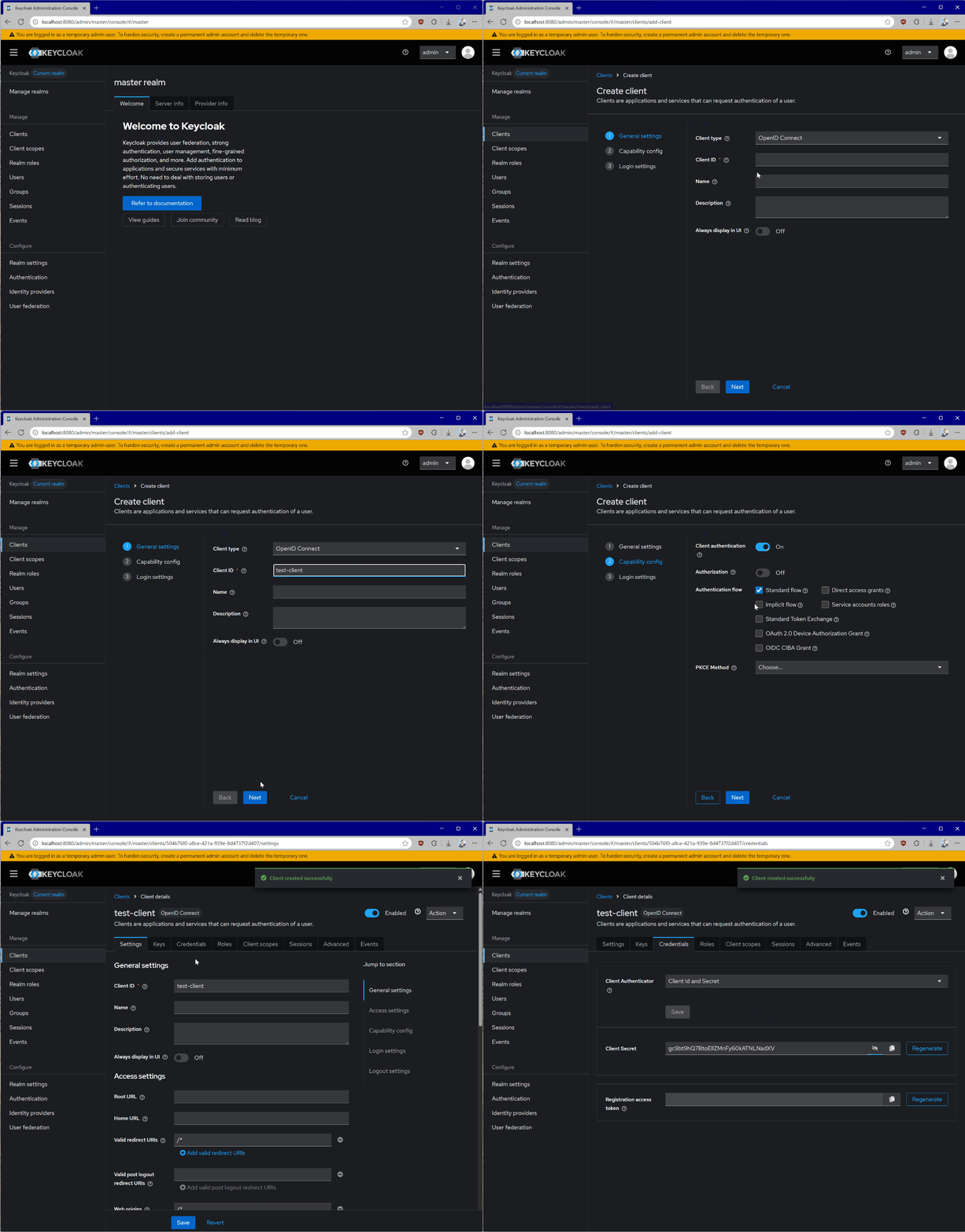
  1. Lastly, we need to register a new client that we can use with the MCP server itself to talk to Keycloak for things like token introspection.
  2. To do that:
    • Go to Clients.
    • Click Create client.
    • Give your client a unique Client ID and click Next.
    • Enable Client authentication and click Next.
    • Click Save.
  3. Worth noting that token introspection is just one of the available approaches to validate tokens.
    • This can also be done with the help of standalone libraries, specific to each language and platform.
  4. When you open the client details, go to Credentials and take note of the Client Secret.
keycloak-client-auth

Handling Secrets

  1. Never embed client credentials directly in your code.
  2. We recommend using environment variables or specialized solutions for secret storage.

With Keycloak configured, every time the authorization flow is triggered, your MCP server will receive a token like this:

1
eyJhbGciOiJSUzI1NiIsInR5cCIgOiAiSldUIiwia2lkIiA6ICI1TjcxMGw1WW5MWk13WGZ1VlJKWGtCS3ZZMzZzb3JnRG5scmlyZ2tlTHlzIn0.eyJleHAiOjE3NTU1NDA4MTcsImlhdCI6MTc1NTU0MDc1NywiYXV0aF90aW1lIjoxNzU1NTM4ODg4LCJqdGkiOiJvbnJ0YWM6YjM0MDgwZmYtODQwNC02ODY3LTgxYmUtMTIzMWI1MDU5M2E4IiwiaXNzIjoiaHR0cDovL2xvY2FsaG9zdDo4MDgwL3JlYWxtcy9tYXN0ZXIiLCJhdWQiOiJodHRwOi8vbG9jYWxob3N0OjMwMDAiLCJzdWIiOiIzM2VkNmM2Yi1jNmUwLTQ5MjgtYTE2MS1mMmY2OWM3YTAzYjkiLCJ0eXAiOiJCZWFyZXIiLCJhenAiOiI3OTc1YTViNi04YjU5LTRhODUtOWNiYS04ZmFlYmRhYjg5NzQiLCJzaWQiOiI4ZjdlYzI3Ni0zNThmLTRjY2MtYjMxMy1kYjA4MjkwZjM3NmYiLCJzY29wZSI6Im1jcDp0b29scyJ9.P5xCRtXORly0R0EXjyqRCUx-z3J4uAOWNAvYtLPXroykZuVCCJ-K1haiQSwbURqfsVOMbL7jiV-sD6miuPzI1tmKOkN_Yct0Vp-azvj7U5rEj7U6tvPfMkg2Uj_jrIX0KOskyU2pVvGZ-5BgqaSvwTEdsGu_V3_E0xDuSBq2uj_wmhqiyTFm5lJ1WkM3Hnxxx1_AAnTj7iOKMFZ4VCwMmk8hhSC7clnDauORc0sutxiJuYUZzxNiNPkmNeQtMCGqWdP1igcbWbrfnNXhJ6NswBOuRbh97_QraET3hl-CNmyS6C72Xc0aOwR_uJ7xVSBTD02OaQ1JA6kjCATz30kGYg

Decoded, it will look like this:

1
2
3
4
5
6
7
8
9
10
11
12
13
14
15
16
17
{
"alg": "RS256",
"typ": "JWT",
"kid": "5N710l5YnLZMwXfuVRJXkBKvY36sorgDnlrirgkeLys"
}.{
"exp": 1755540817,
"iat": 1755540757,
"auth_time": 1755538888,
"jti": "onrtac:b34080ff-8404-6867-81be-1231b50593a8",
"iss": "http://localhost:8080/realms/master",
"aud": "http://localhost:3000",
"sub": "33ed6c6b-c6e0-4928-a161-f2f69c7a03b9",
"typ": "Bearer",
"azp": "7975a5b6-8b59-4a85-9cba-8faebdab8974",
"sid": "8f7ec276-358f-4ccc-b313-db08290f376f",
"scope": "mcp:tools"
}.[Signature]

Embedded Audience

  1. Notice the aud claim embedded in the token
  2. it’s currently set to be the URI of the test MCP server and it’s inferred from the scope that we’ve previously configured.
  3. This will be important in our implementation to validate.

MCP Server Setup

  1. We will now set up our MCP server to use the locally-running Keycloak authorization server.
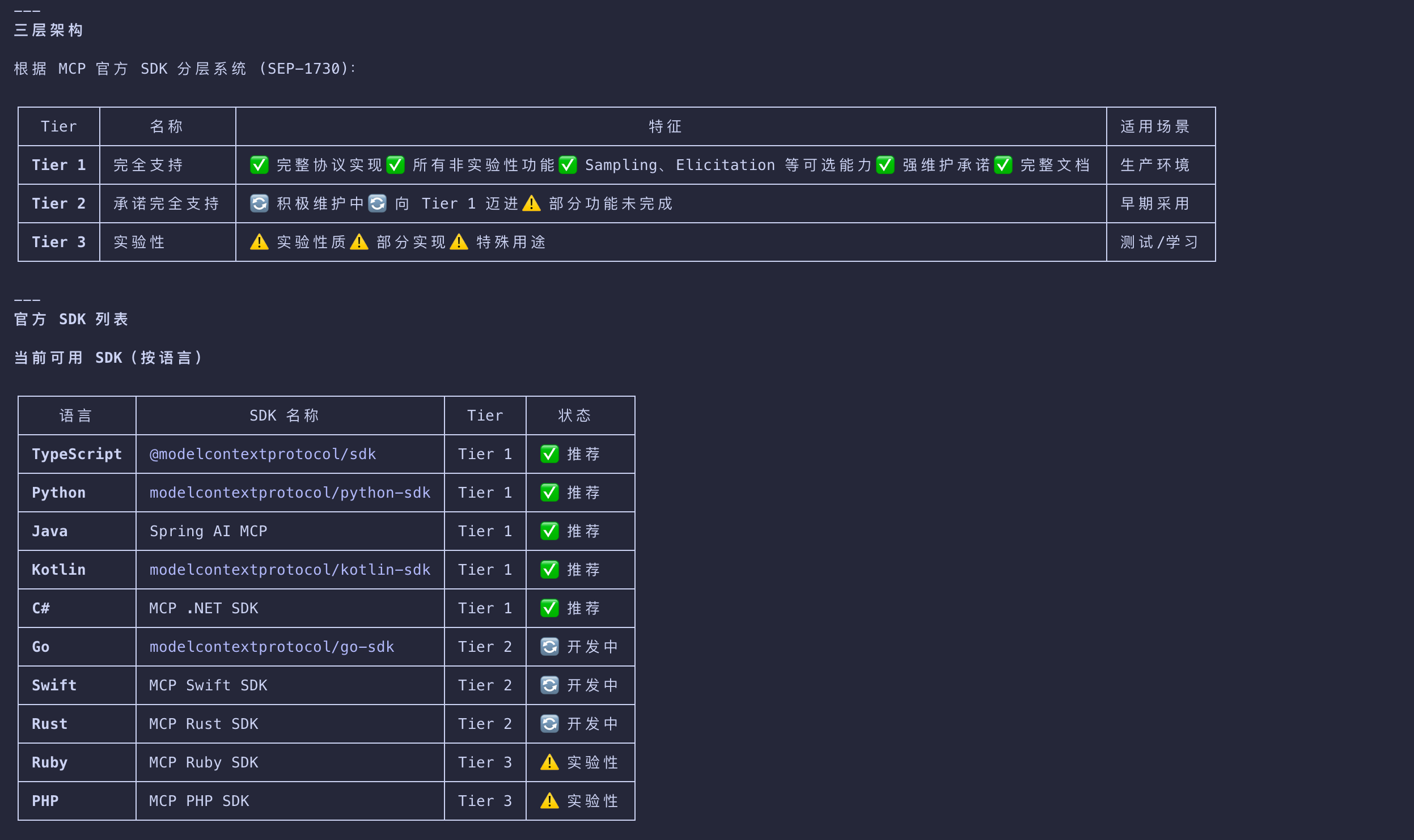
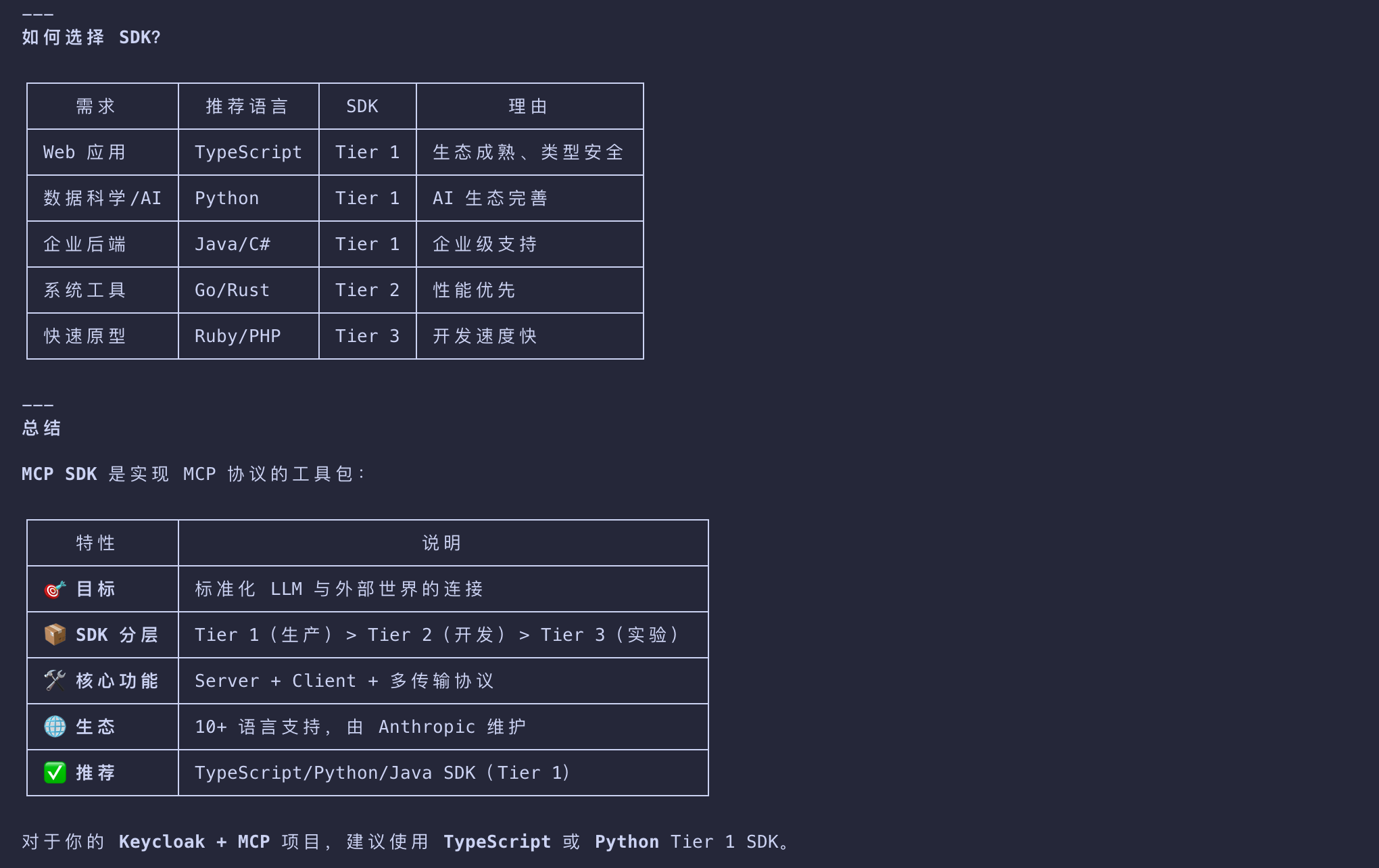
  2. Depending on your programming language preference, you can use one of the supported MCP SDKs.
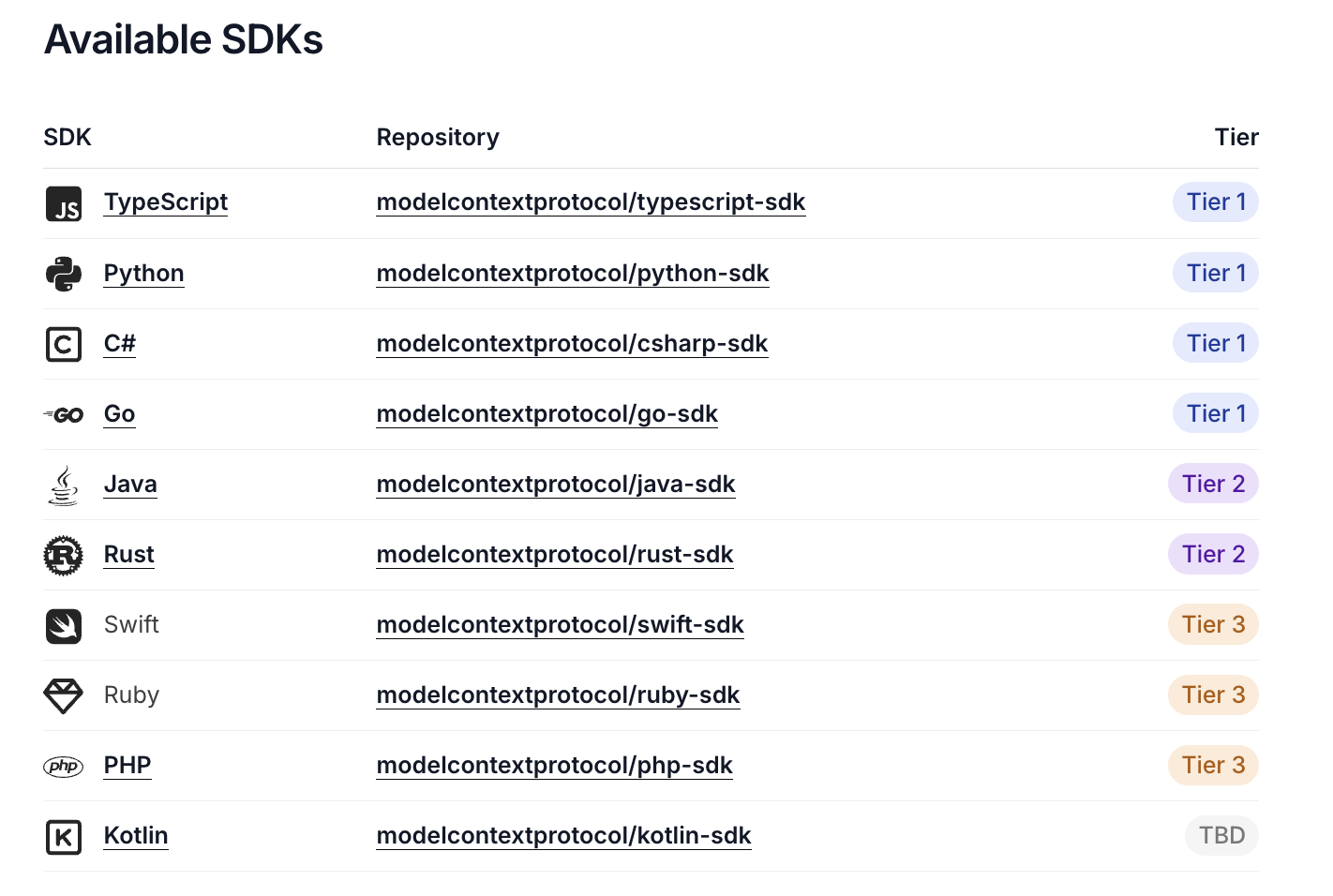
image-20260311140951291

image-20260311141142942

image-20260311141227609

  1. For our testing purposes, we will create an extremely simple MCP server that exposes two tools
  2. one for addition and another for multiplication. The server will require authorization to access these.

Python

  1. To simplify our authorization interaction, in Python scenarios we rely on FastMCP.
  2. Many of the conventions around authorization, like the endpoints and token validation logic
    • are consistent across languages, but some offer simpler ways of integrating them in production scenarios.
  3. Prior to writing the actual server, we need to set up our configuration in config.py
    • the contents are entirely based on your local server setup:
1
2
3
4
5
6
7
8
9
10
11
12
13
14
15
16
17
18
19
20
21
22
23
24
25
26
27
28
29
30
31
32
33
34
35
36
37
38
39
40
41
42
43
44
45
"""Configuration settings for the MCP auth server."""

import os
from typing import Optional


class Config:
"""Configuration class that loads from environment variables with sensible defaults."""

# Server settings
HOST: str = os.getenv("HOST", "localhost")
PORT: int = int(os.getenv("PORT", "3000"))

# Auth server settings
AUTH_HOST: str = os.getenv("AUTH_HOST", "localhost")
AUTH_PORT: int = int(os.getenv("AUTH_PORT", "8080"))
AUTH_REALM: str = os.getenv("AUTH_REALM", "master")

# OAuth client settings
OAUTH_CLIENT_ID: str = os.getenv("OAUTH_CLIENT_ID", "test-client")
OAUTH_CLIENT_SECRET: str = os.getenv("OAUTH_CLIENT_SECRET", "ZPdF24mawV9BifgOef3GvUkfqYGGYs9k")

# Server settings
MCP_SCOPE: str = os.getenv("MCP_SCOPE", "mcp:tools")
OAUTH_STRICT: bool = os.getenv("OAUTH_STRICT", "false").lower() in ("true", "1", "yes")
TRANSPORT: str = os.getenv("TRANSPORT", "streamable-http")

@property
def server_url(self) -> str:
"""Build the server URL."""
return f"http://{self.HOST}:{self.PORT}"

@property
def auth_base_url(self) -> str:
"""Build the auth server base URL."""
return f"http://{self.AUTH_HOST}:{self.AUTH_PORT}/realms/{self.AUTH_REALM}/"

def validate(self) -> None:
"""Validate configuration."""
if self.TRANSPORT not in ["sse", "streamable-http"]:
raise ValueError(f"Invalid transport: {self.TRANSPORT}. Must be 'sse' or 'streamable-http'")


# Global configuration instance
config = Config()

The server implementation is as follows:

1
2
3
4
5
6
7
8
9
10
11
12
13
14
15
16
17
18
19
20
21
22
23
24
25
26
27
28
29
30
31
32
33
34
35
36
37
38
39
40
41
42
43
44
45
46
47
48
49
50
51
52
53
54
55
56
57
58
59
60
61
62
63
64
65
66
67
68
69
70
71
72
73
74
75
76
77
78
79
80
81
82
83
84
85
86
87
88
89
90
91
92
93
94
95
96
97
98
99
100
101
102
103
104
105
106
107
108
109
110
111
112
113
114
115
116
117
118
119
120
121
122
123
124
125
126
127
128
129
130
131
132
133
134
135
136
137
138
import datetime
import logging
from typing import Any

from pydantic import AnyHttpUrl

from mcp.server.auth.settings import AuthSettings
from mcp.server.fastmcp.server import FastMCP

from config import config
from token_verifier import IntrospectionTokenVerifier

logger = logging.getLogger(__name__)


def create_oauth_urls() -> dict[str, str]:
"""Create OAuth URLs based on configuration (Keycloak-style)."""
from urllib.parse import urljoin

auth_base_url = config.auth_base_url

return {
"issuer": auth_base_url,
"introspection_endpoint": urljoin(auth_base_url, "protocol/openid-connect/token/introspect"),
"authorization_endpoint": urljoin(auth_base_url, "protocol/openid-connect/auth"),
"token_endpoint": urljoin(auth_base_url, "protocol/openid-connect/token"),
}


def create_server() -> FastMCP:
"""Create and configure the FastMCP server."""

config.validate()

oauth_urls = create_oauth_urls()

token_verifier = IntrospectionTokenVerifier(
introspection_endpoint=oauth_urls["introspection_endpoint"],
server_url=config.server_url,
client_id=config.OAUTH_CLIENT_ID,
client_secret=config.OAUTH_CLIENT_SECRET,
)

app = FastMCP(
name="MCP Resource Server",
instructions="Resource Server that validates tokens via Authorization Server introspection",
host=config.HOST,
port=config.PORT,
debug=True,
streamable_http_path="/",
token_verifier=token_verifier,
auth=AuthSettings(
issuer_url=AnyHttpUrl(oauth_urls["issuer"]),
required_scopes=[config.MCP_SCOPE],
resource_server_url=AnyHttpUrl(config.server_url),
),
)

@app.tool()
async def add_numbers(a: float, b: float) -> dict[str, Any]:
"""
Add two numbers together.
This tool demonstrates basic arithmetic operations with OAuth authentication.

Args:
a: The first number to add
b: The second number to add
"""
result = a + b
return {
"operation": "addition",
"operand_a": a,
"operand_b": b,
"result": result,
"timestamp": datetime.datetime.now().isoformat()
}

@app.tool()
async def multiply_numbers(x: float, y: float) -> dict[str, Any]:
"""
Multiply two numbers together.
This tool demonstrates basic arithmetic operations with OAuth authentication.

Args:
x: The first number to multiply
y: The second number to multiply
"""
result = x * y
return {
"operation": "multiplication",
"operand_x": x,
"operand_y": y,
"result": result,
"timestamp": datetime.datetime.now().isoformat()
}

return app


def main() -> int:
"""
Run the MCP Resource Server.

This server:
- Provides RFC 9728 Protected Resource Metadata
- Validates tokens via Authorization Server introspection
- Serves MCP tools requiring authentication

Configuration is loaded from config.py and environment variables.
"""
logging.basicConfig(level=logging.INFO)

try:
config.validate()
oauth_urls = create_oauth_urls()

except ValueError as e:
logger.error("Configuration error: %s", e)
return 1

try:
mcp_server = create_server()

logger.info("Starting MCP Server on %s:%s", config.HOST, config.PORT)
logger.info("Authorization Server: %s", oauth_urls["issuer"])
logger.info("Transport: %s", config.TRANSPORT)

mcp_server.run(transport=config.TRANSPORT)
return 0

except Exception:
logger.exception("Server error")
return 1


if __name__ == "__main__":
exit(main())

  1. Lastly, the token verification logic is delegated entirely to token_verifier.py
  2. ensuring that we can use the Keycloak introspection endpoint to verify the validity of any credential artifacts
1
2
3
4
5
6
7
8
9
10
11
12
13
14
15
16
17
18
19
20
21
22
23
24
25
26
27
28
29
30
31
32
33
34
35
36
37
38
39
40
41
42
43
44
45
46
47
48
49
50
51
52
53
54
55
56
57
58
59
60
61
62
63
64
65
66
67
68
69
70
71
72
73
74
75
76
77
78
79
80
81
82
83
84
85
86
87
88
89
90
91
92
93
94
95
96
97
98
99
"""Token verifier implementation using OAuth 2.0 Token Introspection (RFC 7662)."""

import logging
from typing import Any

from mcp.server.auth.provider import AccessToken, TokenVerifier
from mcp.shared.auth_utils import check_resource_allowed, resource_url_from_server_url

logger = logging.getLogger(__name__)


class IntrospectionTokenVerifier(TokenVerifier):
"""Token verifier that uses OAuth 2.0 Token Introspection (RFC 7662).
"""

def __init__(
self,
introspection_endpoint: str,
server_url: str,
client_id: str,
client_secret: str,
):
self.introspection_endpoint = introspection_endpoint
self.server_url = server_url
self.client_id = client_id
self.client_secret = client_secret
self.resource_url = resource_url_from_server_url(server_url)

async def verify_token(self, token: str) -> AccessToken | None:
"""Verify token via introspection endpoint."""
import httpx

if not self.introspection_endpoint.startswith(("https://", "http://localhost", "http://127.0.0.1")):
return None

timeout = httpx.Timeout(10.0, connect=5.0)
limits = httpx.Limits(max_connections=10, max_keepalive_connections=5)

async with httpx.AsyncClient(
timeout=timeout,
limits=limits,
verify=True,
) as client:
try:
form_data = {
"token": token,
"client_id": self.client_id,
"client_secret": self.client_secret,
}
headers = {"Content-Type": "application/x-www-form-urlencoded"}

response = await client.post(
self.introspection_endpoint,
data=form_data,
headers=headers,
)

if response.status_code != 200:
return None

data = response.json()
if not data.get("active", False):
return None

if not self._validate_resource(data):
return None

return AccessToken(
token=token,
client_id=data.get("client_id", "unknown"),
scopes=data.get("scope", "").split() if data.get("scope") else [],
expires_at=data.get("exp"),
resource=data.get("aud"), # Include resource in token
)

except Exception as e:
return None

def _validate_resource(self, token_data: dict[str, Any]) -> bool:
"""Validate token was issued for this resource server.

Rules:
- Reject if 'aud' missing.
- Accept if any audience entry matches the derived resource URL.
- Supports string or list forms per JWT spec.
"""
if not self.server_url or not self.resource_url:
return False

aud: list[str] | str | None = token_data.get("aud")
if isinstance(aud, list):
return any(self._is_valid_resource(a) for a in aud)
if isinstance(aud, str):
return self._is_valid_resource(aud)
return False

def _is_valid_resource(self, resource: str) -> bool:
"""Check if the given resource matches our server."""
return check_resource_allowed(self.resource_url, resource)

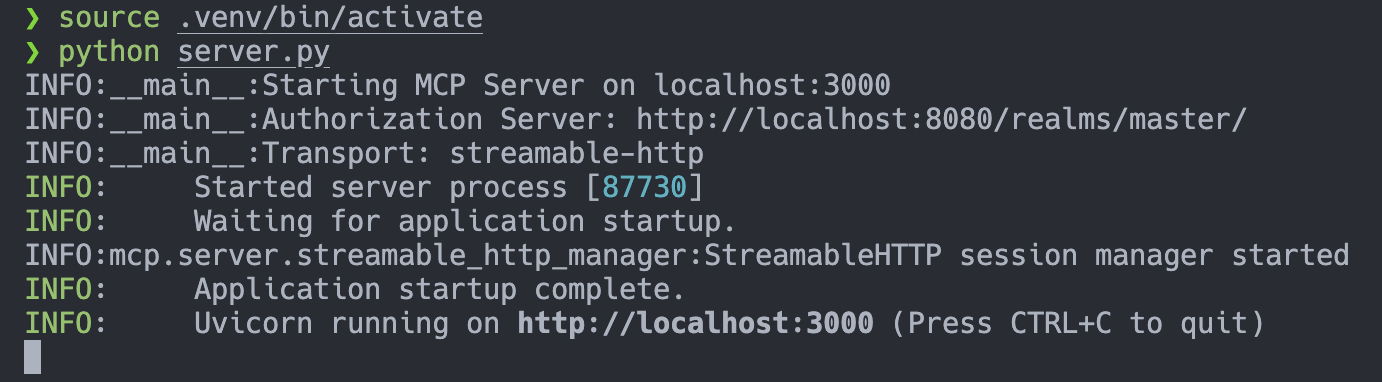
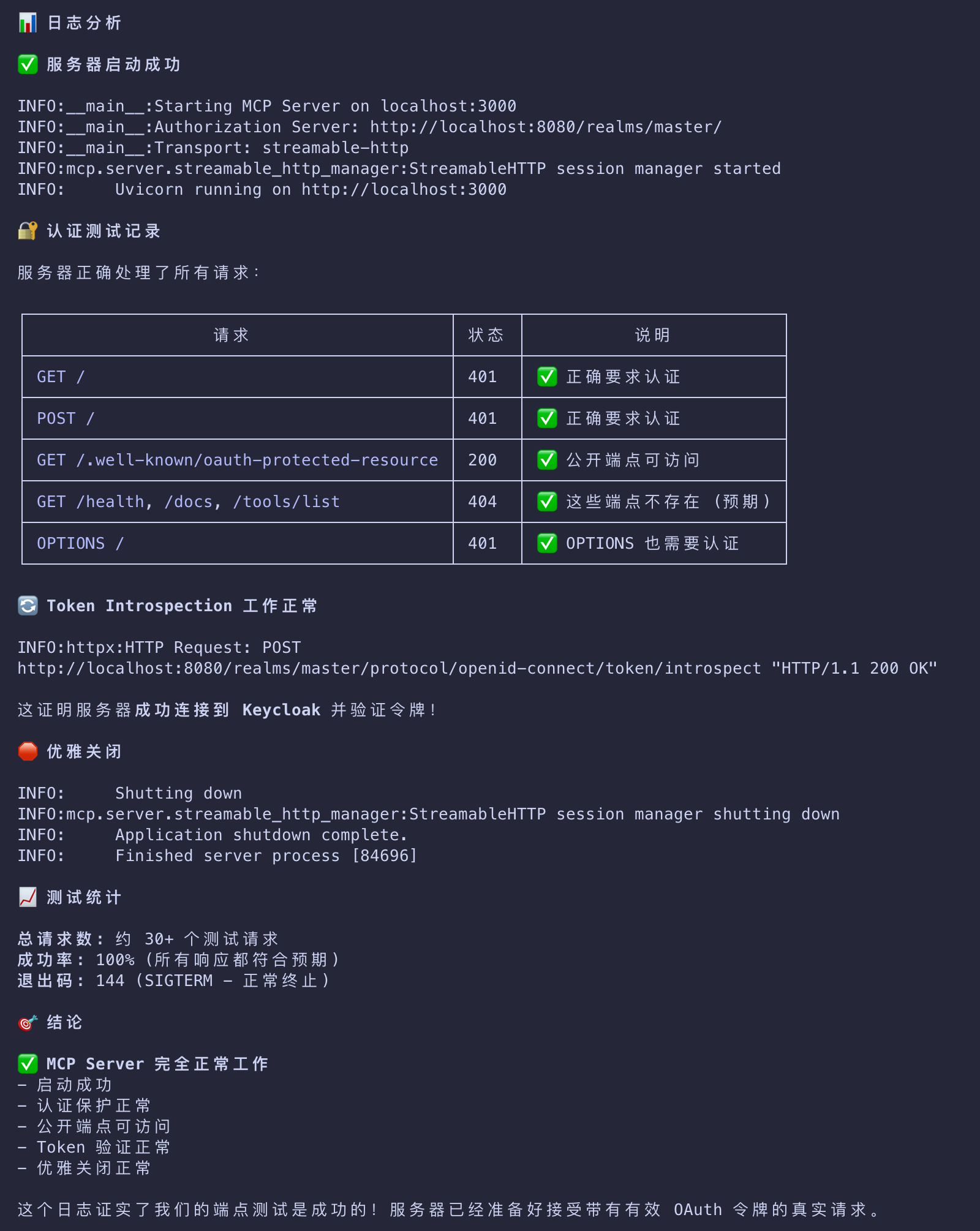
启动并测试 MCP Server

image-20260311144403007

image-20260311144305004

Testing the MCP Server

Visual Studio Code

  1. For testing purposes, we will be using Visual Studio Code
    • but any client that supports MCP and the new authorization specification will fit.
  2. Press Cmd + Shift + P and select MCP: Add server…. Select HTTP and enter http://localhost:3000.
  3. Give the server a unique name to be used inside Visual Studio Code.
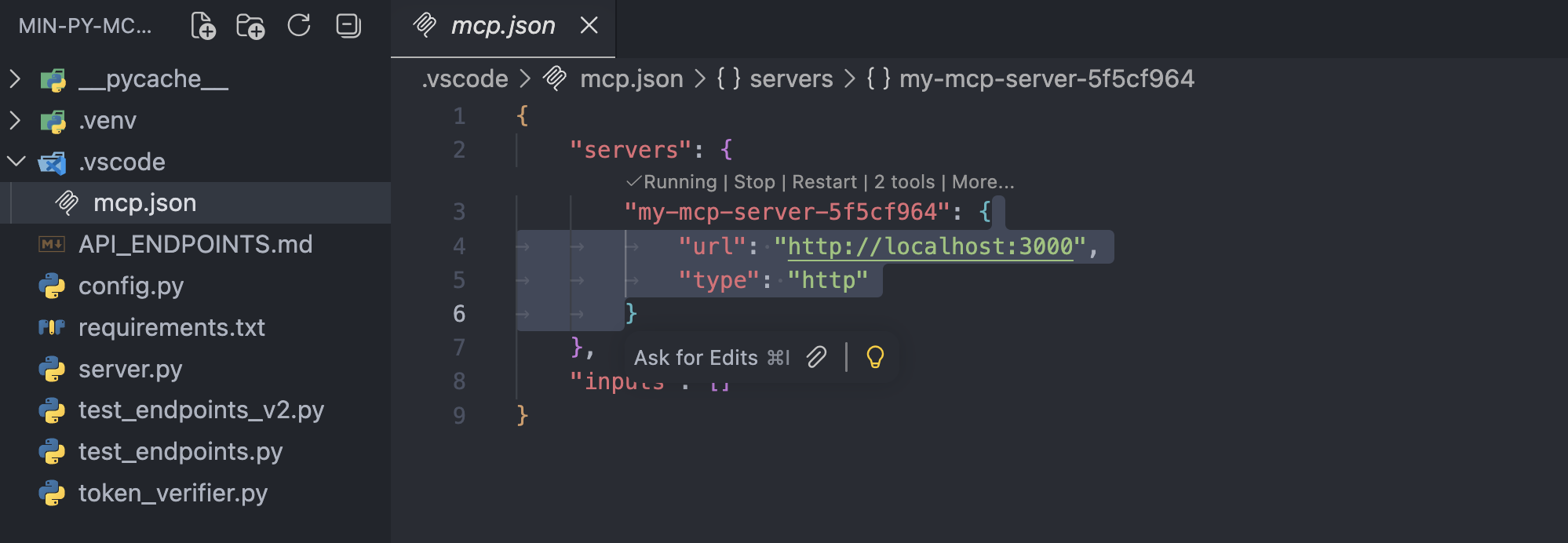
  4. In mcp.json you should now see an entry like this:
1
2
3
4
"my-mcp-server-18676652": {
"url": "http://localhost:3000",
"type": "http"
}

On connection, you will be taken to the browser, where you will be prompted to consent to Visual Studio Code having access to the mcp:tools scope.
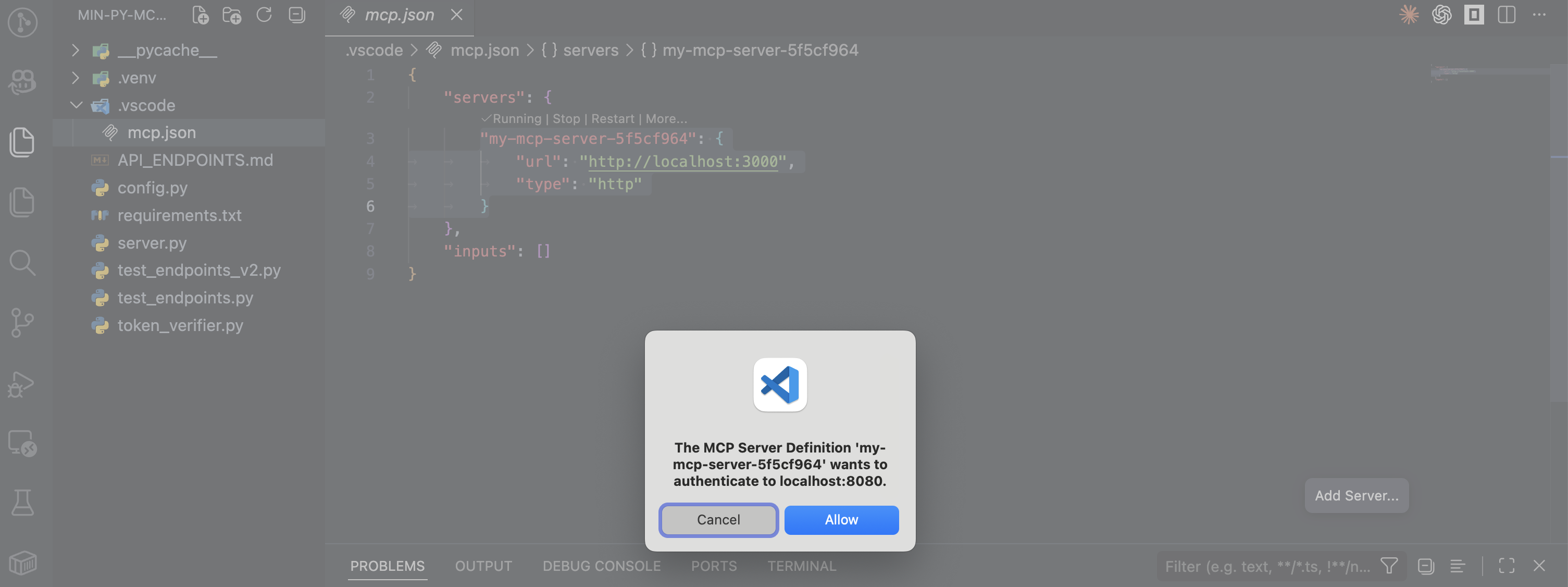
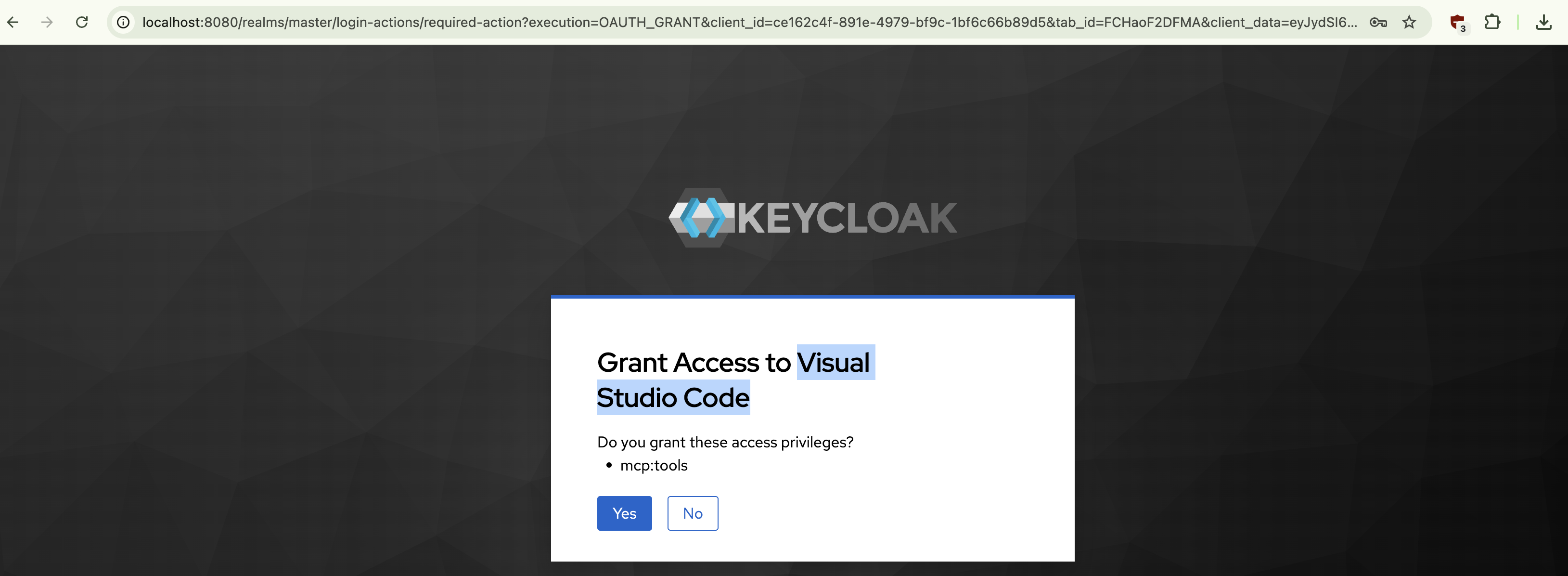
image-20260311144724971

image-20260311144946933

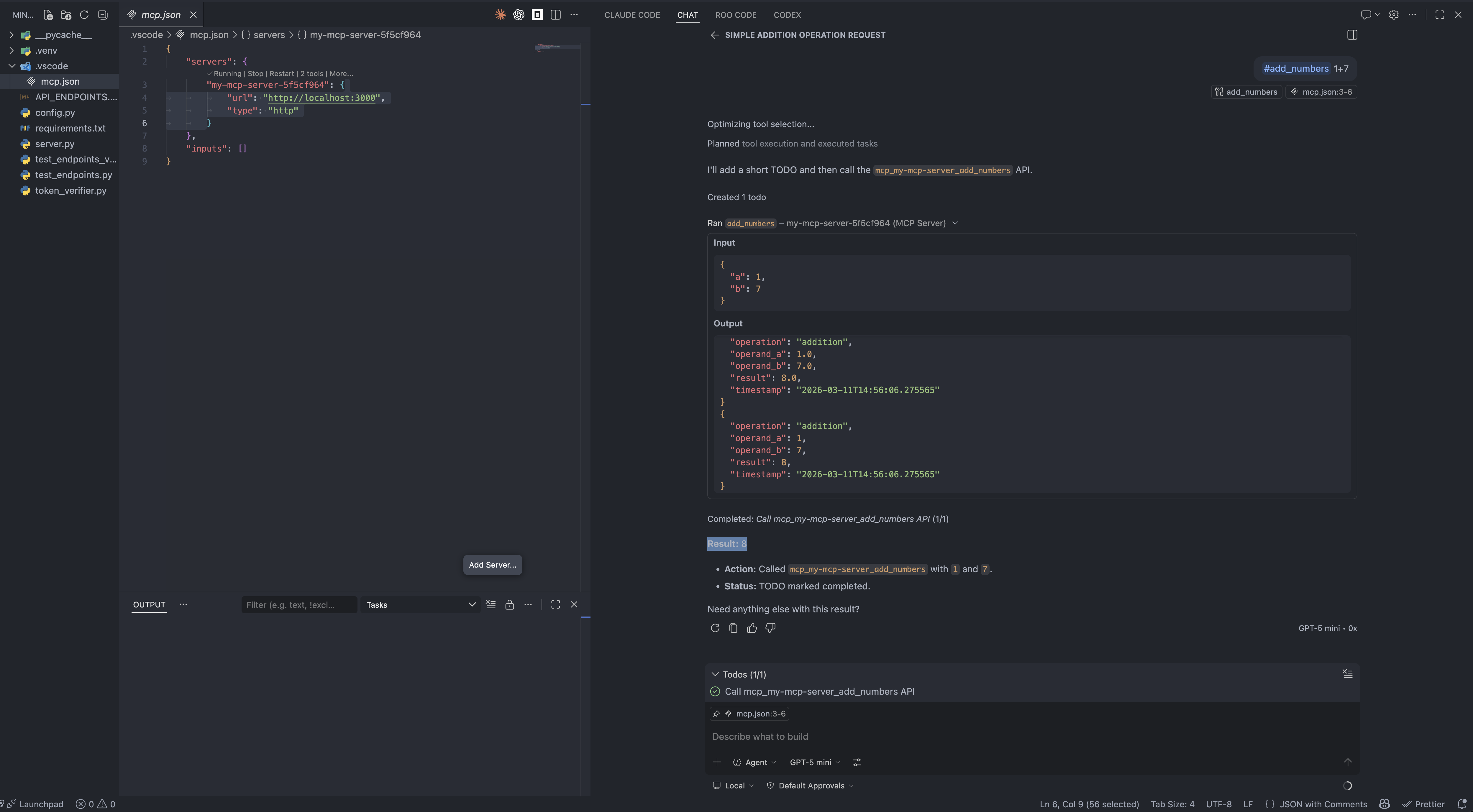
After consenting, you will see the tools listed right above the server entry in mcp.json.
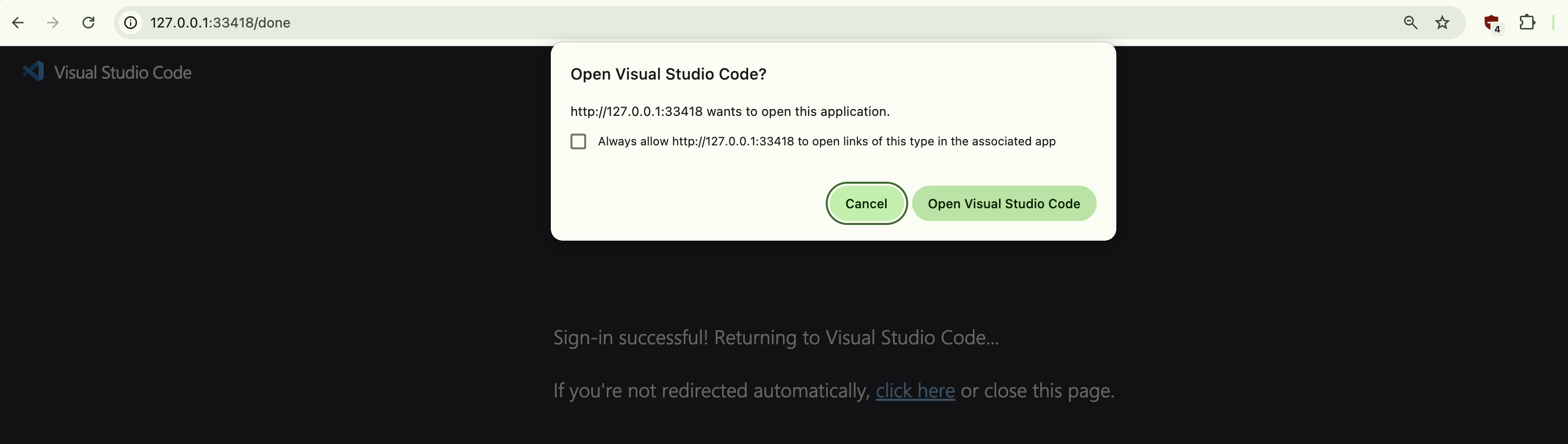
image-20260311145111878

image-20260311145209554

You will be able to invoke individual tools with the help of the # sign in the chat view.
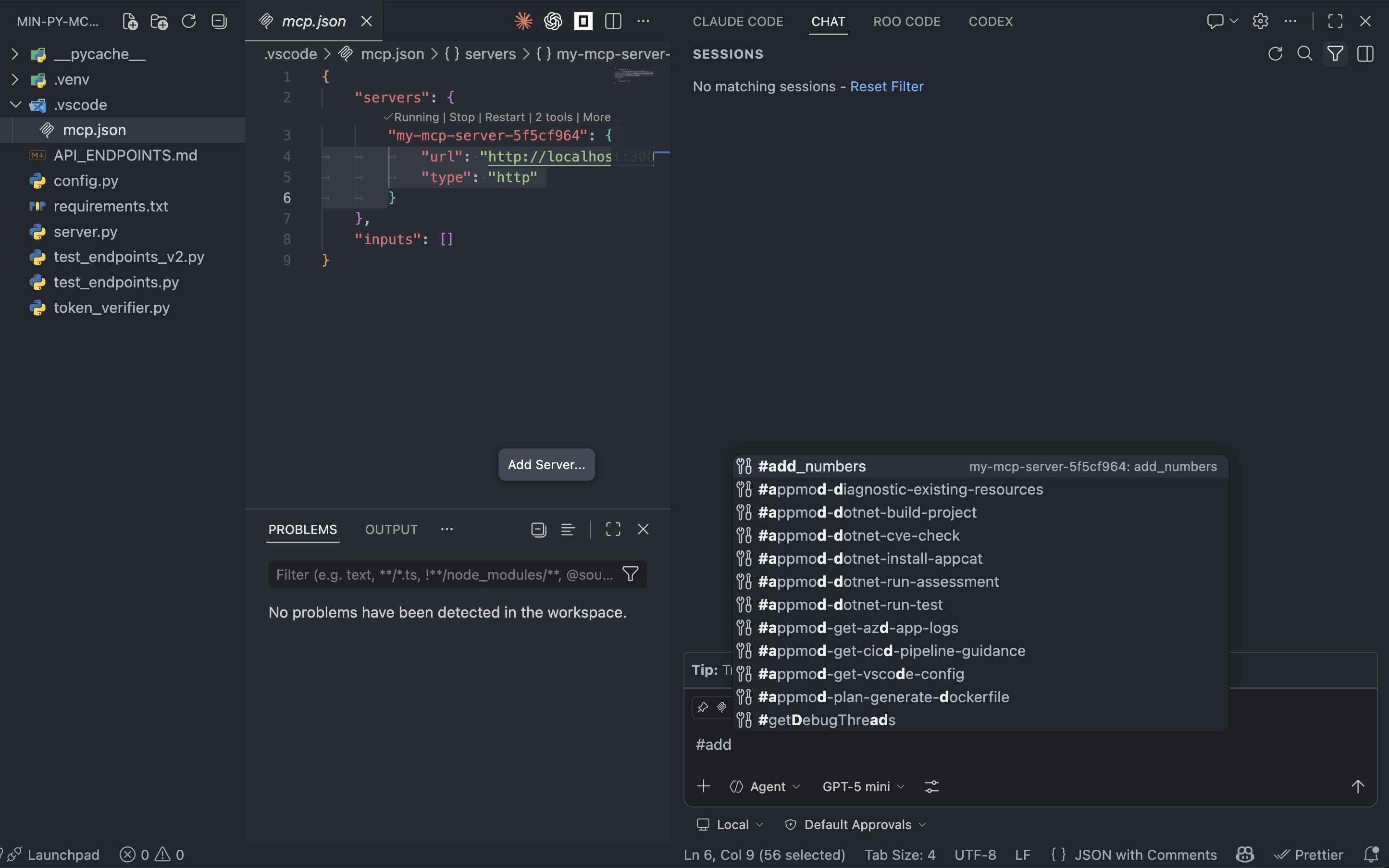
image-20260311145420987

image-20260311145737215

Claude Code

~/.claude.json

1
2
3
4
5
6
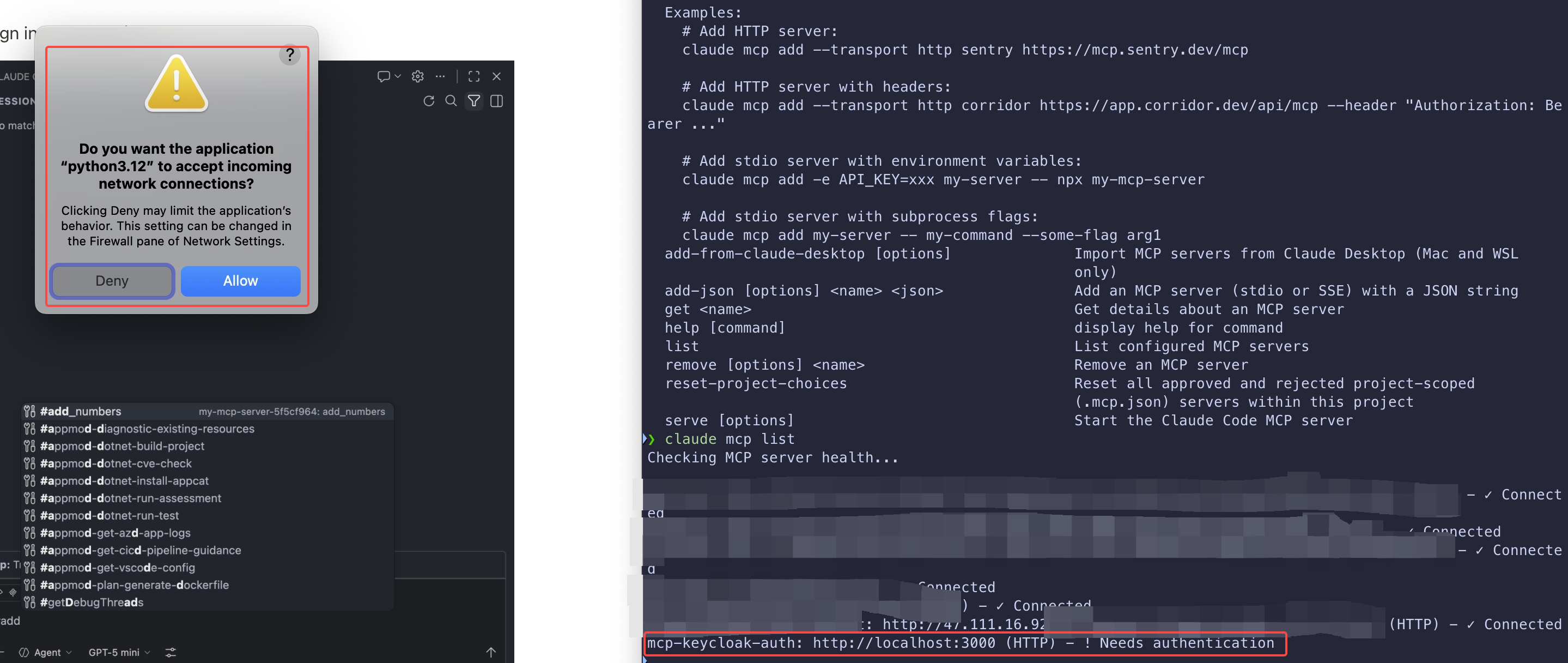
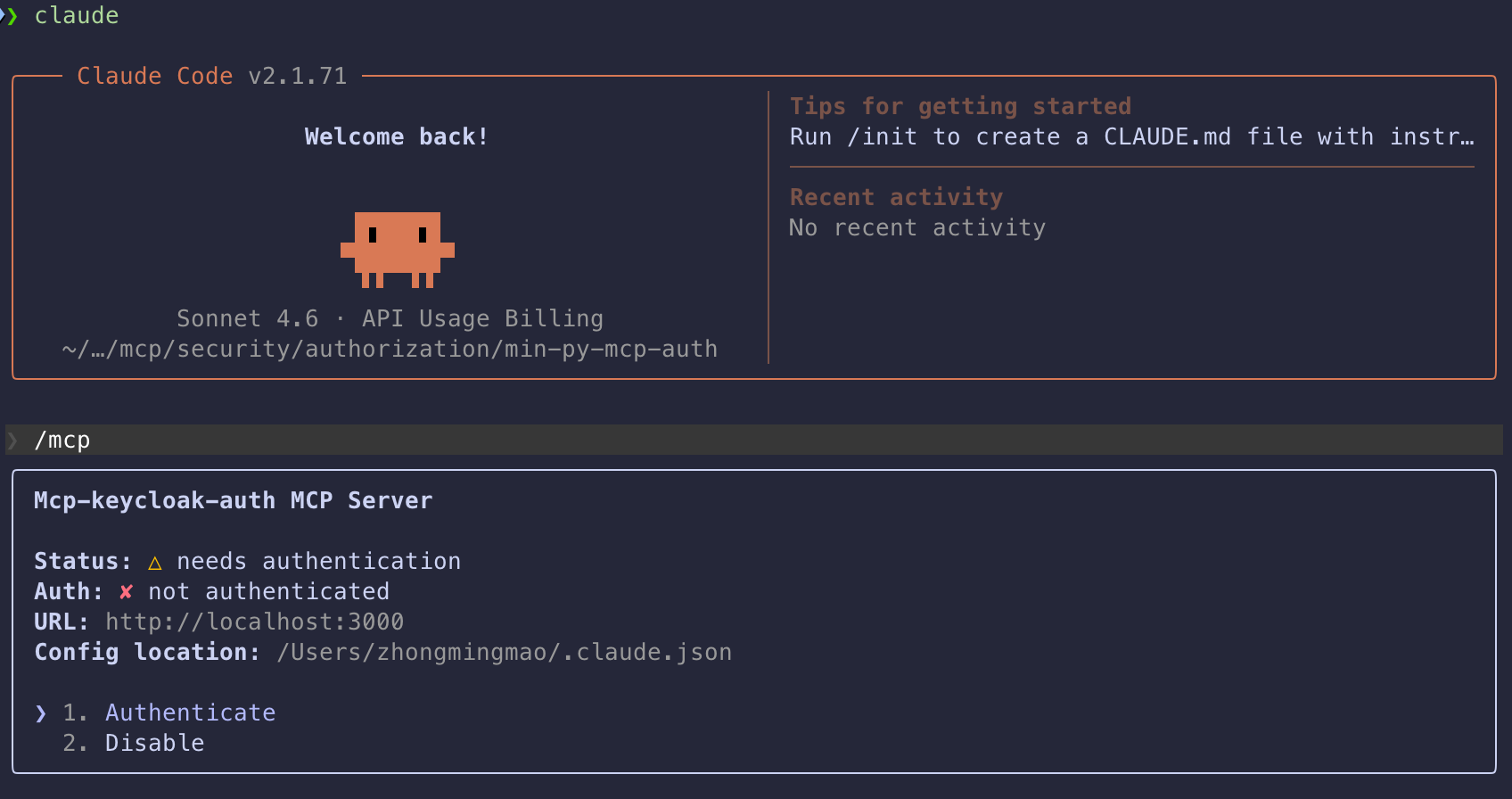
"mcpServers": {
"mcp-keycloak-auth": {
"type": "http",
"url": "http://localhost:3000"
}
}

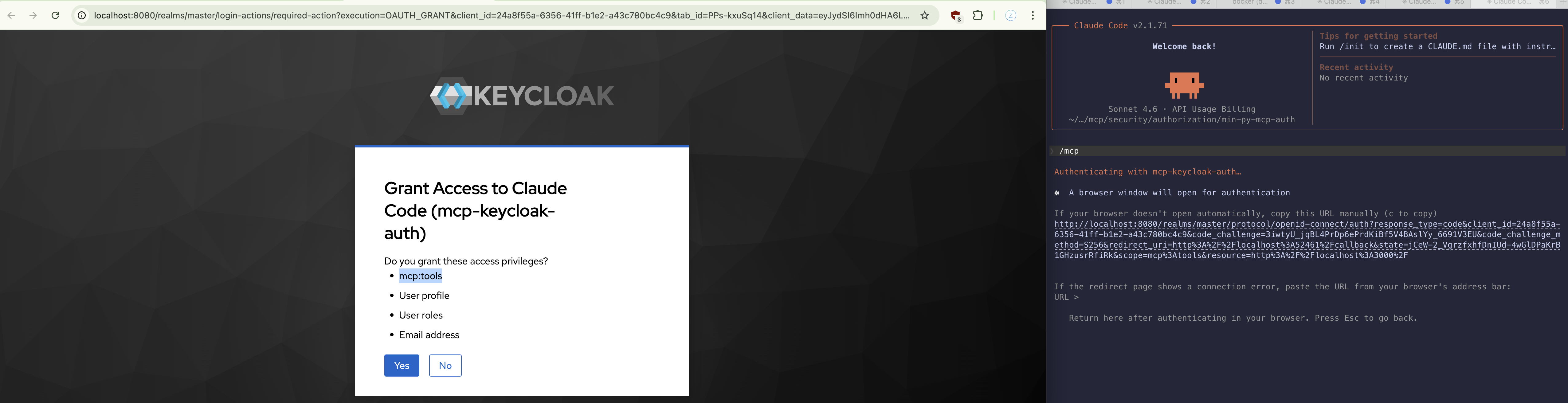
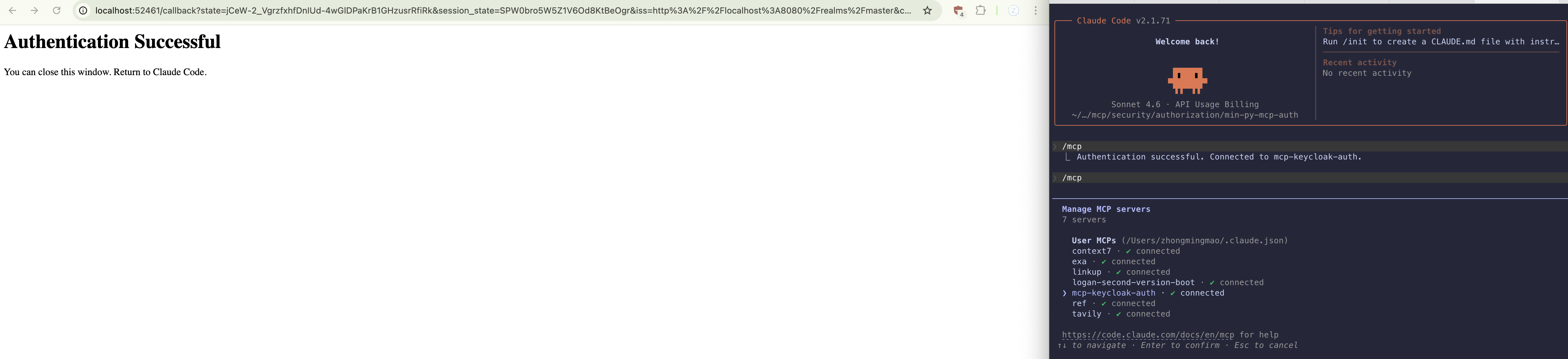
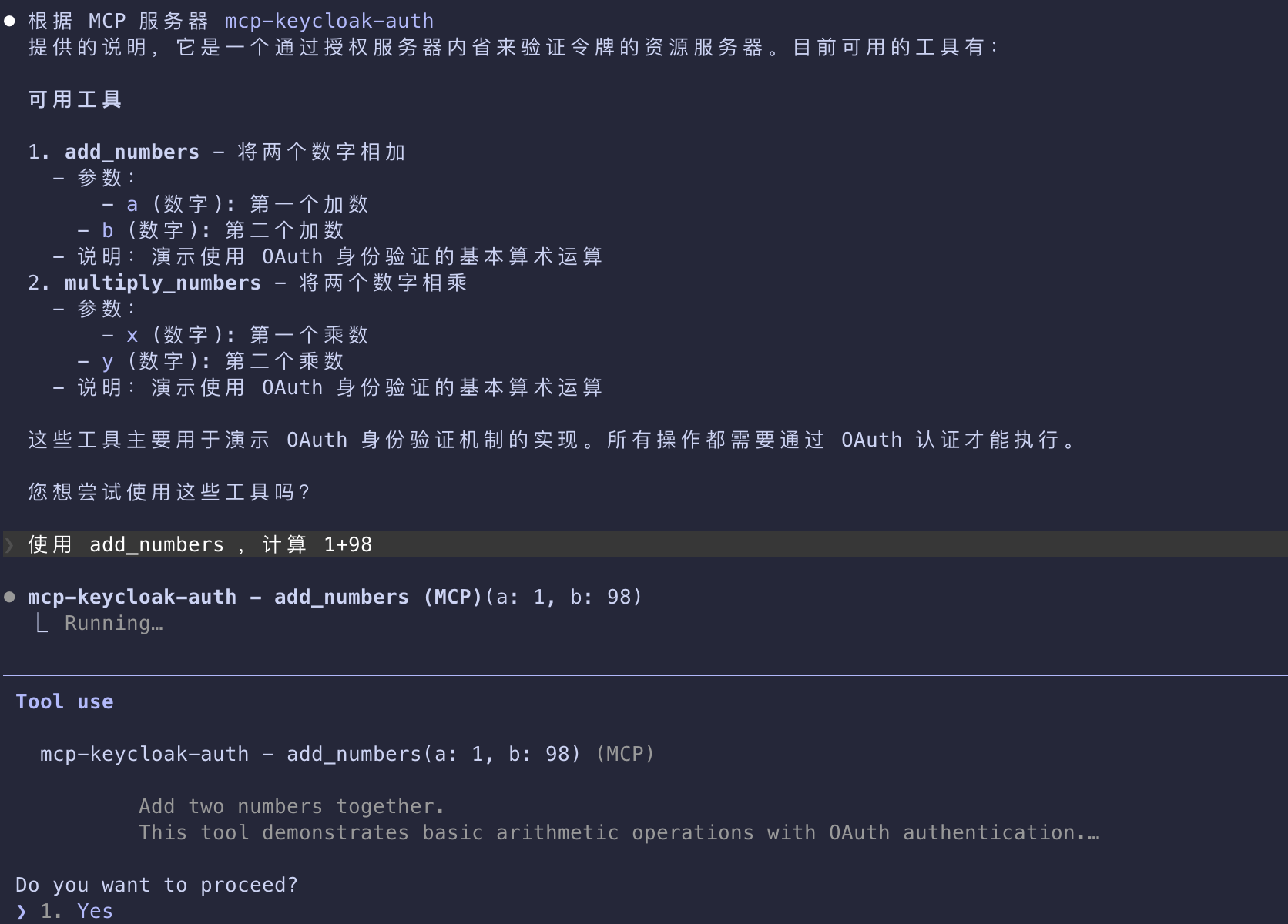
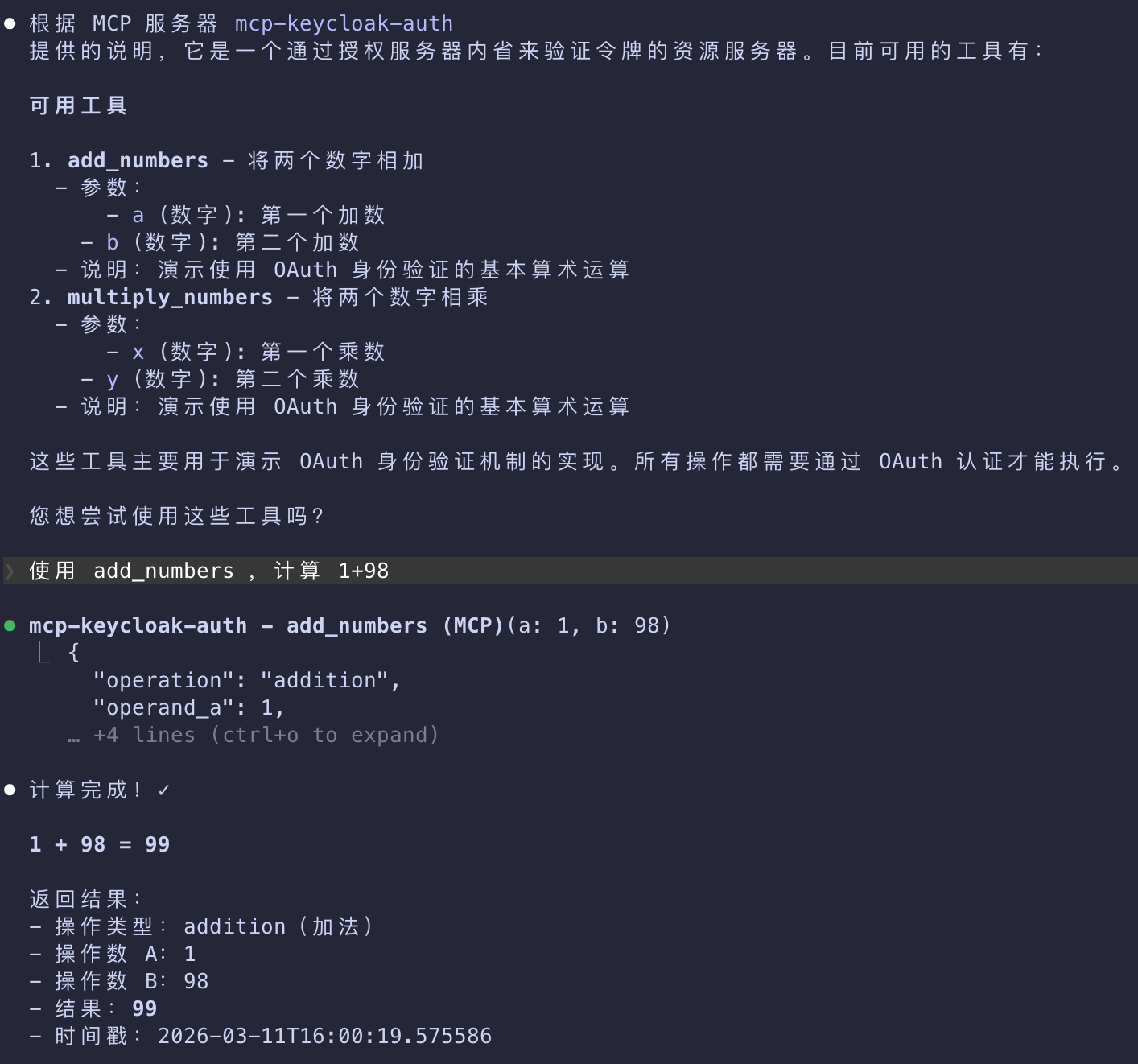
image-20260311155441764

image-20260311155608344

image-20260311155736254

image-20260311155802765

image-20260311155830848

image-20260311160016869

image-20260311160102941

Common Pitfalls and How to Avoid Them

  1. For comprehensive security guidance, including attack vectors, mitigation strategies, and implementation best practices,
  2. make sure to read through Security Best Practices. A few key issues are called out below.

Do not implement token validation or authorization logic by yourself.

  1. Use off-the-shelf, well-tested, and secure libraries for things like token validation or authorization decisions.
  2. Doing everything from scratch means that you’re more likely to implement things incorrectly unless you are a security expert.
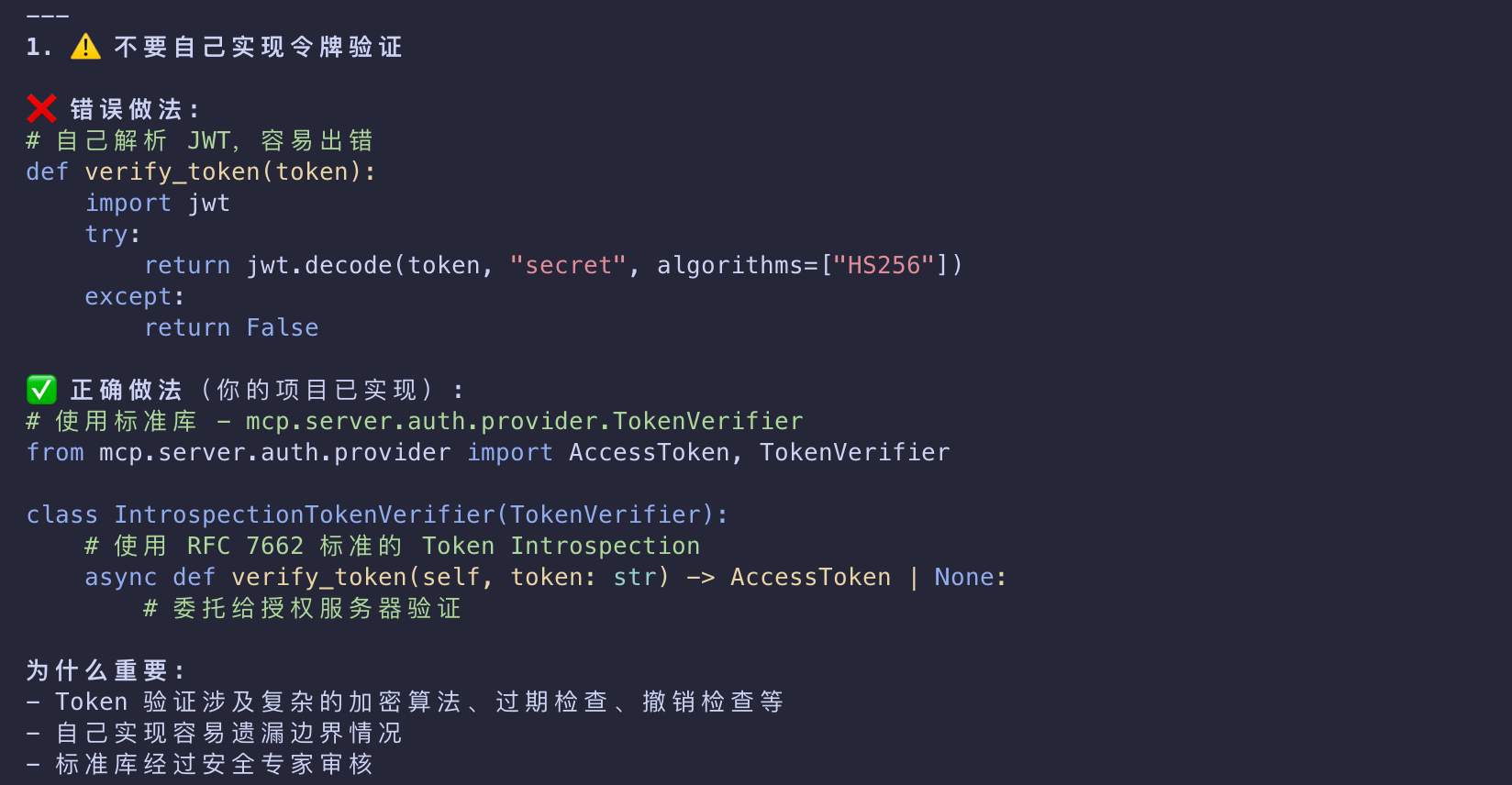
image-20260311153759657

Use short-lived access tokens

  1. Depending on the authorization server used, this setting might be customizable.
  2. We recommend to not use long-lived tokens
  3. if a malicious actor steals them, they will be able to maintain their access for longer periods.
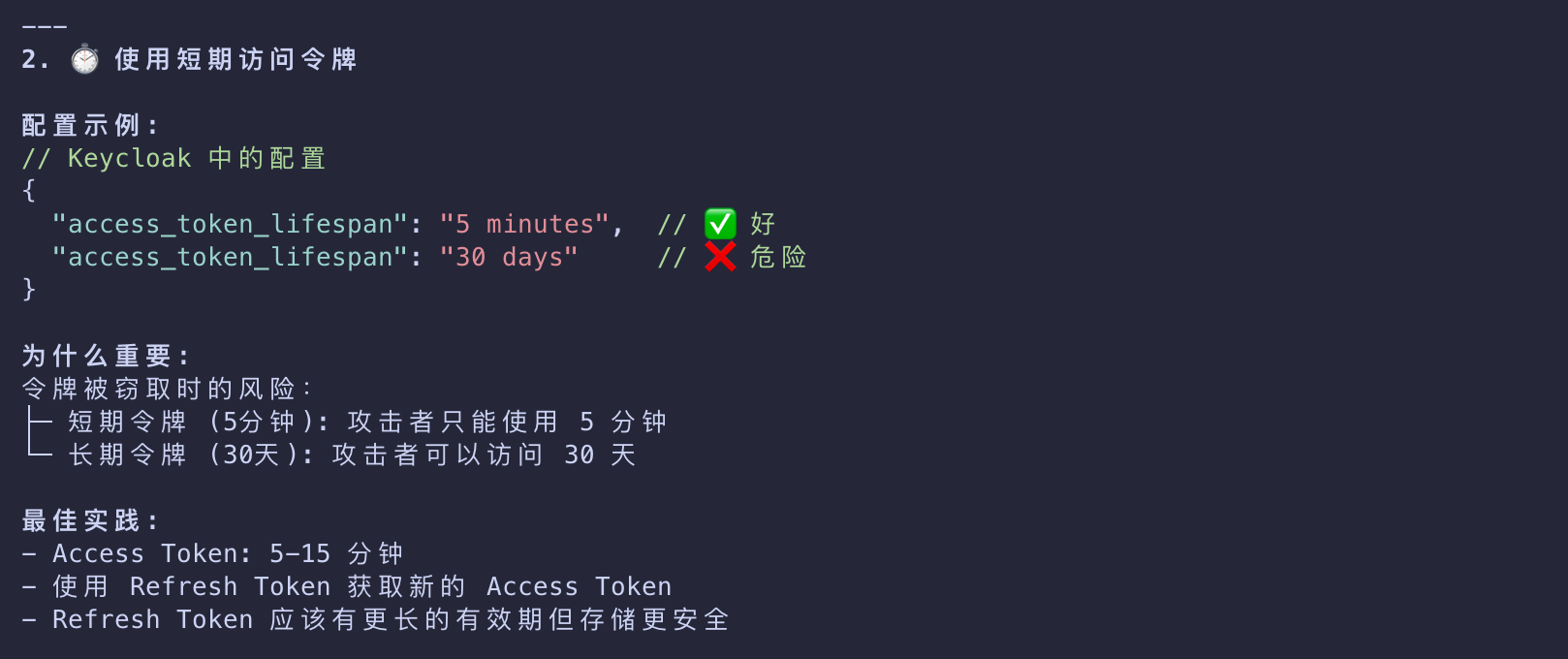
image-20260311153845043

Always validate tokens

  1. Just because your server received a token does not mean that the token is valid or that it’s meant for your server.
  2. Always verify that what your MCP server is getting from the client matches the required constraints.
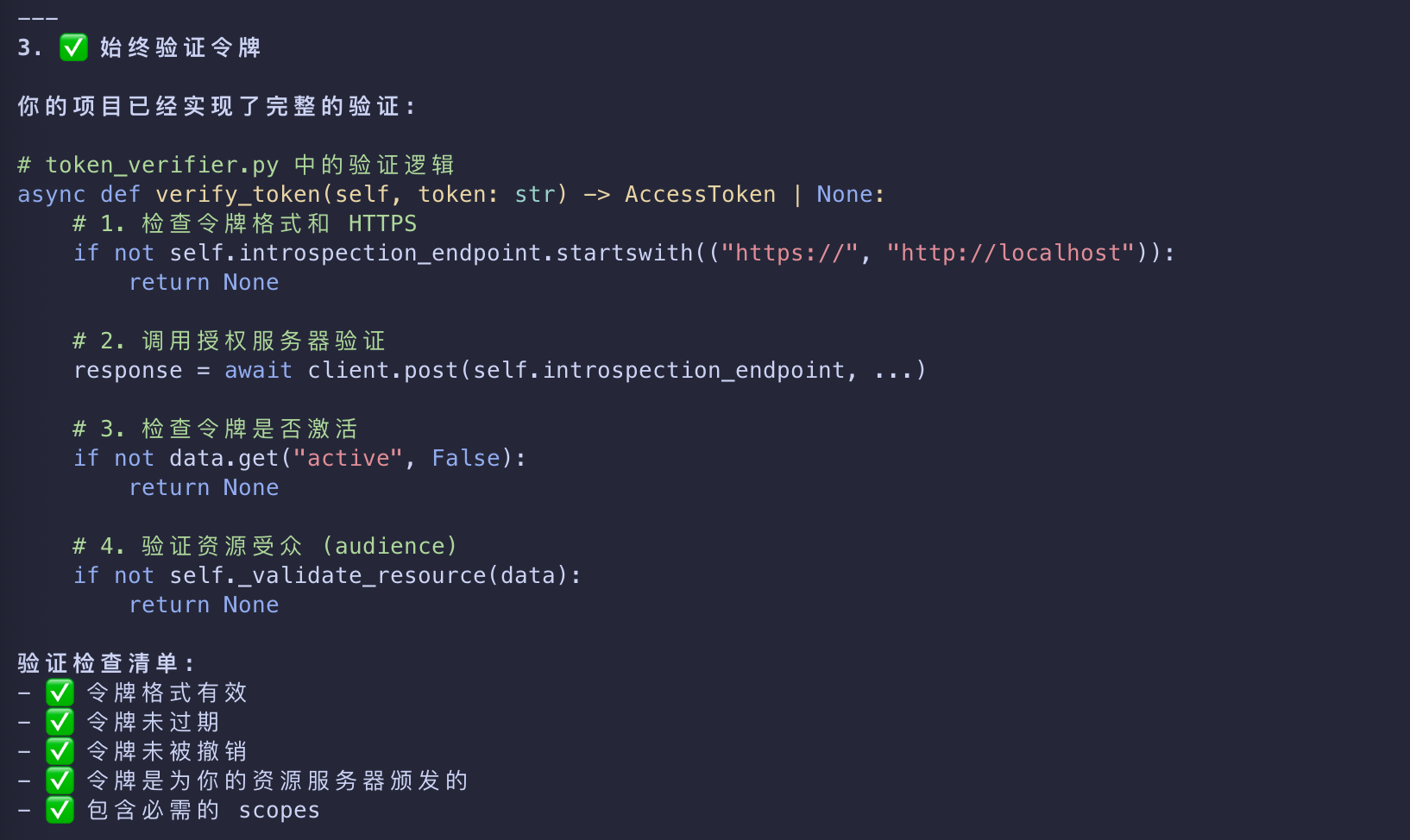
image-20260311154007952

Store tokens in secure, encrypted storage

  1. In certain scenarios, you might need to cache tokens server-side.
  2. If that is the case, ensure that the storage has the right access controls and cannot be easily exfiltrated
    • by malicious parties with access to your server.
  3. You should also implement robust cache eviction policies
    • to ensure that your MCP server is not re-using expired or otherwise invalid tokens.
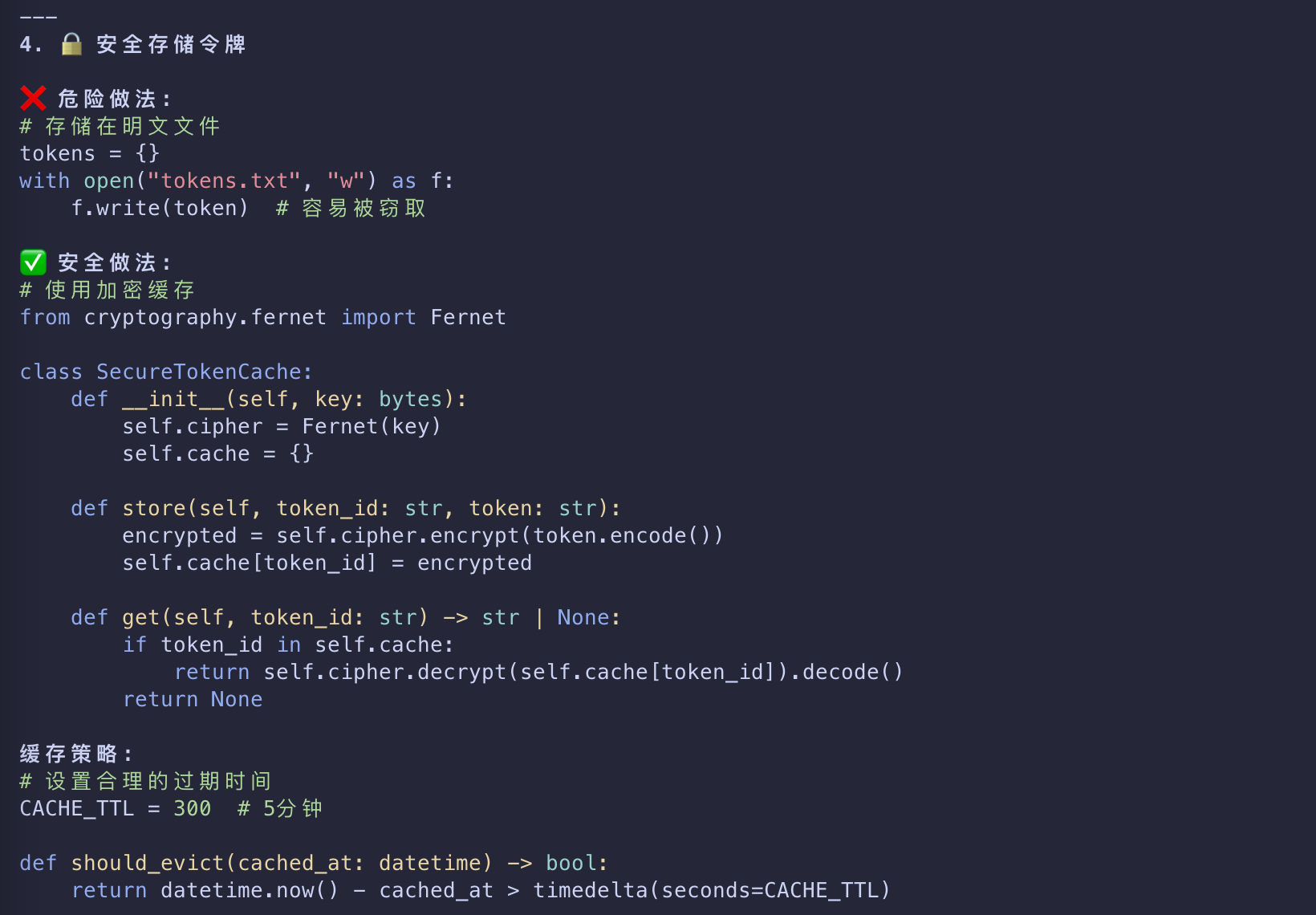
image-20260311154107988

Enforce HTTPS in production

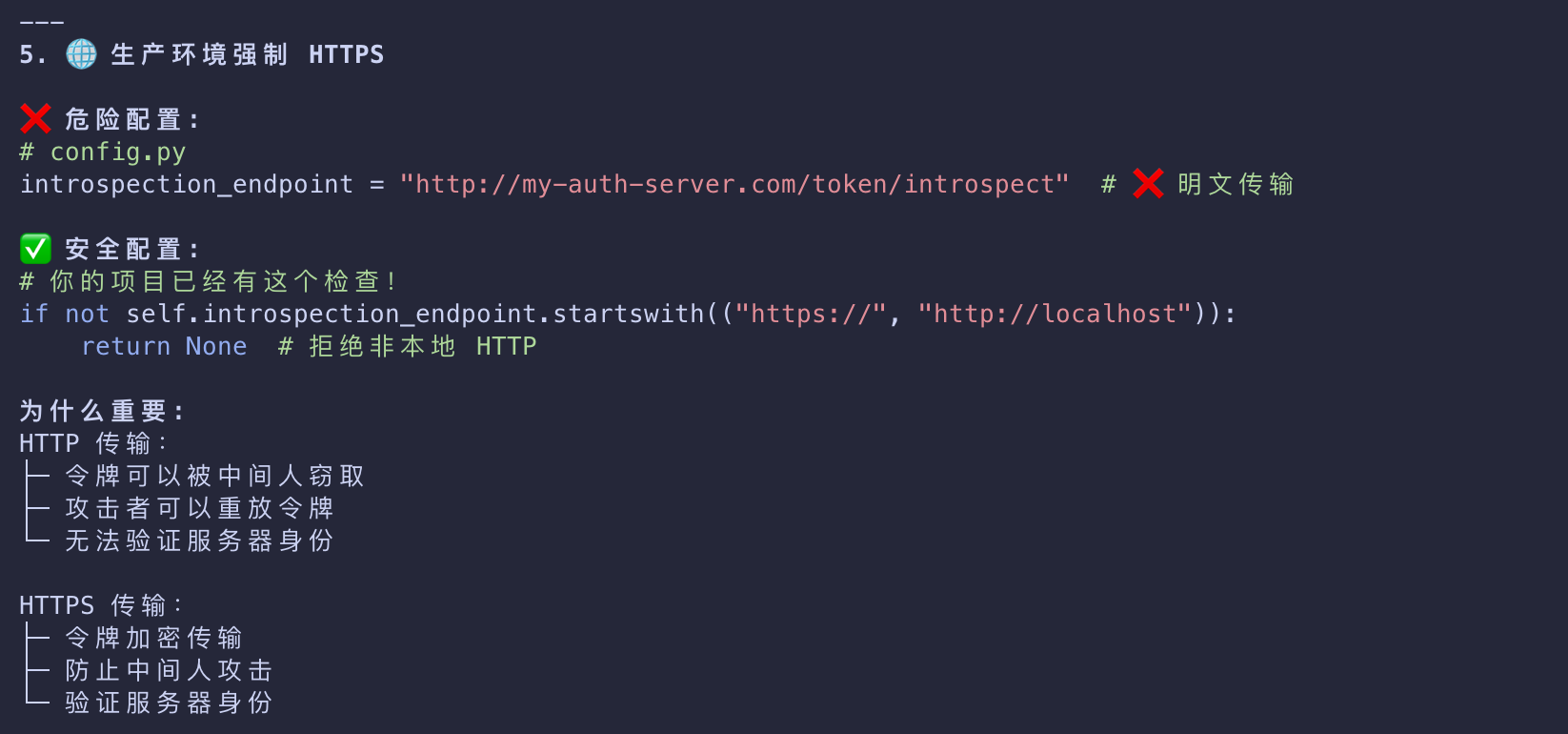
  1. Do not accept tokens or redirect callbacks over plain HTTP except for localhost during development.

image-20260311154148696

Least-privilege scopes

  1. Don’t use catch‑all scopes.
  2. Split access per tool or capability where possible and verify required scopes per route/tool on the resource server.
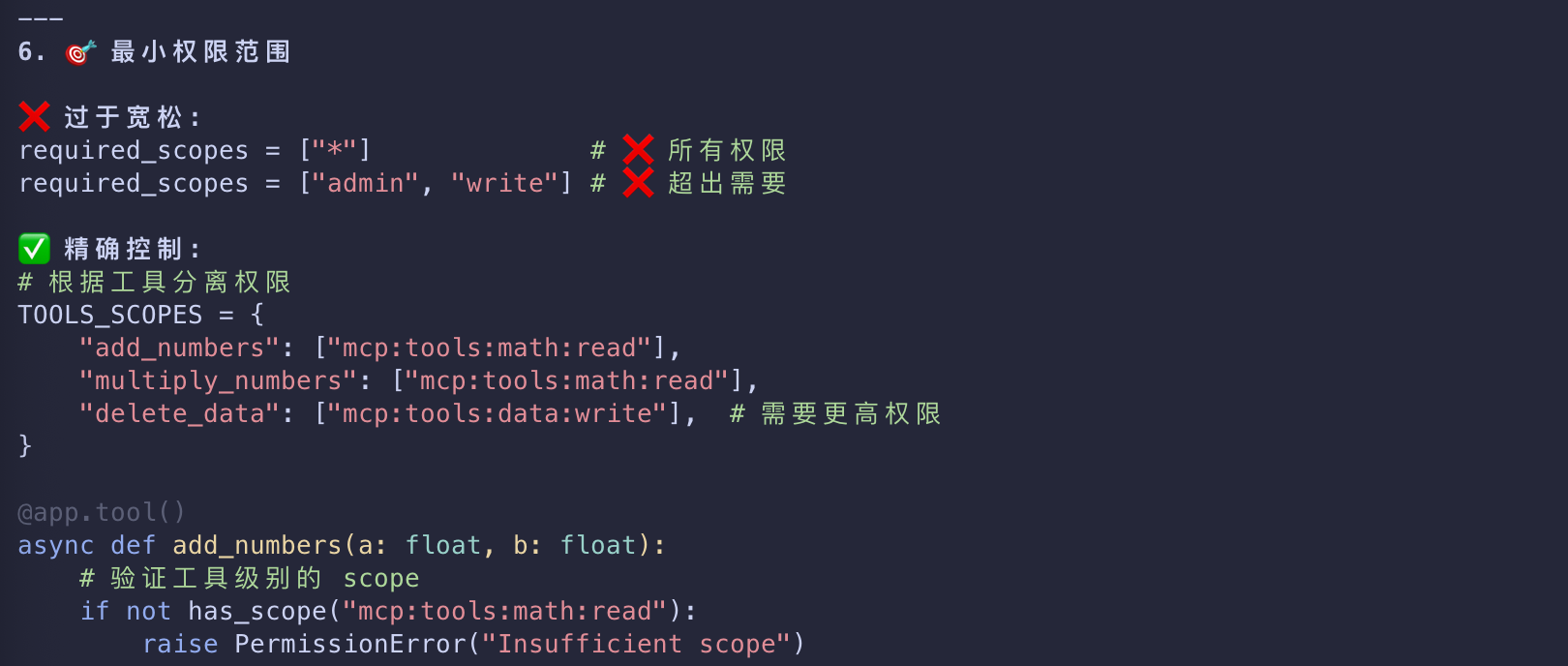
image-20260311154252686

Don’t log credentials

  1. Never log Authorization headers, tokens, codes, or secrets.
  2. Scrub query strings and headers.
  3. Redact sensitive fields in structured logs.
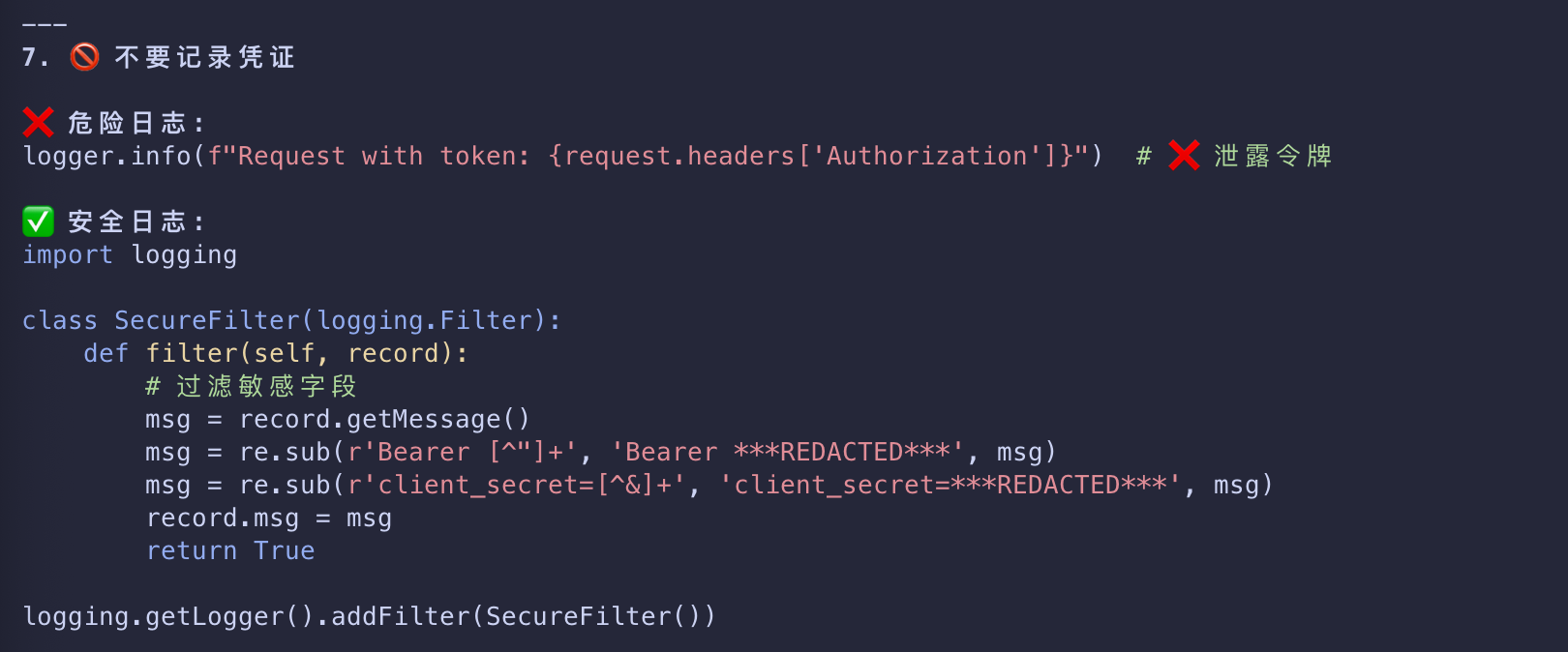
image-20260311154312439

Separate app vs. resource server credentials

  1. Don’t reuse your MCP server’s client secret for end‑user flows.
  2. Store all secrets in a proper secret manager, not in source control.
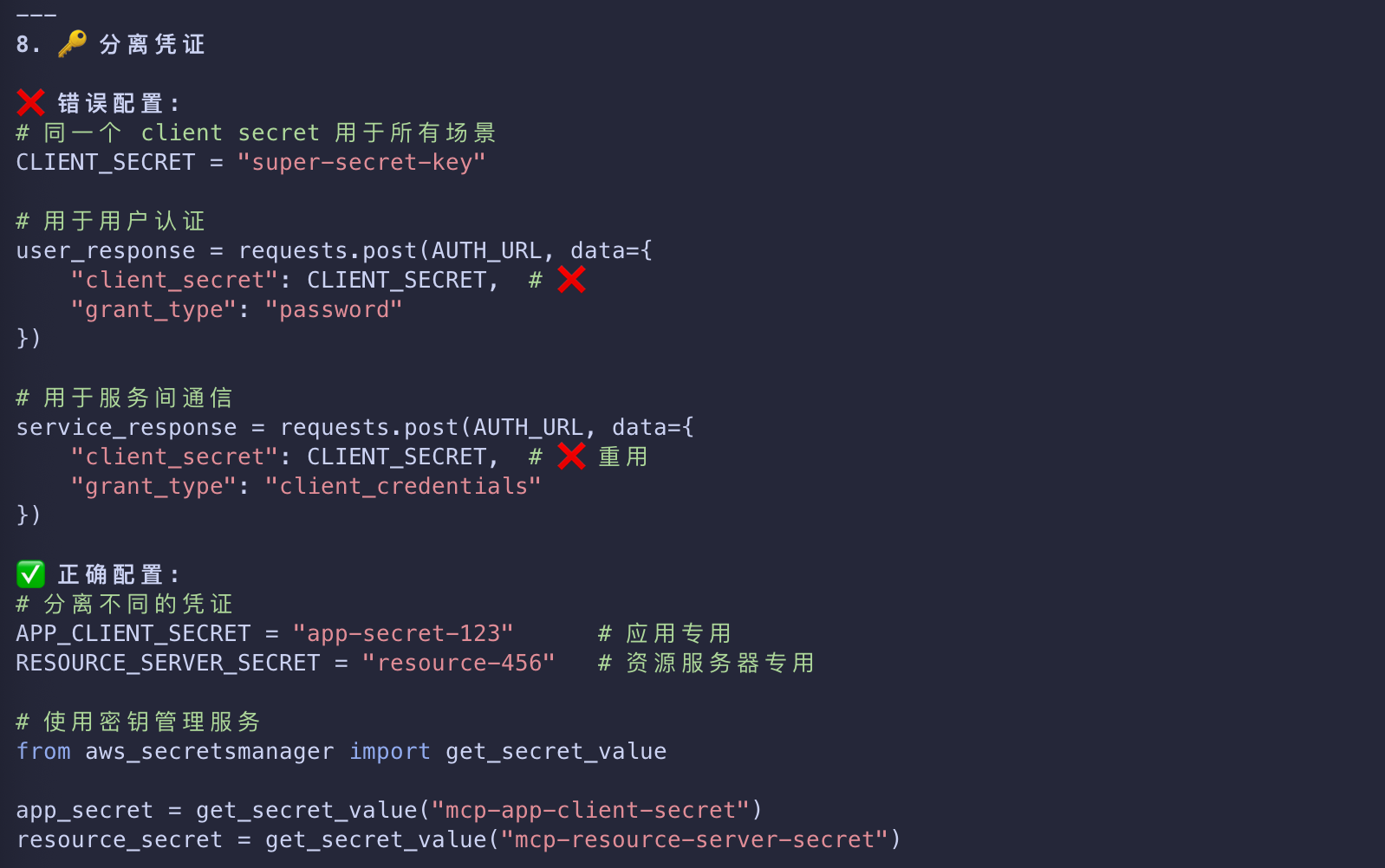
image-20260311154415882

Return proper challenges

  1. On 401, include WWW-Authenticate with Bearer, realm, and resource_metadata
  2. so clients can discover how to authenticate.
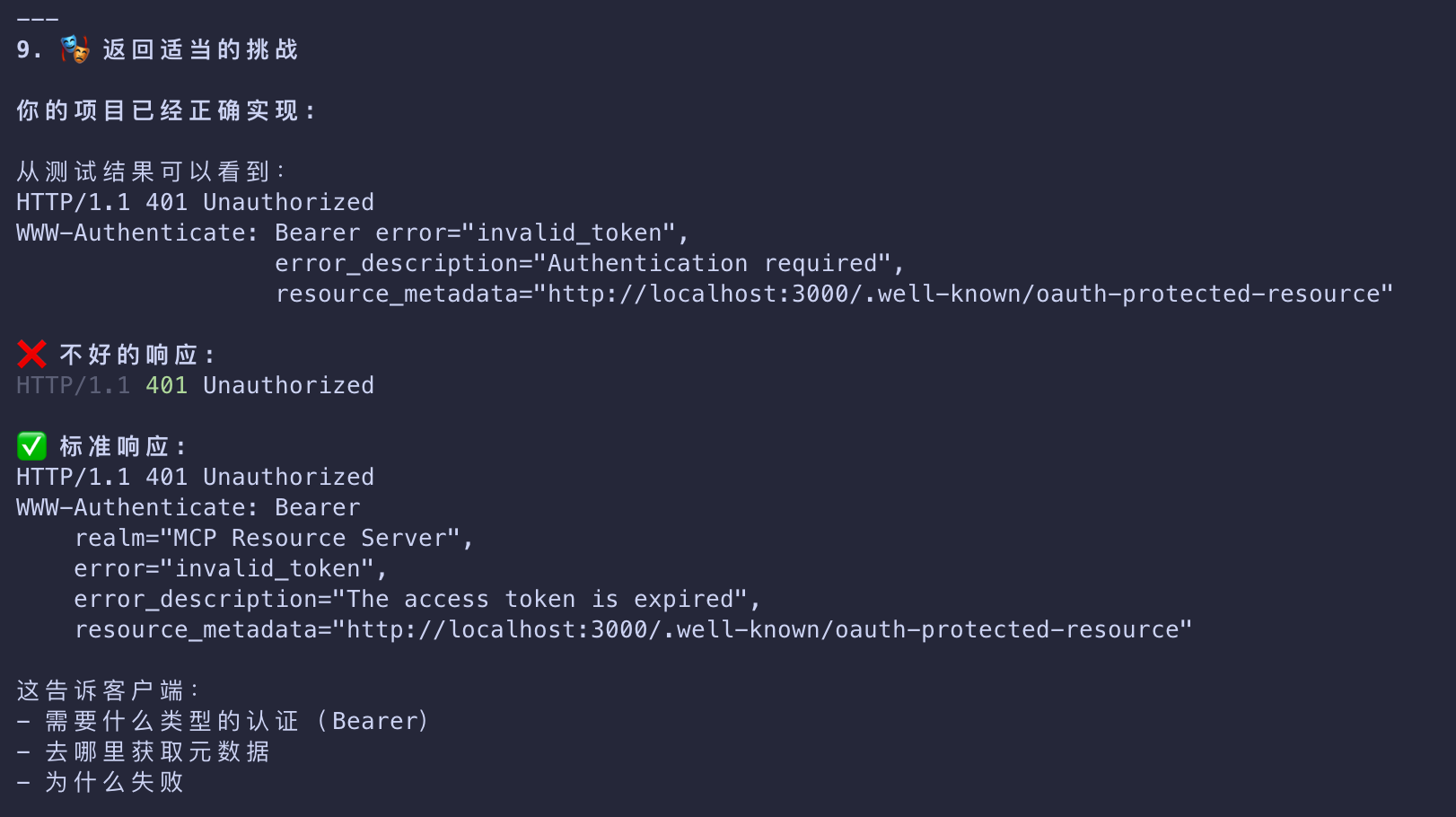
image-20260311154516521

DCR (Dynamic Client Registration) controls

  1. If enabled, be aware of constraints specific to your organization
    • such as trusted hosts, required vetting, and audited registrations.
  2. Unauthenticated DCR means that anyone can register any client with your authorization server.
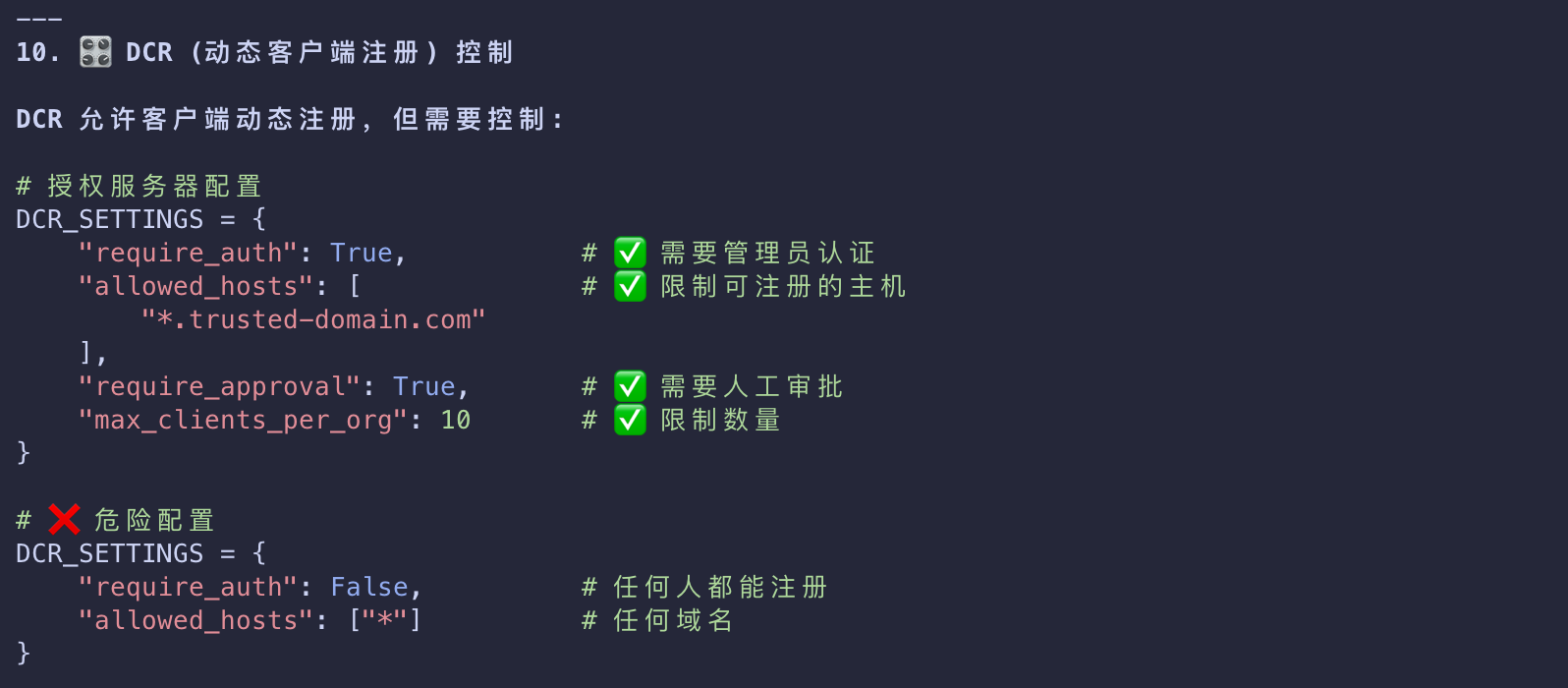
image-20260311154618558

Multi‑tenant/realm mix-ups

  1. Pin to a single issuer/tenant unless explicitly multi‑tenant.
  2. Reject tokens from other realms even if signed by the same authorization server.
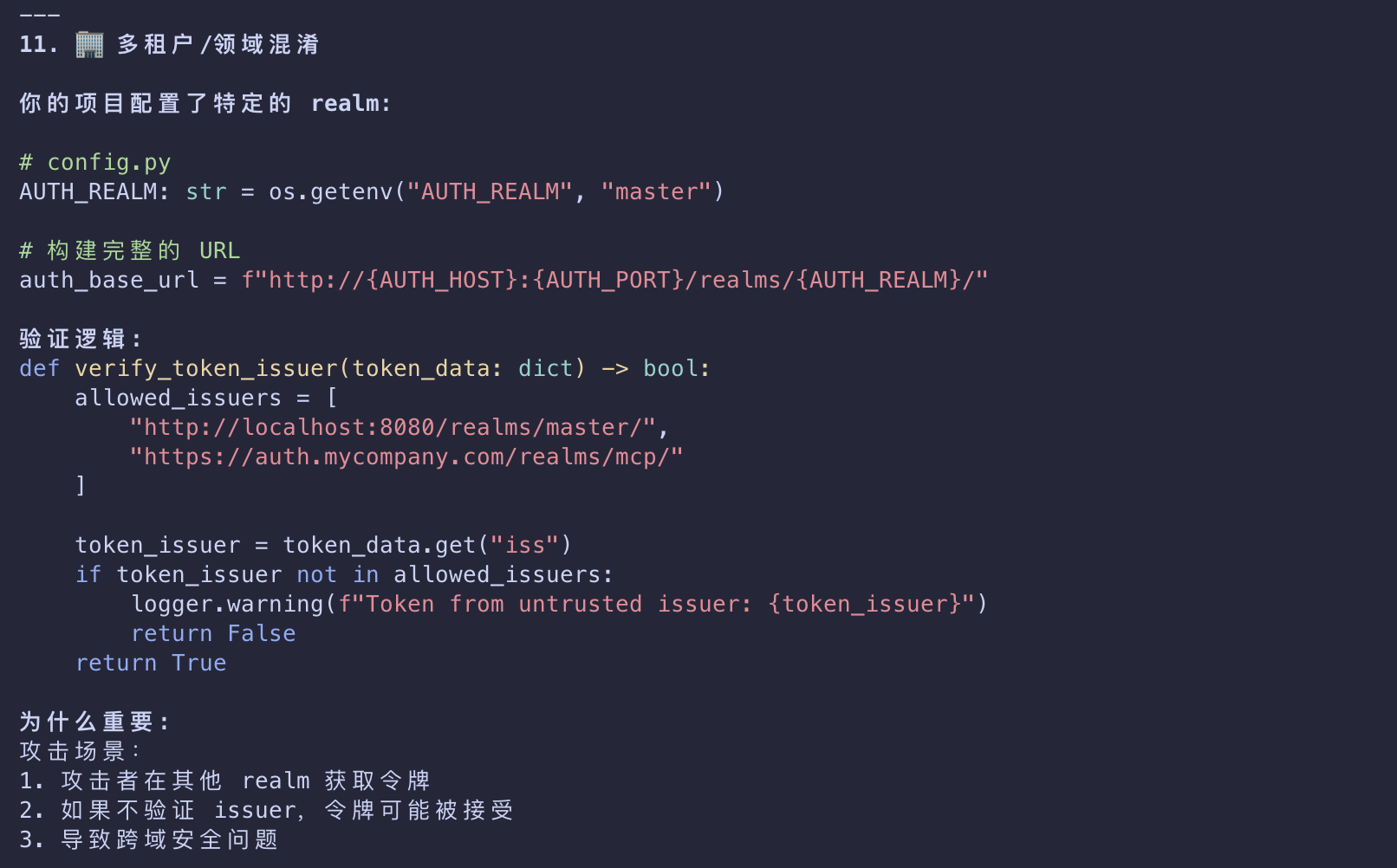
image-20260311154716324

Audience/resource indicator misuse

  1. Don’t configure or accept generic audiences (like api) or unrelated resources.
  2. Require the audience/resource to match your configured server.
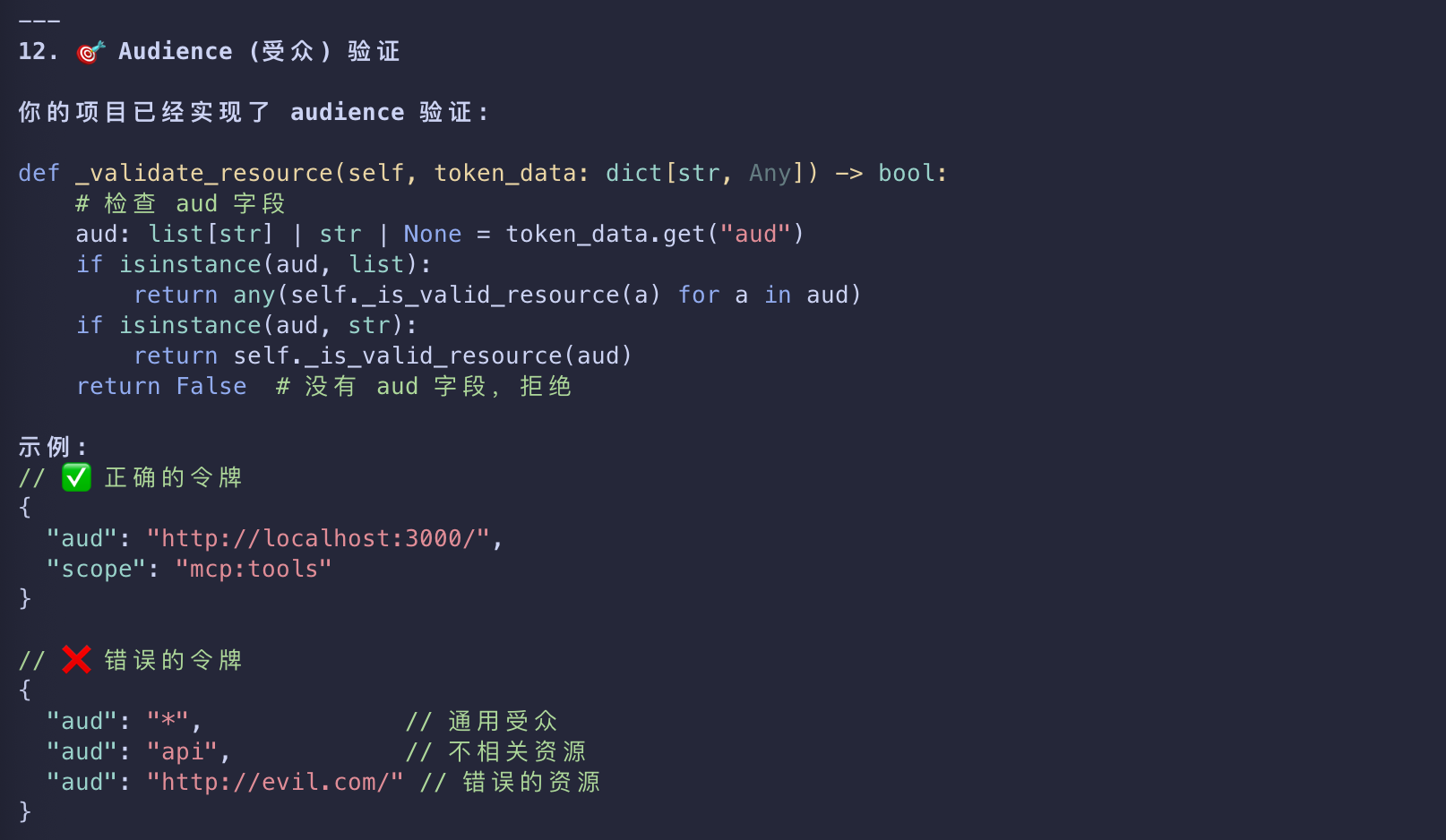
image-20260311154800724

Error detail leakage

  1. Return generic messages to clients, but log detailed reasons with correlation IDs internally
  2. to aid troubleshooting without exposing internals.
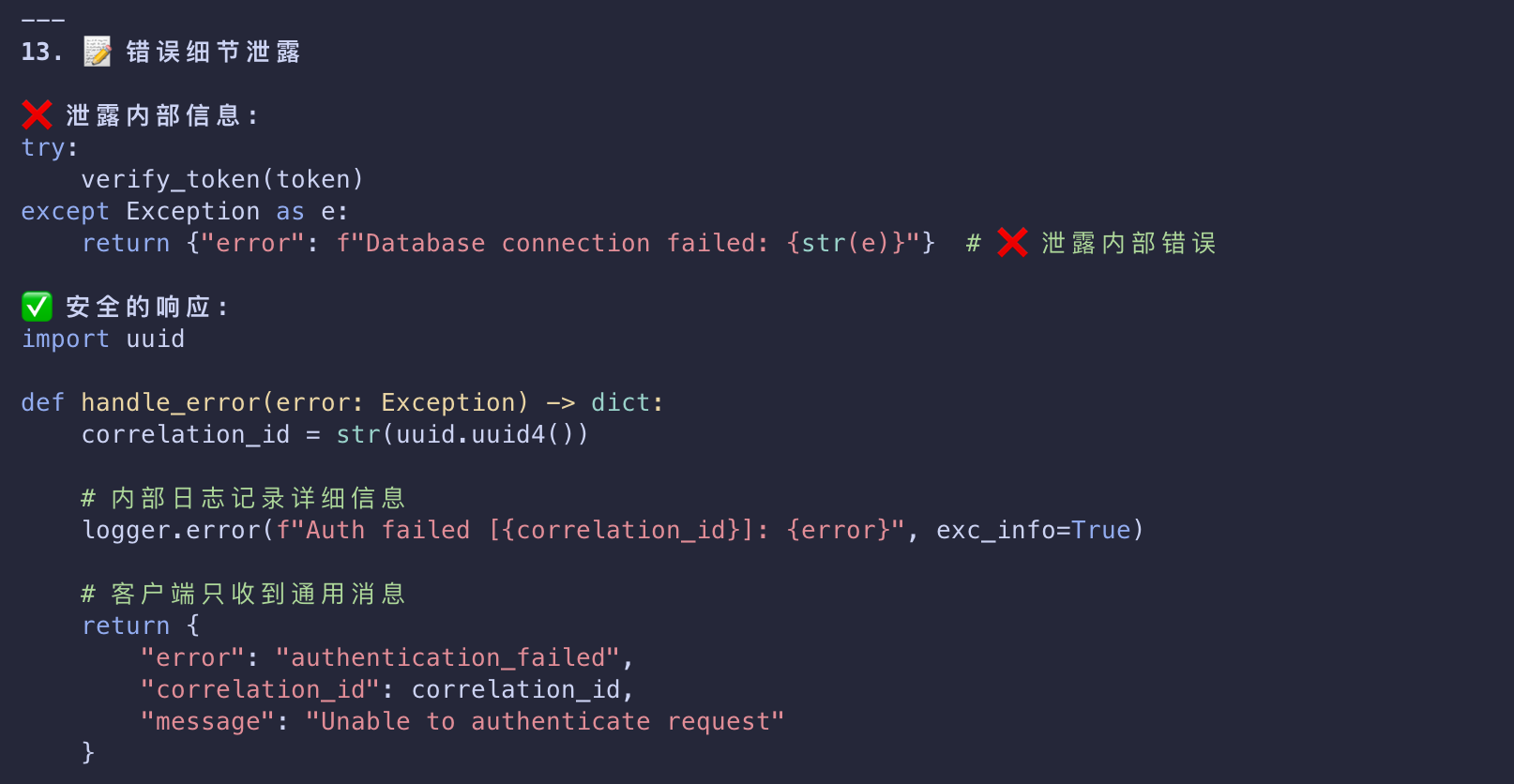
image-20260311154829989

Session identifier hardening

  1. Treat Mcp-Session-Id as untrusted input; never tie authorization to it.
  2. Regenerate on auth changes and validate lifecycle server‑side.
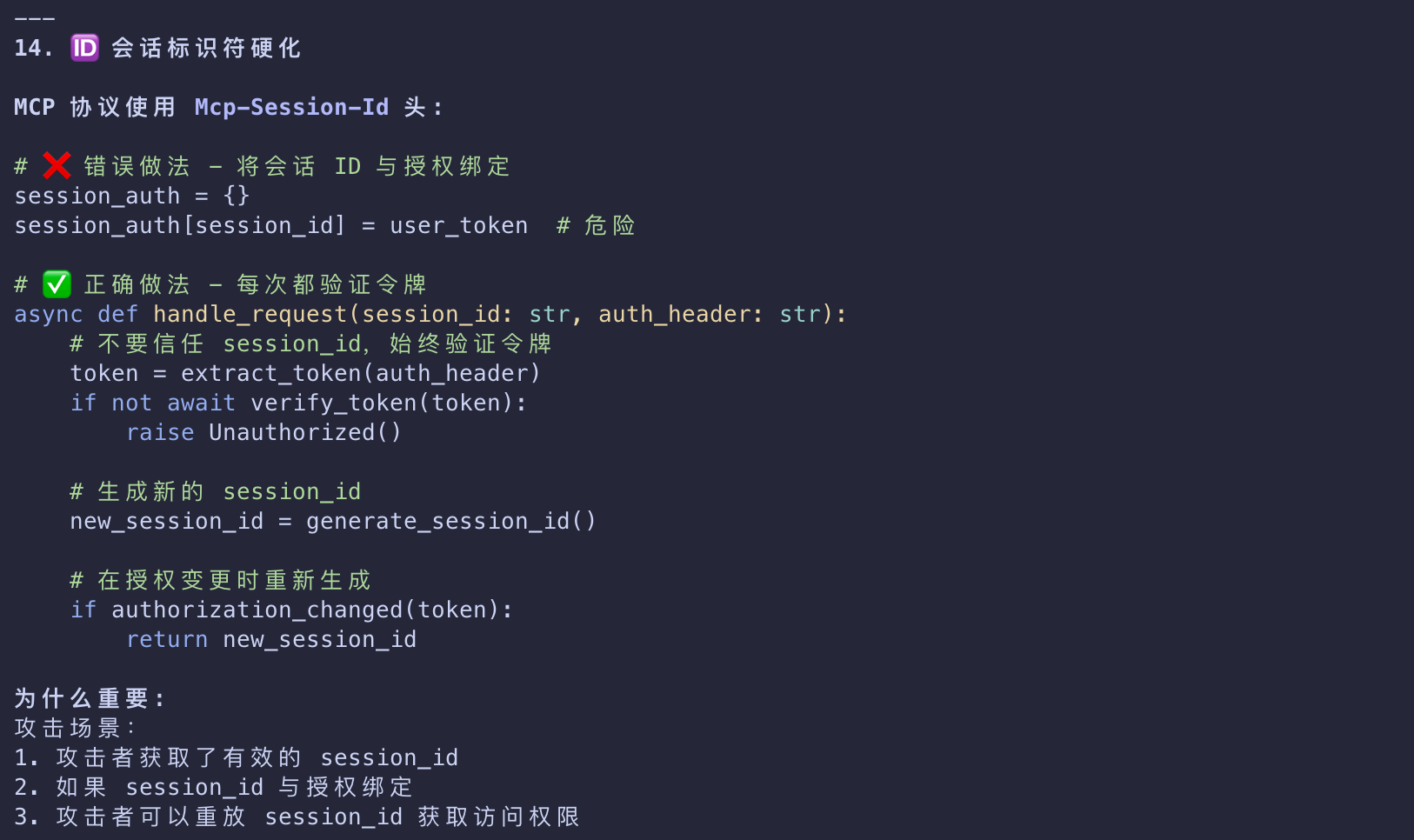
image-20260311154922327

Related Standards and Documentation

MCP authorization builds on these well-established standards

Standards Desc
OAuth 2.1 The core authorization framework
RFC 8414 Authorization Server Metadata discovery
RFC 7591 Dynamic Client Registration
RFC 9728 Protected Resource Metadata
RFC 8707 Resource Indicators

For additional details, refer to
  1. Authorization Specification
  2. Security Best Practices
  3. Available MCP SDKs